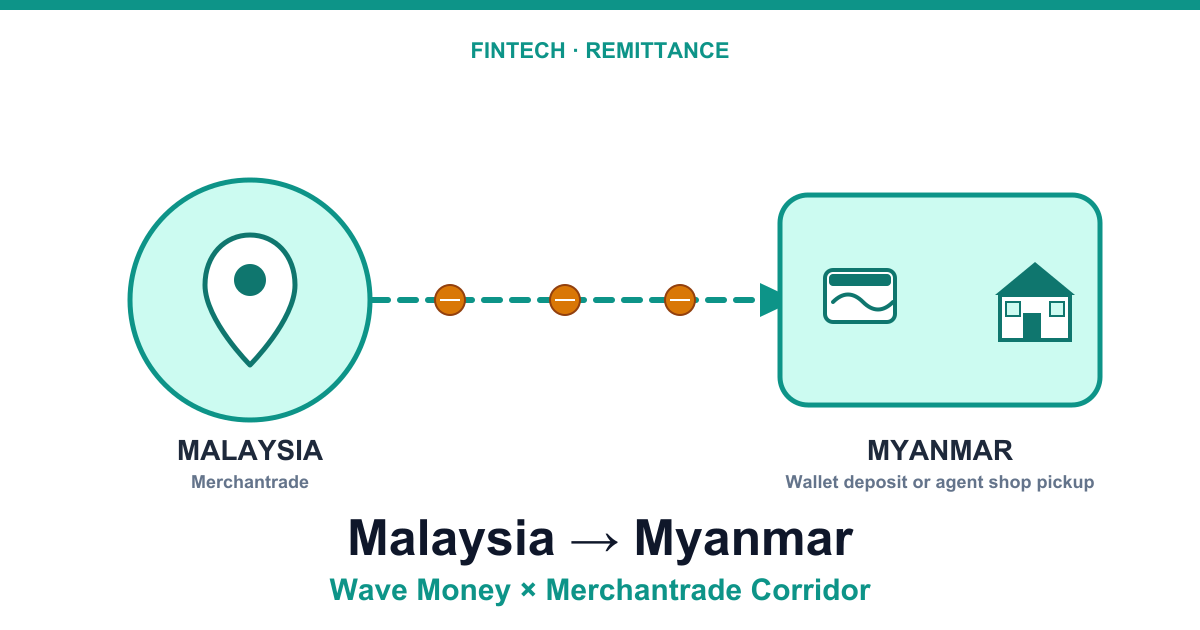
Wave Money has partnered with Malaysian remittance operator Merchantrade to open a new international money transfer corridor from Malaysia to Myanmar, according to a press release published on Wave Money’s official site on July 1, 2026. Money sent through the service can be deposited directly into a recipient’s Wave Wallet or picked up in cash at any of Wave Money’s more than 61,000 Wave Agent shops across Myanmar, per the company’s own figures. For a limited launch period, Wave Money is waiving withdrawal fees for 45 days at its agent shops for customers who present a transfer reference number and identify the transaction as an “International Remittance.” (Source: Wave Money media center, July 1, 2026)
That is the headline. But two details in the same press release are worth sitting with before treating this as breaking news: the service itself had already been running for close to seven weeks before Wave Money said anything about it, and this is not Wave Money’s first international corridor — it is at least the third in roughly two years. Neither point is hidden, exactly, but neither is emphasized in the announcement either, and both change how the news should be read.
The Announcement Came Seven Weeks After the Service Already Went Live
Buried in the body of Wave Money’s press release is the actual go-live date for the corridor: May 13, 2026. The public announcement did not go out until July 1 — a gap of roughly seven weeks between “the product works” and “we’re telling people about it.” Wave Money doesn’t explain the delay, and there’s no evidence of a soft-launch phase or phased rollout described anywhere in the release; it simply states the service began operating in May and was announced in July.
This kind of gap is common enough in fintech PR that it’s worth naming rather than ignoring. A quiet operational start followed by a formal marketing push can mean several things — the company wanted a few weeks of live transaction volume before publicizing the corridor, the partnership required additional regulatory or compliance sign-off in one of the two countries before a public rollout, or the announcement was simply timed to a different internal or marketing calendar unrelated to the technical launch. Wave Money’s release doesn’t say which, so readers should treat the July 1 date as “when this became public,” not “when this began working” — the two are not the same, and the seven-week gap between them is itself a data point about how the corridor was rolled out.
This Is Wave Money’s Third International Corridor, Not Its First
The Merchantrade tie-up is easy to read as a standalone story, but it fits a clear pattern when placed next to Wave Money’s other international remittance moves over the past two years:
- June 2024: Wave Money launched an international remittance service from Thailand to Myanmar, at the time operated jointly with Thai partner DeeMoney. (Wave Money, June 28, 2024)
- August 2025: Wave Money announced a partnership with MoneyGram, extending its reach to MoneyGram’s global sending network. (Wave Money, August 2, 2025)
- May/July 2026: The Merchantrade corridor from Malaysia goes live in May and is announced in July.
Read in sequence, this is a company steadily building out corridor-by-corridor coverage of the countries where Myanmar migrant labor is concentrated — Thailand first, then a global network partner in MoneyGram, and now Malaysia specifically through a local remittance operator rather than a global aggregator. That’s a meaningfully different story than “Wave Money launches international transfers,” which is how a press release written in isolation tends to frame each new corridor. It’s expansion, not debut, and Myanmar Tech Press readers who only saw the 2024 Thailand corridor announcement two years ago may reasonably have assumed Wave Money’s international ambitions stopped there. They didn’t.
A Parallel Race: KBZPay Opened Its Own Thailand Corridor Two Months Earlier
The timing here is also worth placing next to Myanmar’s other dominant mobile wallet. In June 2026, KBZPay — the country’s other major digital wallet, tied to KBZ Bank — partnered with Thai payment operator TrueMoney to launch its own Thailand-to-Myanmar remittance corridor, a deal Myanmar Tech Press covered at the time. At that point, KBZPay reported roughly 22 million users, backed by KBZ Bank’s network of about 500 branches. (Myanmar Tech Press, June 1, 2026)
Wave Money’s answer, in effect, is scale of physical footprint rather than banking infrastructure: more than 61,000 Wave Agent shops nationwide, compared with KBZ Bank’s roughly 500 branches. That’s not really a fair apples-to-apples comparison — agent shops and bank branches serve different functions — but it does explain why Wave Money leans so heavily on the agent-shop pickup option in its own messaging rather than emphasizing wallet-to-wallet transfers alone. In a country where a meaningful share of remittance recipients may not have (or want) a digital wallet account set up at the moment money arrives, “walk into one of 61,000 shops with a reference number” is a more practical pitch than “check your app.”
Whether this is a coordinated, industry-wide response to growing migrant remittance demand or two companies independently reaching the same conclusion at roughly the same time isn’t something either press release states outright, and Myanmar Tech Press has not seen documentation of the two developments being linked. But the pattern — two dominant wallets, two new labor-migration corridors, within about a month of each other — is hard to read as coincidence, and it’s a more useful frame for readers than treating either announcement as an isolated event.
What the Press Release Leaves Out
A few things a reader might reasonably want to know are not addressed in Wave Money’s announcement:
- Standard transfer fees are not published. The release specifies that Wave Agent shop withdrawals are fee-free for 45 days during the launch period for customers who identify the transaction as an international remittance, but it does not state what fees apply after that window, or what fees (if any) Merchantrade charges on the Malaysia side of the transfer. Anyone using the corridor to send money regularly, rather than as a one-off during the promotional period, currently has no public information about ongoing cost.
- No transaction limits or exchange rate mechanism are disclosed. The release doesn’t state a maximum transfer amount, processing time beyond “available,” or how the MYR-to-MMK exchange rate is set and whether it is competitive with informal transfer channels that many migrant workers currently use.
- The scale of the target audience is not quantified by either company. Public estimates of the number of Myanmar migrant workers in Malaysia vary and commonly cluster around the 800,000 range, but that figure comes from general reporting on Myanmar labor migration rather than from Wave Money or Merchantrade themselves, and neither company cites a number in the announcement. Readers should treat any such figure as an approximation, not a verified statistic tied to this partnership.
None of this means the corridor doesn’t work as advertised — there’s no evidence either way in what’s public. It means the announcement, like most fintech partnership press releases, is written to generate coverage of the launch rather than to fully inform someone deciding whether to actually use the service for a recurring transfer. Wave Money describes the corridor as making sending money “faster, safer, and more convenient” for customers — according to the company’s own characterization in its release, not an independent claim Myanmar Tech Press has verified.
Frequently Asked Questions
When did the Wave Money-Merchantrade Malaysia remittance service actually start?
The service went live on May 13, 2026, according to Wave Money’s own press release, even though the public announcement wasn’t published until July 1, 2026 — a gap of about seven weeks.
How can someone in Myanmar receive money sent through this corridor?
Recipients can have funds deposited directly into a Wave Wallet, or pick up cash at any of Wave Money’s Wave Agent shops, which the company says number more than 61,000 nationwide.
Is this Wave Money’s first international remittance service?
No. Wave Money launched a Thailand-to-Myanmar corridor (initially with partner DeeMoney) in June 2024 and partnered with MoneyGram in August 2025. The Merchantrade partnership is at least the third international corridor Wave Money has built out since mid-2024.
What does it cost to send money through the Wave Money-Merchantrade corridor?
Wave Money has not published standard fees. It has confirmed a 45-day fee-free promotion for cash withdrawals at Wave Agent shops for customers who present a transfer reference number and identify the transaction as an international remittance, but pricing after that window is not disclosed in the announcement.
How does this compare to KBZPay’s international remittance options?
KBZPay partnered with Thailand’s TrueMoney in June 2026 to open a Thailand-to-Myanmar corridor, roughly a month before Wave Money’s Malaysia corridor was publicly announced (though the Wave Money service had quietly been live since May). The two developments suggest both of Myanmar’s dominant mobile wallets are actively racing to cover the countries where Myanmar migrant workers are concentrated.
The Bottom Line
Wave Money’s Malaysia corridor with Merchantrade is a real, working addition to how Myanmar migrant workers abroad can send money home, backed by a large existing agent-shop network that gives it a practical edge over wallet-only alternatives. But it’s best understood not as a single new product launch, rather as the latest step in a two-year pattern of Wave Money methodically wiring up corridors to the countries where Myanmar labor migration is concentrated — Thailand, a global MoneyGram network, and now Malaysia — while a direct competitor builds out a nearly identical map on its own timeline. The specifics that would matter most to an actual user sending money every month — ongoing fees, transfer limits, exchange rate terms — remain undisclosed in the public announcement, and Myanmar Tech Press was unable to verify them independently. Anyone planning to rely on this corridor beyond the 45-day promotional window should confirm current pricing directly with Wave Money or Merchantrade before assuming a comparable Wave Agent transaction will remain fee-free.
Sources: Wave Money media center, “Wave Money and Merchantrade Launch [corridor],” published July 1, 2026, https://www.wavemoney.com.mm/media-center/wave-money-and-merchantrade-launch-2026/ (accessed August 2026). Wave Money media center, “Wave Money Partners with MoneyGram,” published August 2, 2025, https://www.wavemoney.com.mm/media-center/wave-money-partners-with-moneygram/. Wave Money media center, “Wave Money Launches International Remittance Service from Thailand to Myanmar,” published June 28, 2024, https://wavemoney.com.mm/media-center/money-myanmar-launches-international-remittance-service-from-thailand-to-myanmar. Myanmar Tech Press, “TrueMoney Partners with KBZPay,” published June 1, 2026, https://en.myanmartechpress.com/truemoney-partners-with-kbzpay/.