This is the first edition of a new weekly column. Each week we pull together the stories we covered, revisit something from our archive that the week’s news puts in a different light, and flag one specific thing worth watching — the kind of claim we can come back and check later. Myanmar Tech Press has been publishing since 2017, and a lot of what makes that archive useful only becomes visible when you set old coverage next to new.
This edition covers the past week.
A national trade portal, built by a sanctioned vendor
On August 12, Myanmar’s military-controlled Customs Department signed a contract in Naypyitaw with Astra Consulting LLC — the Myanmar branch of Russia’s Astra Group — to build the country’s National Single Window Web Portal, the system intended to process all of Myanmar’s import and export documentation. Astra Group has been on the US Treasury’s Specially Designated Nationals list since May 1, 2024, more than two years before the signing. Its best-known product is Astra Linux, an operating system widely deployed inside Russia’s armed forces.
The contract was signed five days before Min Aung Hlaing left for an official visit to Russia, with a Putin meeting scheduled for August 18. The sequence is documented; the causal link between the two is not, and we said so in our coverage rather than implying one.
What we would add now: the most consequential unanswered question here is not the geopolitics, which is at least visible and discussable. It is data hosting. A National Single Window records the consignor, the consignee, the tariff classification, and the shipment manifest for effectively every good that crosses a country’s border. Nothing published so far says where that data will physically live, under which jurisdiction, or who is able to query it. For a system of this kind, that is not a technical footnote to be settled during implementation — it is the substance of the thing. The contract value and timeline are also unstated.
A 5G target, and the arithmetic behind it
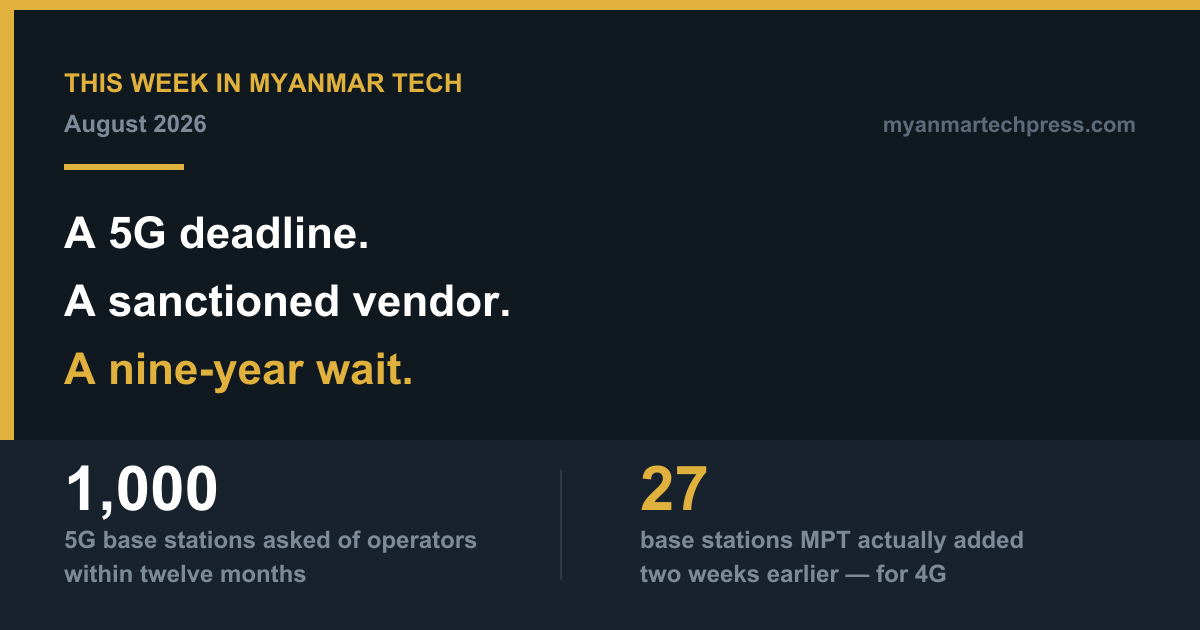
On August 18, Myanmar’s Ministry of Digital Development and Communications set a target to launch nationwide 5G service by the fourth quarter of fiscal year 2026-2027. The 2600MHz band is already allocated, operators have been asked to build roughly 1,000 new base stations over the coming year, and a dedicated 5G Task Force has been formed.
Because Myanmar’s fiscal year runs April 1 to March 31, “Q4 of FY2026-2027” works out to roughly January–March 2027 — five to seven months from the announcement, which is a tighter window than a casual reading of “Q4” suggests.
What we would add now: put that tower number next to something concrete. Two weeks before this announcement, we covered MPT adding 27 base stations and upgrading 9 existing sites to 4G LTE. We described it at the time as a routine, geographically targeted update — because that is what it was. The ministry is now asking for roughly 1,000 new sites across all operators within twelve months, for 5G specifically, which generally requires denser siting than 4G to deliver its advantages. Even spread across four operators working in parallel, that implies each building at something like ten times the pace of what we recently called routine.
That does not make the target impossible — build-out can scale non-linearly once tower-sharing and permitting are lined up. But it does mean the 1,000 figure is better read as an aspirational ceiling than a baseline expectation.
From the archive: we first wrote about 5G in 2017
In May 2017 we published a piece explaining 5G to our readers: a new generation of mobile network, up to a hundred times faster than 4G. It was a forward-looking explainer about technology that was, at the time, somewhere over the horizon.
Nine years later, the news is that Myanmar has set a target date for its first nationwide 5G network. Not a launch — a target.
The same archive makes a second point that is easy to miss. When we wrote about Myanmar’s fourth mobile operator arriving in 2017, the market was MPT, Telenor, Ooredoo, and the newcomer Mytel. Today two of those four no longer carry the names they launched with: Telenor Myanmar became ATOM in June 2022 after Telenor Group exited the country, and Ooredoo Myanmar became U9 in September 2025. MPT is the only one of the original names still standing. It is also, incidentally, why searching for Myanmar telecom pricing from a few years ago mostly turns up dead or redirected pages.
One thing worth watching
Here is a specific, checkable claim to return to: whether any Myanmar operator publishes a 5G-specific base station count before the end of 2026.
Every public infrastructure number we have seen from Myanmar’s operators this year has been about 4G — sites added, sites upgraded, coverage extended. The ministry’s 1,000-tower target is for 5G. Until at least one operator states how many 5G sites it has actually built, that figure has no denominator, and there is no way for anyone outside the process to judge whether the January–March 2027 window is being approached or quietly slipping.
A second, smaller one: whether the Customs Department or Astra Consulting discloses the contract value, the implementation timeline, or any data-hosting terms for the National Single Window. All three are standard disclosures for a project of that scale, and all three are currently absent.
We will come back to both.
About this column
This roundup appears once a week and is not a replacement for our regular reporting, which continues at around two stories a week. Its purpose is to connect the week’s stories to each other and to what we have already published, and to make our own expectations explicit enough that they can be checked against what actually happens. If a claim we flag here turns out to be wrong, that is worth writing about too.