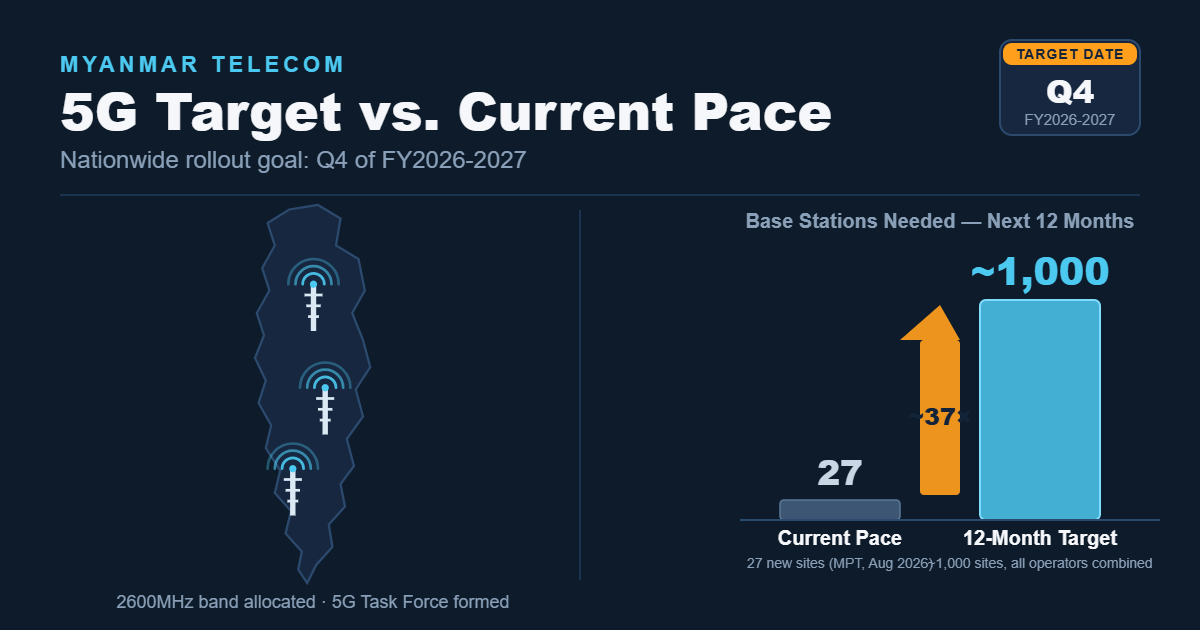
Myanmar’s Ministry of Digital Development and Communications says the country should have nationwide 5G service running by the fourth quarter of fiscal year 2026-2027. The target came out of a coordination meeting held on August 18, 2026, and was reported the following day by One News Myanmar, with the same meeting details — date, spokesperson, spectrum band, and tower target — independently reported by Myanmar National Post. Deputy Minister U Thet Win Aung told the meeting that the 2600MHz band has already been allocated for 5G use, that mobile operators have been asked to build roughly 1,000 new base stations over the coming year, and that a dedicated “5G Task Force” has already been formed to coordinate the rollout.
On paper, that’s a concrete, numbers-backed announcement — a specific frequency band, a specific tower count, a specific quarter. It’s also the kind of announcement that’s easy to read past without asking the questions that actually determine whether it happens on schedule. This piece works through what the ministry said, what it implies about the state of Myanmar’s telecom sector right now, and what it conveniently leaves unanswered.
What the Ministry Actually Announced on August 18
Strip the story down to its verifiable core and it’s this: at an August 18, 2026 coordination meeting, the Ministry of Digital Development and Communications set a goal of launching 5G service nationwide by Q4 of fiscal year 2026-2027. The 2600MHz spectrum band is already assigned for the purpose. Mobile network operators — MPT, Mytel, ATOM, and any others operating under Myanmar’s current licensing regime — were instructed to work toward building around 1,000 new base stations over the next twelve months. A 5G Task Force already exists to oversee the effort. That’s the full set of hard facts available from the two independently reported sources.
What’s notably absent from both reports: no breakdown of how the 1,000-tower target is split between operators, no funding or subsidy mechanism mentioned, no city-by-city or region-by-region rollout sequence, and no discussion of device affordability or consumer pricing. We’ll come back to those gaps later in this piece.
Why a National Target Now, After Years of Solo Trials
The interesting question isn’t that Myanmar wants 5G — it’s why a government-level national target is landing in August 2026, when individual operators have already been running their own 5G efforts for years. MPT, for instance, publicly documented a live 5G trial around its Sule office in downtown Yangon back in June 2024, more than two years before this ministry announcement. So this isn’t a case of the technology being new to Myanmar, or of operators sitting on their hands waiting for a government green light.
What’s changed is coordination. Individual operator trials in isolated downtown pockets don’t add up to a national rollout on their own — they demonstrate feasibility in a small, controlled area with strong existing infrastructure, not a repeatable, funded, scheduled national build-out. A government target with a task force attached reads less like “5G is arriving in Myanmar” (it already had, in a limited pilot sense) and more like an attempt to convert scattered operator-level pilots into a single coordinated national program with a deadline attached to it. That’s a meaningfully different — and harder — thing to deliver than a downtown trial zone.
There’s also a simpler, more skeptical reading worth naming directly: government targets with task forces and deadlines are also what gets announced when the underlying pace of progress needs a public push. We can’t verify motive from a press report, but the two readings aren’t mutually exclusive, and readers should hold both in mind rather than assume the announcement alone means acceleration is already underway.
Can Operators Really Build 1,000 Towers in a Year?
This is where the scale of the target deserves more scrutiny than either report gave it. For a useful point of comparison, look at our own site’s coverage of MPT’s most recent infrastructure update, published just two weeks before this announcement: MPT added 27 base stations and upgraded 9 existing sites to 4G LTE — a rollout our own coverage described at the time as “a modest, targeted addition” and “a routine, geographically targeted infrastructure update,” not a milestone. That’s one operator, one upgrade cycle, 27 new sites — for 4G, not even 5G, which typically requires denser site spacing than 4G to deliver its bandwidth and latency advantages.
Now compare that to the government’s ask: roughly 1,000 new base stations across all operators combined, within twelve months, specifically for 5G. Even if we’re generous and assume the 1,000-tower figure is spread across three or four operators working in parallel, each would need to be building at something like ten times the pace of what was recently described as a routine, modest update — and doing it for 5G equipment, which generally means more sites per square kilometer than an equivalent 4G expansion, not fewer.
None of this makes the target impossible. Base station build-out can scale non-linearly once supply chains, tower-sharing agreements, and permitting are lined up, and a single-site news update isn’t necessarily representative of an operator’s full annual pace. But the gap between “27 sites was notable progress” and “1,000 sites in a year is the plan” is large enough that it’s fair to treat the ministry’s number as an aspirational ceiling rather than a baseline expectation. Myanmar’s broader operating environment this year — logistics constraints, security-related access issues in parts of the country, and periodic infrastructure disruption reported through 2026 — adds further reason for caution, even though none of our cited sources quantify how much that environment specifically affects tower construction timelines. That’s a genuine unknown, not a confirmed fact, and we’re flagging it as such rather than asserting a specific slowdown.
When Exactly Is “Q4 of FY2026-2027”?
The reports cite a fiscal quarter rather than calendar dates, which is easy to misread if you’re not tracking Myanmar’s government fiscal year calendar. Myanmar’s fiscal year runs April 1 to March 31 — the country switched back to this calendar starting with FY2022-2023, after a brief 2018-2021 experiment with an October-to-September year (with a six-month bridge period from October 2021 to March 2022 covering the transition). Applying that structure consistently to FY2026-2027 gives:
- Q1: April–June 2026
- Q2: July–September 2026
- Q3: October–December 2026
- Q4: January–March 2027
By that calculation, the ministry’s target points to roughly January–March 2027 — about 5 to 7 months after the August 18, 2026 meeting where it was announced, a notably tighter window than a casual reading of “Q4” might suggest.
We want to flag something honestly here rather than gloss over it: neither cited article spells out the exact calendar months behind “Q4,” so this conversion rests on Myanmar’s standard fiscal-year structure rather than an explicit statement from the ministry. It’s also worth noting Myanmar’s fiscal calendar has changed more than once in the past decade, so a reader checking older sources may encounter a different (October-start) structure that no longer applies. We’re publishing the January–March 2027 range as our best calculation, but this specific detail — the precise calendar window the ministry means by “Q4 of FY2026-2027” — would benefit from direct confirmation from a ministry statement or the (currently inaccessible to us) Global New Light of Myanmar coverage of the same meeting before being treated as settled.
What the Announcement Doesn’t Say
Reading the two reports side by side, a few things stand out by their absence:
- No operator-by-operator breakdown. It’s unclear whether the ~1,000-tower target is a shared pool, an equal split, or individually negotiated per operator based on existing footprint.
- No mention of funding. Base station build-out at this scale is capital-intensive; whether operators are expected to self-fund, whether there’s any state subsidy or spectrum-fee incentive, and whether import costs for 5G equipment factor in aren’t addressed.
- No geographic sequencing. “Nationwide” is the stated goal, but there’s no indication of whether Yangon and Mandalay get built out first (as is typical, and as MPT’s own trial history suggests) while smaller towns and rural areas wait, or whether there’s a genuine attempt at simultaneous, more equitable coverage.
- No consumer-side detail. Device compatibility, expected data pricing on 5G plans, and whether existing 4G LTE customers would need new SIMs or handsets are all left out — understandable for a ministry coordination meeting, but worth watching for in follow-up coverage as the launch date approaches.
Frequently Asked Questions
When will 5G actually launch in Myanmar?
The Ministry of Digital Development and Communications has set a target of Q4 of fiscal year 2026-2027, which — based on Myanmar’s current April-to-March government fiscal calendar — works out to roughly January through March 2027. This is a government target announced at an August 18, 2026 coordination meeting, not a confirmed operator launch date, so it’s reasonable to treat it as a goal rather than a guarantee.
Which frequency band will Myanmar’s 5G network use?
The 2600MHz band has been allocated for 5G use, according to the ministry’s announcement.
Which mobile operators are involved?
Neither report names specific operators individually, but Myanmar’s existing mobile network operators — MPT, Mytel, ATOM, and others — are the parties who would be building the roughly 1,000 new base stations the ministry is asking for. MPT has the longest publicly documented 5G trial history, dating to a June 2024 pilot in Yangon.
Is this Myanmar’s first 5G announcement?
No. Operators, particularly MPT, have run 5G trials since at least mid-2024. What’s new in August 2026 is a government-level national target and timeline, plus a dedicated 5G Task Force, rather than the first appearance of 5G technology in the country.
Is a 1,000-tower build in one year realistic?
That’s genuinely uncertain based on what’s public. For comparison, MPT’s most recent reported infrastructure update — 27 new base stations and 9 sites upgraded to 4G LTE — was itself described as a modest, routine update, not a milestone. A 1,000-site target across all operators, for the more site-dense demands of 5G, in twelve months, is a considerably steeper pace than that recent baseline suggests, though non-linear scale-up isn’t impossible if supply chains and permitting align.
The Bottom Line
What’s confirmed is straightforward: Myanmar’s telecom ministry has set a formal, dated national target for 5G — Q4 of FY2026-2027, translating to roughly January–March 2027 under the country’s current fiscal calendar — backed by an already-allocated spectrum band, a stated tower-build goal of about 1,000 sites, and a coordinating task force. What’s not confirmed is whether the pace implied by that target is achievable given the infrastructure build rates operators have recently reported, how the build will be funded or distributed geographically, and what it means for consumers in terms of pricing and device readiness. We’ll be watching for the next operator-level infrastructure update — the kind of report MPT put out in early August — as the clearest real-world signal of whether this timeline is holding.
Sources: One News Myanmar, “Myanmar strives to launch 5G network service” (published August 19, 2026, reporting on an August 18, 2026 ministry meeting); Myanmar National Post (published August 19, 2026, corroborating coverage of the same meeting); MPT official blog, “MPT Brings 5G Network Trial to Its Customers” (published June 10, 2024); Myanmar Tech Press, “MPT Adds 27 Base Stations and Upgrades 9 to 4G LTE” (published August 6, 2026). Note: an attempt to check the Global New Light of Myanmar’s coverage of the same meeting for additional confirmation was blocked (403 error) during research for this piece; a party with direct access may want to confirm the exact calendar months behind “Q4 of FY2026-2027” against that or another primary government source.
Source: https://onenewstvchannel.com/en/science-technology/myanmar-strives-to-launch-5g-network-service/