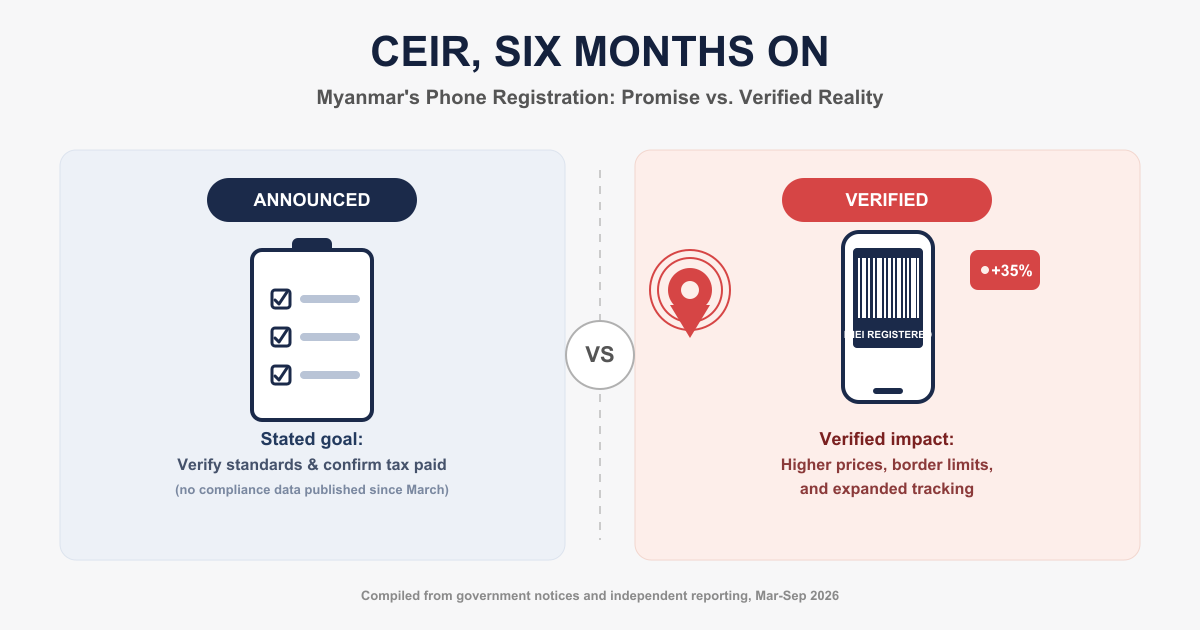
In early March 2026, Myanmar’s government rolled out a mandatory phone registration system called CEIR (Central Equipment Identity Register), linking every handset’s IMEI number to its SIM card and, by extension, to the owner’s national ID. The government’s own framing for the system, laid out in the Office of the President’s announcement, was narrow: it would let people “confidently use devices that meet standards and for which the required taxes to the State have been duly paid” (presoffministry.gov.mm, March 6, 2026). In other words, officially, CEIR is a standards-and-tax-compliance tool — the announcement does not mention theft, counterfeiting, or fraud. Existing phones were automatically registered if their SIM was activated by March 31; from April 1 onward, unregistered devices faced a 30-day grace period before losing network access entirely.
Six months later, we went looking at what that modest official framing has actually produced. What we found, across government notices and independent reporting from March through July, is a system whose real-world footprint reaches well beyond “standards and tax compliance”: it has made phones more expensive, capped how many devices travelers can bring across the border, and strengthened the state’s ability to track who is using which device and where — none of which were part of the original pitch.
What the Government Actually Announced in March
The mechanics of CEIR, as described in the original announcement and corroborated by Eleven Myanmar’s March 5, 2026 report, were straightforward. Four carriers — MPT, ATOM, U9 (formerly Ooredoo), and Mytel — were brought into the system. Anyone with an existing phone had until March 31 to insert an active SIM card, which triggered automatic registration into what the government called the “white list.” Phones not registered by that date entered a 30-day grace window starting April 1; after that, owners had to pay outstanding tax and any penalties through the ceir.gov.mm portal, or in border regions, at Internal Revenue Department or Customs Department counters, or lose service.
Then in July, the rules expanded to cover people entering the country. According to a client alert from tax and legal advisory VDB Loi (July 14, 2026), travelers arriving through Yangon, Naypyidaw, or Mandalay international airports must now declare any unregistered phone on a Passenger Declaration Form. Each person is limited to two devices per year, and registration requires paying 5% customs duty, 5% commercial tax, and a 2% advance income tax within 30 days of declaring. Malaysia’s The Star ran the same figures, credited to Eleven Media/ANN (Asian News Network), on July 17, 2026, confirming the two-device cap independently.
The Gap: A Stated Goal With No Measurable Result
Here is the gap. Officially, CEIR exists so people can use devices “that meet standards and for which the required taxes to the State have been duly paid” — a framing about product compliance and tax collection, not about crime. Nothing in the government’s own announcement, or in Eleven Myanmar’s contemporaneous report, mentions theft, counterfeiting, or fraud at all. Yet six months on, the system’s most visible, verifiable effects go well beyond enforcing standards and collecting tax: it has raised the price of a phone, put a hard cap on how many devices can cross the border, and given the state a new way to tie a specific device to a specific, identified person.
None of that makes the tax-and-standards framing dishonest on its face — collecting duty on undeclared devices is a normal customs function, and device registries of some form exist in other countries too. But a system whose stated job is narrow (verify standards, collect tax) and whose demonstrated footprint is this broad (cost, border friction, surveillance capability) deserves more public scrutiny than it has gotten. In the six months since launch, we have not located a single official statistic — on tax revenue collected, phones disconnected, or standards violations caught — that would let the public check even the narrow, stated version of what CEIR is supposed to do.
Three Things We Can Actually Verify
1. Phones got more expensive. Independent Mon News Agency, reporting on April 2, 2026, calculated that new devices now carry 5% customs duty, 5% commercial tax, and 2% advance income tax, with fines of up to 25% for non-compliant devices — pushing total costs up by roughly 30–37%. Their examples: a 1,000,000-kyat phone rising to 1,300,000 kyat, a 6,000,000-kyat phone crossing 8,000,000 kyat. A shop owner in Mawlamyine told the outlet that for a 2-million-kyat phone, “tax alone can add more than 700,000 kyat.” A resident of Kyaikto township put it more bluntly: if prices rise further, “there’s no way to buy a new phone — we’ll just have to keep using the old one.”
2. Cross-border device movement is now capped and taxed. The July expansion isn’t a minor administrative footnote — it’s a hard limit. Two phones per person, per year, full stop, with a 30-day clock to pay import-style taxes on anything beyond what’s already registered. For a country with significant cross-border trade and a diaspora that regularly brings phones home, this is a new friction point that didn’t exist before March.
3. The state’s tracking capability has expanded. This is the part the original announcement doesn’t mention at all. Ko Thit Nyan, a digital rights researcher with the Myanmar Internet Project, told Burma News International (March 7, 2026) that “the junta has been implementing and using digital surveillance methods for quite some time. This new program is an additional upgrade to their digital surveillance mechanisms.” The outlet’s own reporting adds that because a SIM typically connects to at least three base stations, linking IMEI, SIM, and national ID significantly increases the state’s location-tracking capability and its ability to identify who is using a specific device — a technical point BNI reported, not a direct quote from Ko Thit Nyan, who instead said “what we can recommend is for people to remain aware of security risks and improve their digital literacy.” A separate interview carried by Business & Human Rights Resource Centre (March 5, 2026) quotes him warning that “under dictators who seek absolute control, this is deeply concerning” and that “we are likely to see more harm to the public than any supposed benefits.” Combined with biometric data collection efforts already underway, this is the kind of capability that persists long after any tax-compliance benefit would have been measured — assuming it ever gets measured at all.
What the Announcements Leave Out
Beyond the missing tax and compliance statistics, two gaps stand out from the reporting we reviewed. First, awareness outside major cities appears to be thin. A report from Global Reporter (April 2, 2026) describes confusion among the public — some feared even backup phones would be disconnected — and notes that residents in areas with poor connectivity were sometimes unaware the system existed at all. Second, the rollout itself was chaotic at the deadline: DVB (March 31, 2026) reported week-long queues outside phone shops as customers who had bought devices without checking registration status scrambled to get help before the cutoff. A shop worker described lines that had “continued for a week, and since today is the final day, it’s even more chaotic.”
Neither of those is a footnote. A registration system whose enforcement deadline produces a week of panic queues, and whose existence isn’t reliably known in less-connected regions, is not obviously working as smoothly as the original announcement implied — regardless of how it holds up against its own, narrower tax-and-standards goal.
Where This Fits: A Pattern We Keep Seeing
This is the third time in recent months we’ve written about the distance between an official announcement and its verifiable outcome. We saw it with MPT’s flood-response messaging, where a free data pack ended on schedule while the underlying disaster kept growing. We saw it with Mytel’s exclusive World Cup broadcast rights, a deal framed as a coup that translated into stadium screenings nobody attended. CEIR fits the same shape: a announcement with a clear, appealing justification, followed by six months of silence on whether that justification held up, alongside side effects — cost, surveillance, friction — that are easy to verify and rarely mentioned in the original pitch. None of this means the stated goals were dishonest. It means Myanmar’s tech and telecom announcements consistently need a follow-up check, because the follow-up rarely comes from the source itself.
What This Means for You Right Now
If you own a phone in Myanmar, you can check its registration status directly at ceir.gov.mm by entering the device’s IMEI number — this was the same portal DVB referenced during the March 31 crush. If you are traveling into Myanmar via Yangon, Naypyidaw, or Mandalay international airports with an unregistered phone, you are limited to two devices per calendar year and need to complete the Passenger Declaration Form, with duties and taxes due within 30 days. If you’re planning to buy a new device inside the country, budget for the added tax — the 30–37% markup reported by Mon News in April appears to still apply as of this writing, though we found no updated pricing survey since then to confirm whether the actual retail impact has shifted.
Frequently Asked Questions
What is CEIR and when did it start in Myanmar?
CEIR (Central Equipment Identity Register) is a system that links a phone’s IMEI number to its SIM card and the owner’s national ID. It launched in the first week of March 2026, with existing phones auto-registered through SIM activation by March 31, 2026.
What happens if my phone isn’t registered?
Under the original rules announced in March, unregistered phones got a 30-day grace period starting April 1, 2026, after which they lose network access until outstanding tax and penalties are paid through ceir.gov.mm or designated tax offices.
Does CEIR apply to travelers visiting Myanmar?
Yes, since a July 14, 2026 expansion. Travelers arriving by air, land, or sea with unregistered phones must file a Passenger Declaration Form and are capped at two devices per person per year, with taxes due within 30 days.
Was CEIR introduced to fight phone theft or fraud?
No — that is a common assumption, but it isn’t what the government said. The official announcement frames CEIR as a standards-and-tax-compliance system, not a security measure. We could not find any official statistics — on tax revenue collected, phones disconnected, or standards violations caught — showing what the system has achieved even on its own, narrower terms.
Why do new phones cost more in Myanmar now?
New devices are subject to 5% customs duty, 5% commercial tax, and 2% advance income tax under CEIR-linked rules, with penalties of up to 25% for non-compliant devices. Reporting from April 2026 estimated this adds roughly 30–37% to retail prices.
The Bottom Line
Six months on, Myanmar’s CEIR system has clearly done three things: raised the cost of owning a phone, restricted how many devices can cross the border, and deepened the state’s ability to tie a specific device to a specific, identified person. Officially, it was only ever supposed to verify device standards and collect tax — and even on that narrower claim, no public data shows what it has collected or caught. Until an official accounting of tax revenue, disconnected devices, or standards violations is published, the honest description of CEIR is not “a compliance system doing exactly what it says,” but “a registration and taxation system with a surveillance capability nobody advertised, whose stated goals remain unmeasured.” Readers deciding whether to trust the next such announcement — on this system or Myanmar’s next digital ID rollout — should keep asking for the follow-up numbers, because based on what we found, nobody is volunteering them.
Sources: Office of the President’s Ministries, “CEIR announcement,” presoffministry.gov.mm, March 6, 2026. Eleven Myanmar, March 5, 2026. Burma News International, March 7, 2026. Business & Human Rights Resource Centre, March 5, 2026. Independent Mon News Agency, April 2, 2026. DVB, March 31, 2026. Global Reporter, April 2, 2026. VDB Loi, July 14, 2026. The Star (Eleven Media/ANN), July 17, 2026. All dates verified against primary or near-primary sources as noted.