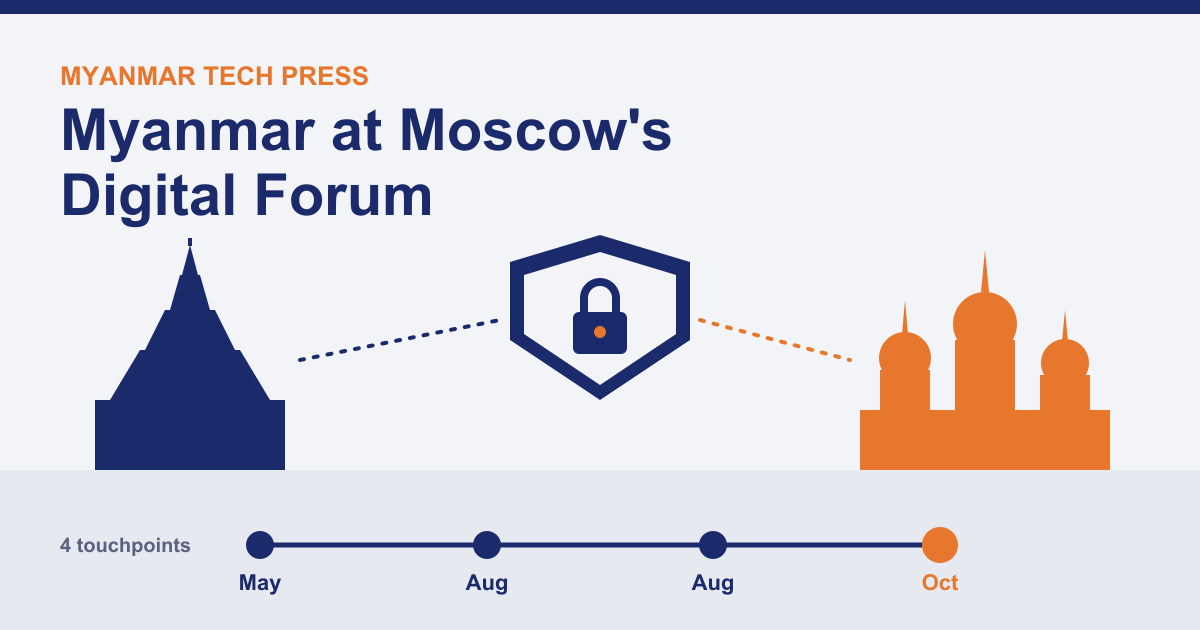
A Myanmar delegation led by Deputy Minister U Min Zeyar Hlaing of the Ministry of Digital Development and Communications attended the 2nd Global Digital Forum in Moscow from 8 to 10 October 2026, according to the Global New Light of Myanmar (GNLM), published 13 October 2026. GNLM is a state-run newspaper, so its account reflects the government’s own framing. It says Myanmar co-chaired the 6th Russia-ASEAN Dialogue on ICT Security-Related Issues on behalf of ASEAN, that the deputy minister spoke on an “e-Governance Knowledge Sharing” roundtable, and that he met Russian Deputy Minister Alexander Shoitov of the Ministry of Digital Development, Communications and Mass Media.
The report lists the topics of that bilateral meeting as digital government systems, cybersecurity frameworks, and technology-focused human resource development through training programmes. It does not report any agreement or memorandum signed at the forum, and it gives no figures or budgets. This article looks at why the trip matters even without a signed deal, and what the announcement leaves out.
What did Myanmar actually do at the forum?
Going only by GNLM, the delegation had three activities:
- Co-chairing a regional security dialogue. Myanmar co-chaired, on ASEAN’s behalf, the 6th Russia-ASEAN Dialogue on ICT Security-Related Issues.
- Speaking on e-governance. The deputy minister was a panellist at an “e-Governance Knowledge Sharing” roundtable.
- A bilateral meeting. Talks with Deputy Minister Shoitov covered digital government, cybersecurity frameworks and training.
GNLM also says the forum drew more than 1,000 IT professionals from over 100 countries and executives from more than 50 technology companies. That is the report’s description of the event’s scale, and we have not independently verified it.
A separate report, from Bernama dated 8 October 2026 (carrying material from Sputnik and RIA Novosti), covers a Russia-ASEAN Dialogue meeting held during the same forum. It quotes Russian Deputy Foreign Minister Alexander Alimov as saying “Today’s meeting is being held at a high level for the first time” and that “confidence in the digital area among our countries is growing”. He linked the dialogue to sovereign equality, non-interference in internal affairs, overcoming the digital divide, and commitments made at a Russia-ASEAN summit in Kazan in June, according to Alimov. To be clear, the Bernama report does not mention Myanmar. The Myanmar co-chair detail rests on GNLM alone.
Why was Myanmar co-chairing for ASEAN at all?
The seat is less surprising than it first looks. Myanmar’s own Ministry of Foreign Affairs described the country, in a statement dated 10 July 2025, as “Country Coordinator for ASEAN-Russia Dialogue Relations (2024-2027)”. A country coordinator typically fronts the bloc’s dealings with a dialogue partner, so a co-chair role in a Russia-ASEAN track fits that mandate.
The appointment itself has been contested. On 1 March 2024, the activist group Justice For Myanmar argued that ASEAN’s choice of the military-run government as coordinator “legitimises the junta as if it were the government of Myanmar”. That is an advocacy group’s view, not a settled fact, but it explains why a seemingly technical ICT security dialogue carries political weight. Every time Myanmar chairs such a session, it gets to present itself as a normal regional partner.
Is this a one-off trip or part of a pattern?
It is a pattern. Counting only public events that Myanmar Tech Press or the sources below have documented, this is the fourth Russia-Myanmar digital touchpoint in about five months:
- May 2026, Nizhny Novgorod. According to The Irrawaddy (22 May 2026), Science and Technology Minister Myo Thein Kyaw attended the 11th Digitalization of Industrial Russia Forum, sought help reviving the Yadanabon Cyber City in Pyin Oo Lwin, and met Astra Group and the Russian IT-security maker Security Code. The report mentioned a potential memorandum between a Russian telecom university (MTUCI) and Naypyitaw State Polytechnic University.
- 12 August 2026, Naypyitaw. The Customs Department signed the National Single Window trade portal contract with Astra Consulting LLC, the Myanmar branch of Astra Group, as we covered in our report on the trade portal contract. Astra Group has been on the US OFAC sanctions list since 1 May 2024. The contract value and data-hosting terms are not public.
- 18 August 2026, a Putin meeting. The Star (21 August 2026) reported that Vladimir Putin, speaking to the media alongside Min Aung Hlaing, said Russian companies have many proposals and plans in Myanmar’s digital sector, cybersecurity and other high-tech fields. It was a general statement, and no specific project was announced.
- 8 to 10 October 2026, Moscow. The forum covered in this article.
We also wrote earlier about the Russia-backed state space programme in our article on Myanmar’s first astronaut candidates, which shows the relationship reaches beyond software. Taken together, the sequence suggests that Russia is positioning itself as a technology partner for Naypyitaw across several layers: operating systems and software (Astra), security products, government digital services, and diplomatic visibility through the ASEAN channel.
What does “cybersecurity frameworks” mean in this context?
GNLM does not explain it, and that is the most important gap in the announcement. The best available clue is the language of an earlier agreement. In December 2023, according to TASS (5 December 2023), Russian Security Council Secretary Nikolay Patrushev signed a cybersecurity cooperation agreement with Myanmar counterparts during a visit to Myanmar. The text as reported affirmed each state’s sovereign right to determine and implement state policy regarding the internet, and jurisdiction over information infrastructure on its territory, and voiced concern that information technology could be used to interfere in internal affairs or destabilise domestic politics.
Alimov’s remarks in Moscow used similar vocabulary: sovereign equality and non-interference. That suggests the Russian side sees the ICT security track as a place to advance a sovereignty-centred view of cyberspace. It does not tell us what concrete projects, if any, are planned.
What this means at home is a fair question, but we should be careful not to overstate. We have no evidence in these reports that Russian technology is being used for censorship or surveillance in Myanmar, and we are not asserting that. The question is raised by the context: the Cybersecurity Law penalises unauthorised VPN services, and earlier this month we covered reports that TikTok access has been restricted. When a government that already restricts access talks about “cybersecurity frameworks” with a partner that champions state control over the internet, readers are entitled to ask which definition of security is being built. The announcements so far do not answer it.
What the announcement leaves out
- No agreement was reported. GNLM mentions discussions, not signed documents. Nothing in the sources supports a claim that a deal was concluded at this forum.
- No text, scope or funding. We do not know what “technology HR development through training” involves: who is trained, where, by whom, and at whose cost.
- No mention of AI. The report does not mention artificial intelligence, even though it is a headline topic at most digital forums.
- No independent account of the bilateral meeting. The only Myanmar-specific source is state media. The Russian side’s readout, if any, was not found in the material we reviewed.
- No data-protection detail. If Russian-built government platforms expand, the questions raised by the trade portal contract (where data is hosted, who has access) apply equally to any “digital government systems” cooperation.
Frequently asked questions
Did Myanmar sign any agreement with Russia at the Moscow digital forum?
None was reported. The GNLM account describes discussions on digital government, cybersecurity frameworks and training, and does not mention a signed agreement or memorandum.
Why did Myanmar co-chair the Russia-ASEAN ICT security dialogue?
Myanmar’s foreign ministry describes the country as Country Coordinator for ASEAN-Russia Dialogue Relations for 2024 to 2027. The co-chair role on ASEAN’s behalf is consistent with that position, according to GNLM’s report of the forum.
Who is U Min Zeyar Hlaing?
He is the Deputy Minister for Digital Development and Communications and led the Myanmar delegation, according to GNLM.
Does this mean Russian technology will be used in Myanmar’s government systems?
Russian firms already have a footprint: Astra Consulting signed the National Single Window trade portal contract in August 2026. Whether the Moscow talks lead to more projects has not been announced. Putin has said only, in general terms, that Russian companies have proposals and plans in the sector.
Does the Bernama report confirm Myanmar’s role?
No. Bernama’s report on the Russia-ASEAN Dialogue does not mention Myanmar. The detail about Myanmar’s co-chair role comes from state media GNLM.
Our view: watch the follow-through, not the forum
Forums like this produce photographs and statements of intent. What counts is what appears afterwards: a contract, a training programme with named participants, a published agreement text. So far, the pattern across May to October is steady contact, one concrete contract (the trade portal), and a growing amount of rhetoric about cooperation in cybersecurity. For ordinary users and businesses in Myanmar, the practical stakes are where government data lives, which software it runs on, and how “security” is defined when rules about VPNs and platform access are already tightening.
Watch item: before Myanmar’s term as ASEAN-Russia coordinator ends in 2027, see whether a memorandum (for example between MTUCI and Naypyitaw State Polytechnic University) or a new contract with a Russian software or security vendor becomes public. If one does, the question will be whether its terms, including data hosting, are disclosed. If none does, the Moscow forum may turn out to have been mostly diplomacy.
Sources: Global New Light of Myanmar, “Myanmar delegation attends 2nd Global Digital Forum in Moscow” (13 October 2026), link; Bernama (8 October 2026), link; Myanmar Ministry of Foreign Affairs (10 July 2025), link; Justice For Myanmar (1 March 2024), link; TASS (5 December 2023), link; The Irrawaddy (22 May 2026), link; The Star (21 August 2026), link; Myanmar Tech Press (17 August 2026, 7 October 2026, 10 August 2026), linked above.