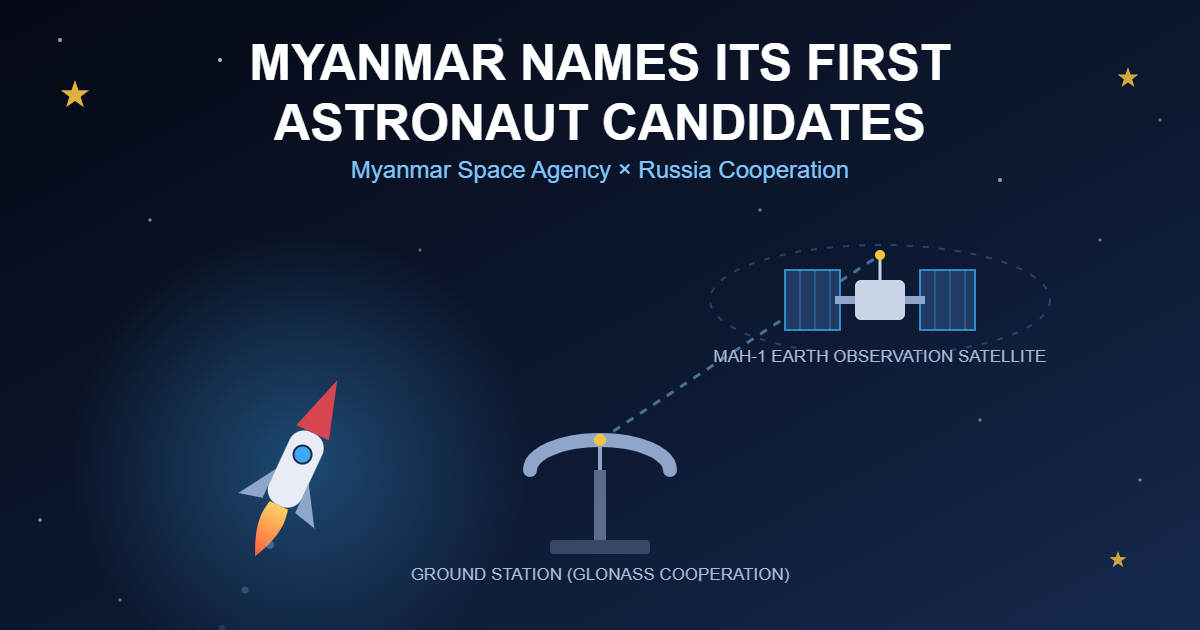
Myanmar’s government said on July 28, 2026 that it has preliminarily selected candidates for the country’s first-ever astronaut programme, unveiling the news alongside a broader progress update on the Myanmar Space Agency (MSA) at a ceremony marking the government’s “first 100-day plan.” According to the Ministry of Information’s official report, President U Min Aung Hlaing attended the event and met with the preliminarily-selected candidates after the ceremony. Eleven Myanmar and The Star report that the candidates went through academic, physical, and medical evaluation before reaching this stage, though none of the three sources say how many candidates remain or how many will ultimately be chosen.
The announcement was corroborated by two other outlets that covered the same event: Eleven Myanmar, which quoted the president describing the space agency’s progress as the realization of “a long-held national dream,” and Malaysia’s The Star, which picked up the story on July 29 for its ASEAN Plus section. Both accounts line up with the Ministry of Information’s version of events on the core facts, and neither adds a candidate count or a training timeline.
What the Ceremony Actually Announced, Beyond the Astronauts
The astronaut candidate programme was only one part of a longer list of MSA milestones presented at the ceremony. Per the Ministry of Information report, the agency also disclosed progress on:
- MAH-1, an earth observation satellite under development;
- 3D map data covering the whole of Myanmar;
- a ground control station and a Multi-Mission Operation Command and Control (MOCC) facility;
- space weather research;
- lunar lander testing; and
- Mars exploration research.
That is a wide spread of activity for a space agency to claim progress on simultaneously, and it’s worth reading the astronaut announcement as one line item in a larger state showcase rather than as a stand-alone story. The framing at the ceremony, per the reporting cited above, tied all of this to disaster monitoring, environmental research, and the practical application of satellite data — not to crewed spaceflight specifically. The astronaut programme is the most attention-grabbing item on the list, but it’s presented by the agency itself as one piece of a broader infrastructure build-out.
This Didn’t Come Out of Nowhere: The February 2026 Agreement With Russia
The July 28 announcement is not an isolated event — it’s a direct, traceable follow-up to a bilateral agreement signed five months earlier. On February 26, 2026, Roscosmos chief Dmitry Bakanov visited Myanmar and signed a human-spaceflight cooperation agreement with his Myanmar counterpart, according to a report from Global Banking & Finance, which did not name the Myanmar signatory. That agreement, per the report, covers three things: support for selecting and training Myanmar’s first astronaut(s), the installation of a GLONASS satellite data ground station, and a near-Earth object tracking facility — the report did not specify a site for either facility.
Read against that February agreement, the astronaut candidate reveal is best understood as evidence that a specific, previously-announced bilateral commitment is actually moving — evaluations have happened, candidates have been shortlisted, and the president has met them in person. That’s a meaningfully different story than “Myanmar announces a space programme” in the abstract; it’s the second data point in what now reads as a sustained Myanmar–Russia project with concrete deliverables, not a one-off press event. Whether the remaining pieces of the February agreement — the GLONASS ground station and the near-Earth object tracking facility — have also progressed was not addressed at the July 28 ceremony, at least not in any of the reporting we could verify.
Peaceful Framing, Dual-Use Infrastructure: A Gap Worth Naming
The public framing on July 28, consistent across all three outlets we cite here, was squarely civilian and developmental: disaster monitoring, environmental research, mapping, and the broader goal — in the president’s words as reported by the Ministry of Information — of Myanmar gaining “knowledge and understanding of space technology” so it can be “effectively applied for beneficial purposes.” Nothing in the July 28 reporting mentions the GLONASS ground station or the near-Earth object tracking facility from the February agreement, and nothing frames the astronaut programme itself in security or defense terms.
That framing is worth holding up against what the February agreement actually includes. A GLONASS ground station is, by design, infrastructure that supports Russia’s own satellite-navigation system — a system with acknowledged military as well as civilian applications, the same dual-use character GPS has for the United States. A near-Earth object tracking facility of this kind is not inherently sinister — asteroid and debris tracking is a legitimate scientific field on its own — but it is also the kind of sensor infrastructure that has utility beyond pure science. None of this means the July 28 announcement is disguising something; it means the “peaceful, disaster-monitoring” framing offered at the ceremony describes only part of what the underlying Russia agreement actually covers, and the two halves of the story — the astronaut programme’s public face and the ground-station/tracking-facility infrastructure — haven’t been discussed together in any of the coverage we found. Readers evaluating what Myanmar’s space cooperation with Russia actually amounts to should weigh both halves, not just the one that was on stage.
What the Announcement Leaves Unanswered
None of the three sources we verified — the Ministry of Information, Eleven Myanmar, or The Star — specify how many candidates were preliminarily selected, what the selection criteria actually measured beyond “academic, physical, and medical evaluation,” what a training timeline looks like, when a final astronaut (or astronauts) might be named, or what budget any of this — the satellite, the mapping programme, the ground facilities, the astronaut training — is operating on. For a state announcement covering seven distinct programme areas (astronaut selection, a satellite, national mapping, ground control, space weather, lunar testing, and Mars research), the absence of any figures at all is notable. It’s the kind of gap that’s common in early-stage government science announcements everywhere, not unique to Myanmar, but it does mean that “Myanmar has an astronaut programme” is, as of this writing, a statement about intent and process rather than about a fixed date or a named individual.
It’s also fair to note, independent of any single source, that an ambitious multi-track space programme announcement will read very differently to different audiences depending on how Myanmar’s broader economic situation is factored in — that’s a legitimate point of scrutiny for any government spending on prestige science programmes, and it applies here as much as it would to any other country’s space ambitions announced during a period of domestic economic strain. We don’t have verified reporting quantifying MSA’s budget or how it compares to other government spending, so we’re flagging this as a fair question rather than asserting numbers we can’t back up.
Frequently Asked Questions
Has Myanmar sent anyone to space yet?
No. As of the July 28, 2026 announcement, Myanmar has only reached the stage of preliminarily selecting astronaut candidates through academic, physical, and medical evaluation. No training start date, launch date, or final astronaut selection has been announced in any of the sources we reviewed.
How many astronaut candidates does Myanmar have?
This has not been publicly disclosed. Neither the Ministry of Information’s report nor the Eleven Myanmar or The Star coverage of the July 28 ceremony gives a candidate count.
Is Myanmar’s astronaut programme connected to Russia?
Yes. The July 28 announcement follows a February 26, 2026 human-spaceflight cooperation agreement between Myanmar Space Agency and Russia’s Roscosmos, under which Russia is supporting astronaut selection and training. That same agreement also covers a GLONASS ground station and a near-Earth object tracking facility, though the report announcing the agreement did not specify where either would be sited.
What is MAH-1?
MAH-1 is the earth observation satellite that MSA said, at the July 28 ceremony, is currently under development. No launch date or technical specifications were disclosed in the sources we reviewed.
What is the Myanmar Space Agency’s stated purpose for its space programme?
Per the president’s remarks as reported by the Ministry of Information and Eleven Myanmar, the stated goals are disaster monitoring, environmental research, national mapping, and applying satellite data and space-technology knowledge toward economic development.
The Takeaway
Myanmar’s astronaut candidate reveal is a real, verifiable milestone in a specific bilateral project that started with a signed agreement in February 2026, not a standalone publicity stunt — the timeline and the named parties on both sides check out across multiple sources. But the July 28 ceremony answered fewer questions than it raised: no candidate numbers, no training schedule, no budget, and no mention of the ground-station and tracking-facility infrastructure that sits alongside the astronaut-training component in the underlying Russia agreement. Readers following this story going forward should watch for whether MSA discloses a candidate count or training timeline, and whether the GLONASS ground station and near-Earth object tracking facility from the February agreement — the less camera-friendly half of that deal — ever get their own progress update.
Sources: Ministry of Information, Myanmar, “Myanmar Space Agency unveils astronaut candidate programme” (moi.gov.mm, published July 28, 2026, https://www.moi.gov.mm/moi:eng/news/21672); Eleven Myanmar, “Myanmar president hails space agency progress, unveils first astronaut candidate programme” (published July 28, 2026, https://elevenmyanmar.com/news/myanmar-president-hails-space-agency-progress-unveils-first-astronaut-candidate-programme?language=en); The Star (Malaysia), “Myanmar president hails progress on space agency, unveils first astronaut candidate programme” (published July 29, 2026, https://www.thestar.com.my/aseanplus/aseanplus-news/2026/07/29/myanmar-president-hails-progress-on-space-agency-unveils-first-astronaut-candidate-programme); Global Banking & Finance, “Russia to help select, train first Myanmar cosmonaut” (published February 26, 2026, https://www.globalbankingandfinance.com/russia-help-select-train-first-myanmar-cosmonaut/).