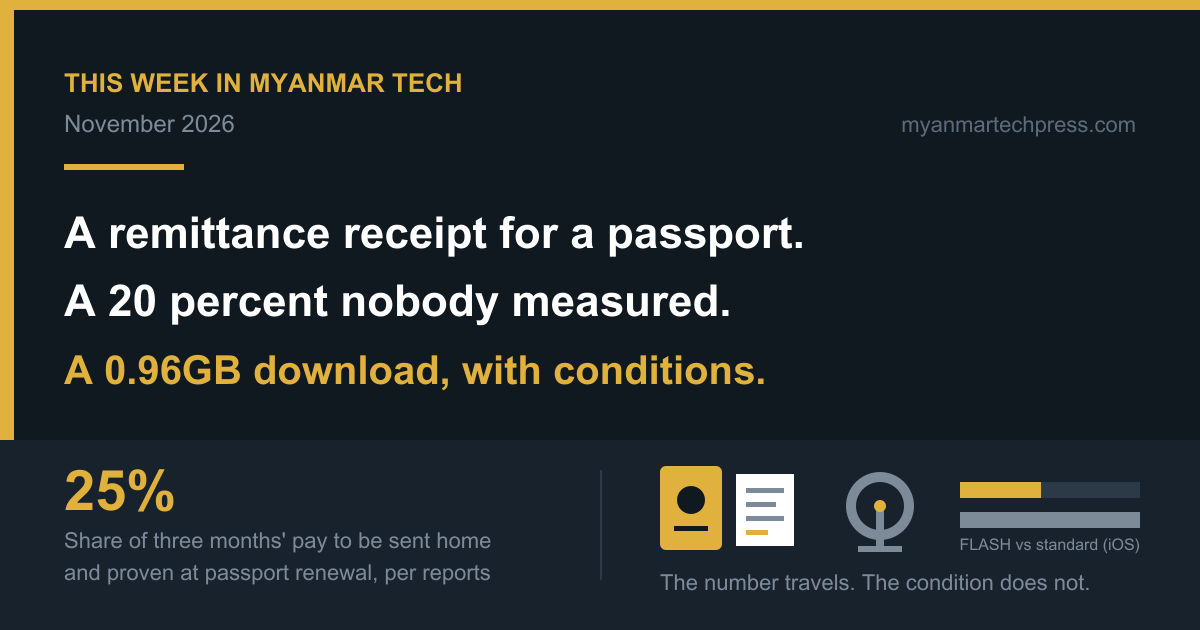
Once a week, this column puts the stories we published side by side, checks them against our archive, and names a few things that can be verified later. This edition covers the past week. The three stories sit in different fields: migrant remittances, satellite internet in conflict areas and a mobile game. What they share is a number that travels well and a condition that does not travel with it.
Passport renewal now comes with a remittance receipt check
According to The Irrawaddy and BNI, Myanmar embassies in Singapore, Hong Kong and Macau now ask Passport for Job applicants for proof of 2% income tax paid and proof that 25% of the last three months’ earnings was sent home through official channels. BNI says accepted proof in Singapore is limited to DBS or OCBC slips, or records from licensed operators such as Western Union and Ria. The 25% rule itself dates from 2023. What is new is that it is checked at the passport counter.
What we would add now: The rule turns a bank record into a credential, and that only works where someone can produce the record. Our Starlink article, two days later, is a reminder that the families receiving this money do not all live where a bank slip is easy to act on. A transfer that arrives in Sagaing still has to be collected, and our article noted that the sources do not say whether wallets such as KBZPay or Wave count as proof. A web search on 21 November found nothing that settles it. That gap matters on both ends: for the worker abroad who chooses the channel, and for the family at home who has to use it.
Starlink’s “20 percent cut off” figure, traced back
RFA reported that more than 20 percent of Starlink devices in Myanmar have had service cut off, attributing the figure to Athan’s Dead Air report. We followed it back: Athan cites it as an external study, footnoting an EU SEE alert from 29 July, and the earliest appearance we found was a DVB report on 6 July quoting unnamed service providers. That estimate predates the Roam rule’s 17 August start for existing customers. The cut-offs are documented; their current size is not.
What we would add now: Athan’s survey contains a second 20 percent: 26 of 130 respondents (20.0%) said they did not receive warnings in time. Two different numbers that look alike are easy to merge in a retelling, which is exactly how a figure gains authority. The more useful number for the rest of this week’s stories is a different one. Only 14 of 127 respondents (11.0%) used a terminal owned by their own household; 46 (36.2%) used commercial Starlink shops. In those areas, connectivity is something people buy by the hour, at about 500 to 2,000 kyats in early 2026 according to one local official quoted by Athan.
PUBG MOBILE FLASH: under 1GB, with conditions
A press release from Vero Myanmar announced PUBG MOBILE FLASH, a lightweight edition, at 0.96GB on Android and 1.75GB on iOS. We checked the store listings and the global release. The size holds up: on Apple’s Singapore storefront FLASH lists about 1.77GB against about 3.93GB for the standard app. But the Myanmar release leaves out the 2GB RAM minimum stated globally, and presents performance figures that the global release calls targets measured against the FLASH beta, “not guaranteed”.
What we would add now: Our arithmetic put the first download at roughly one MPT 1GB pack (3,889 kyats), or around 14,000 to 15,000 kyats at ATOM’s pay-as-you-go rate. That assumes a working mobile network. Set next to Athan’s figures, where 92.3% of respondents lacked full network access, the cost of a download in those townships is not a data-pack question at all. We are not suggesting anyone in a conflict area is downloading games; the point is that “lighter” is a saving that depends on which connection you have. There is also a small answer to an older question below.
From the archive: when the official channel came with a reward
In December 2021 we reported that CB Bank launched a promotion for Western Union remitters from Singapore, Malaysia and Thailand: an additional 10,000 kyats in cash, as our article put it “per day”, on remittances of 500,000 kyats and above, from 15 December 2021 to 15 January 2022. The corridors are almost the same ones now named in the passport notices, and Western Union is one of the channels BNI lists as acceptable proof today.
The comparison is the point. Five years ago, a bank tried to pull money into the official channel with a cash bonus. Now the same channel is enforced at the passport counter. Our 2021 article was a short, single-source piece, and we did not record whether the promotion worked, so we cannot say the carrot failed. But the direction is clear: from reward to requirement. That is also consistent with what workers told The Irrawaddy, that informal channels pay more. A promotion has to beat that gap; a requirement only has to be checked.
One thing worth watching
Three new items:
- Will any Myanmar embassy state in writing, by the end of 2026, whether mobile-wallet transfers such as KBZPay or Wave count as remittance proof? The notices as reported name banks and licensed operators only.
- Will SpaceX publish any count of restricted terminals in Myanmar, or an appeals route for civilian users, by the end of 2026? A count would settle the 20 percent question; an appeals route was among Athan’s recommendations.
- Will the next PUBG MOBILE release sent to Myanmar media state a minimum RAM requirement or the size of on-demand downloads? The FLASH release did neither.
Checking earlier items: we have been waiting for a PUBG MOBILE or Vero Myanmar release that states a final tournament ranking. This week’s release was a product launch, not a tournament, so the item stays open. On the Yangon-Bagan train, a web search on 21 November found no official start date, payment list or word on counters for trains 61 and 62. We found no full terms for ATOM’s Viber packs on ATOM’s site, and no new SpaceX statement specific to Myanmar, which also leaves the Hopong terminals question open. The remaining carried-over items, from the FATF action plan to 5G base-station counts, had no updates we could find.
About this column
This is a weekly roundup from Myanmar Tech Press. It links the past week’s stories to each other and to our archive, which goes back to 2017, and it ends with items that can be checked in later editions. We publish around two to three news articles a week; this column is where we look back at them with a few more days of context. Earlier editions are in the Articles section.