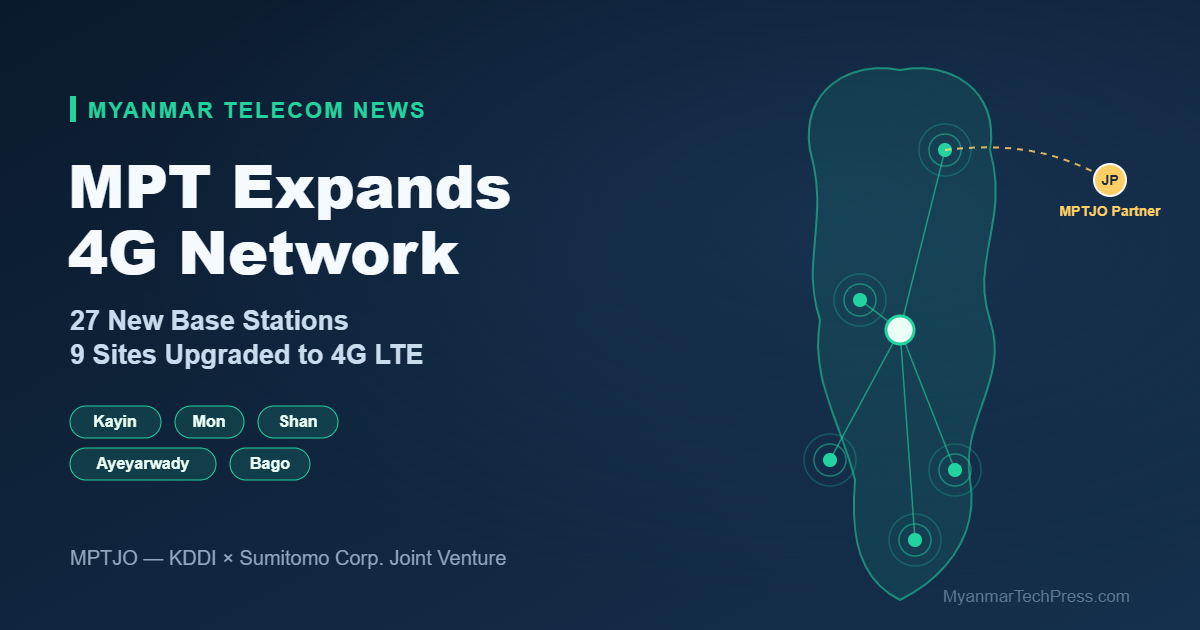
MPT, Myanmar’s largest mobile carrier, announced on July 14, 2026 that it has built 27 new mobile base stations and upgraded 9 existing ones to 4G LTE, spread across the Naypyidaw Council Territory, Kayin (Karen) State, Mon State, eastern and southern Shan State, Ayeyarwady Region, and eastern Bago Region — with the 4G upgrades concentrated in Magway Region. The announcement was accompanied by a ribbon-cutting ceremony on July 12 at Gwe Pin Yoe village in Ottarathiri township, part of Naypyidaw, and it was quickly followed by a second ceremony on July 17 at Chin Su village in Naypyidaw’s Tatkon township, according to local coverage from Eleven Myanmar (July 13, 2026) and Myanmar ITV (July 18, 2026).
On the surface, this reads like a routine infrastructure update — the kind of press release most telecom carriers put out a few times a year. What makes it worth a closer look is who MPT chose to quote in its own announcement: Minoru Nagata, described as the head of the technical division at MPTJO, the MPT-Japan Joint Operation formed with Japan’s KDDI and Sumitomo Corporation. That’s not a name that shows up often in MPT’s Myanmar-language press releases, and it’s worth unpacking why it’s there this time, what the region list actually tells us, and what the announcement leaves out.
What MPT Actually Announced
Stripped of the ceremony details, the substance of the July 14 release is fairly narrow: 27 newly constructed base stations and 9 existing stations upgraded from older technology to 4G LTE, across eight administrative areas (counting the Naypyidaw Council Territory alongside the seven regions and states). The new-build sites are spread across Naypyidaw, Kayin State, Mon State, eastern Shan State, southern Shan State, Ayeyarwady Region, and eastern Bago Region. The 4G upgrade work — taking existing stations from an older network generation to 4G LTE rather than building anything new — is concentrated in Magway Region.
MPT’s release also restates two long-standing figures about its network as context: that its 4G/LTE service, launched in October 2016, now reaches more than 300 townships nationwide and covers roughly 96% of Myanmar’s population. Those aren’t new numbers from this announcement — they’re MPT’s standing claim about its overall network footprint — but they matter for sizing up what 36 stations (27 new plus 9 upgraded) actually represents: a modest, targeted addition to a network that, by MPT’s own account, is already close to nationwide in reach on paper.
Why the Japanese Joint Venture’s Presence in the Announcement Is the Real Story
MPTJO — the MPT-Japan Joint Operation involving KDDI and Sumitomo Corporation — has provided technical and operational support to MPT since 2014, but it doesn’t typically headline network-expansion press releases in the way it does here. Having Minoru Nagata, MPTJO’s technical division head, quoted directly in a Myanmar-language announcement about rural base station construction is a deliberate signal, not an incidental detail.
For readers tracking Japan’s broader economic footprint in Myanmar — KDDI is one of Japan’s three major mobile carriers, and Sumitomo Corporation is a general trading house with decades of history in the country — this is one of the more visible reminders in recent months that the KDDI-Sumitomo partnership with MPT is still active and still doing infrastructure work on the ground, even as headlines about Myanmar tend to focus elsewhere. It’s a useful data point for anyone assessing whether Japanese telecom investment in Myanmar has continued at a meaningful pace, separate from whatever conclusions one might draw about the political environment it’s operating in.
A Pattern Worth Naming: One Project, Multiple Township Ceremonies
The two ceremonies reported so far — July 12 in Ottarathiri township and July 17 in Tatkon township, both within Naypyidaw — are not two separate projects that happen to share the same headline numbers. MPT’s own release notes that additional stations from this same batch will be opened “in turn” across the other regions and states named in the announcement, which means readers should expect more local ceremony coverage to trickle in over the coming weeks, each one presumably reported by local outlets as its own story rather than as an installment of the July 14 announcement.
This rollout style — one national press release, followed by a string of local ribbon-cuttings each covered independently — has an obvious explanation on the technical side (base stations don’t finish construction on the same day even if they’re part of one contract), but it also functions as a way to generate multiple rounds of local, positive coverage from a single underlying project. That’s not a criticism specific to MPT; it’s a familiar pattern in infrastructure PR anywhere. It’s just worth naming so that readers who later come across, say, a “new mobile tower opens in [township]” story from October or November don’t mistake it for a brand-new project rather than a continuation of this one.
Who the Region List Actually Points To
The geography here is not incidental. Kayin State, Mon State, and eastern/southern Shan State have historically been among the parts of Myanmar where mobile network build-out lagged the fastest-covered urban centers, both because of terrain and because of decades of intermittent conflict that made infrastructure construction logistically and politically harder. Ayeyarwady Region and eastern Bago Region are lower-conflict but still rural, agriculture-heavy areas where population density doesn’t make network investment as commercially obvious as it is in Yangon or Mandalay.
MPT’s release frames the selection as prioritizing areas where coverage was previously weaker — which lines up with the region list on paper. Whether the specific 27 sites meaningfully close coverage gaps in the areas of Kayin and Shan States that have historically been hardest to reach, versus simply adding density in already-reachable townships within those states, isn’t something the announcement specifies, and it’s a distinction that matters more to the residents of a specific village than the region name does.
What the Announcement Doesn’t Say
A few things a reader would reasonably want to know are absent from MPT’s release and from the secondary coverage of it. There’s no cost or investment figure attached to the 27-station build-out or the 9-station upgrade — no capital expenditure number, no breakdown of MPTJO’s specific financial or technical contribution versus MPT’s own. There’s no stated timeline for when the remaining stations (beyond the two townships already celebrated) will go live, only the general statement that more openings will follow. And there are no subscriber or usage numbers tied specifically to these 36 sites — the 96%-population and 300-township figures are pre-existing network-wide claims, not a measurement of the impact of this particular project.
One more item worth flagging for anyone fact-checking this story further: a search on this topic also surfaces a report from the state-run Global New Light of Myanmar covering the same announcement, but we were unable to load that page directly to confirm its publish date, and it is not used as a source for this article. Readers who want the state-media framing of this same story should treat that report as unverified for now rather than assume it matches the timeline described here.
Frequently Asked Questions
How many new mobile base stations did MPT build in this project?
MPT built 27 new base stations and separately upgraded 9 existing stations to 4G LTE, according to its July 14, 2026 announcement.
Which regions and states are covered by the new stations?
The new base stations are located in the Naypyidaw Council Territory, Kayin (Karen) State, Mon State, eastern Shan State, southern Shan State, Ayeyarwady Region, and eastern Bago Region.
Where did MPT upgrade existing stations to 4G LTE?
The 9 upgraded stations are in Magway Region, bringing those sites from an older network generation up to 4G LTE.
What is MPTJO and why is it involved?
MPTJO (MPT-Japan Joint Operation) is the joint venture between MPT and Japan’s KDDI and Sumitomo Corporation that has supported MPT’s technical and network operations since 2014. MPT’s announcement quotes Minoru Nagata, MPTJO’s head of technical division, directly — a notably prominent role for the joint venture in this particular release.
How big is MPT’s overall 4G network now?
Per MPT’s own figures cited alongside this announcement, its 4G/LTE network — launched in October 2016 — now covers more than 300 townships and around 96% of Myanmar’s population. The 27 new and 9 upgraded stations announced here are additions to that existing footprint, not a new network buildout.
The Takeaway
Taken at face value, this is a routine, geographically targeted infrastructure update — 36 base stations, spread across historically under-covered states and regions, on top of a network MPT already describes as reaching 96% of the population. What makes it worth a second look is the visibility given to MPTJO and KDDI/Sumitomo’s role in an announcement that easily could have been framed as purely an MPT initiative, and the multi-ceremony rollout pattern that readers should expect to keep generating standalone local headlines for the rest of the year. Neither the investment figures nor the completion timeline for the remaining sites have been made public yet, which is the piece of this story worth watching for next.
Sources: MPT, “MPT Brings Stronger Connections to More Communities with Expanded Network,” published July 14, 2026 (mpt.com.mm). Eleven Myanmar, “Myanmar expands mobile network with 27 new base stations and 4G upgrades in eight regions and states,” published July 13, 2026 (elevenmyanmar.com). Myanmar ITV, “Better communication services: MPT opens 27 new mobile stations, upgrades 9 stations,” published July 18, 2026 (myanmaritv.com).