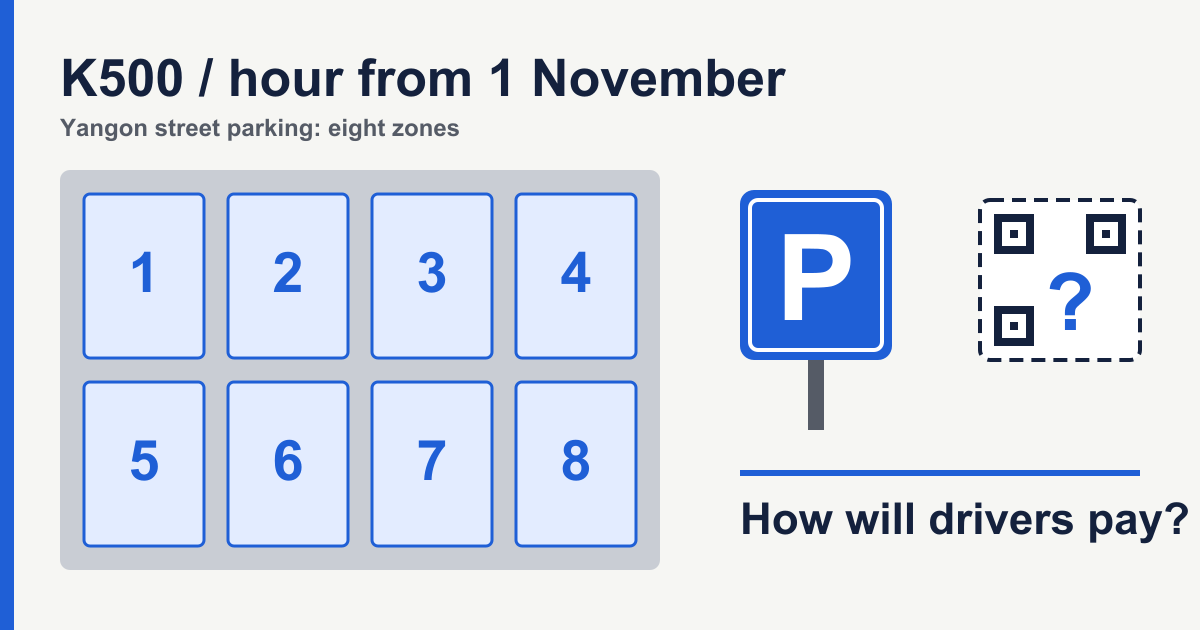
Parking fees will be introduced in downtown Yangon from 1 November 2026, according to the Yangon Region Government, as reported by Eleven Media on 30 October 2026. The report gives a price, hours, an area and a structure. It does not mention any app, mobile payment option or other way for drivers to pay. For a city whose authorities have been talking about a “smart parking system” since 2018, that omission is the most interesting part of the story.
This article sets out what the report says, places it against the earlier attempts, and is explicit about what we could not confirm. It was written two days before the stated start date, so some of the open questions may be answered very soon.
What the Yangon Region Government says is changing on 1 November
All of the following comes from Eleven Media, citing the Yangon Region Government:
- Fees are charged daily, from 8am to 6pm, at K500 per hour.
- An additional K300 applies for parking beyond the allotted time by up to 30 minutes, and an extension of up to 60 minutes incurs an additional K500.
- The area covered lies between Strand Road and Bogyoke Aung San Road, and between Yazadarit Road and Aung Yadana Road.
- The designated area is divided into eight zones.
- The service is operated through a tender system, with tenders invited through newspaper advertisements, according to the report.
Two readings of the overstay wording are possible. It could mean that K300 is added if you stay up to 30 minutes past your paid time and K500 if you stay up to 60 minutes past it. It could also describe a paid extension. The report does not settle which, so we are not going to guess. Drivers should wait for the operators’ own notices.
What the report does not say
The same report is silent on several things a driver would want to know. It does not say how fees are paid, whether there is an app, who the operators are, whether the tender has closed, what happens to someone who does not pay, whether residents are exempt, or which individual streets inside the boundary are included. We are not drawing conclusions from this silence. A short news item can leave out details that exist. But it means anything beyond the five facts above, including what the experience will be like on 1 November, is not yet public in the source we have.
We also do not state which townships the boundary falls in. The report describes the area by roads, and we have not matched those roads to township lines.
How this compares with the 2018 and 2020 plans
The new plan reads, as reported, more like the 2018 scheme than the 2020 one.
2018: eight zones, a tender, a flat rate. In October 2018, Yangon’s then mayor told the regional parliament that a tender had been run for eight parking zones across six downtown townships, at K200 per hour from 8am to 6pm daily, according to Eleven Media’s 2018 report. Only five of the eight zones had successful applicants, and he said tender contenders had negotiated among themselves over prices. The fees were to run from 1 November to 1 March while a modernised system was prepared. He also said the government had not collected parking fees since December 2014. We have not verified whether fees were actually collected under that scheme, and we are not claiming either way. The Irrawaddy reported in November 2019 that plans to reintroduce fees had been suspended in 2017 and 2018 because of implementation problems and public objections.
2019 to 2020: tiers, apps and phones. By late 2019 the language had changed. A city official quoted by state-run Myanmar Digital News said the system would use smart technology to collect parking fees, per its December 2019 report. The May 2020 report from the same outlet described three groups covering downtown blocks, naming Paradigm Technology for the first and Myanmar Gateway and Naung Yoe for the second, with a separate app for each block: Parking Yangon, Smart Parking @ Yangon and Flowbird. Payment was to be online or in cash, with rates of K500, K300 and K200 per hour by red, yellow and green street label, and drivers could check space availability and label colours on their phones. A pilot planned for 22 March to 4 April 2020 was suspended on 22 March because of COVID-19. The Irrawaddy had reported in January 2019 that a smart parking system with automated payment was already running in a few Mandalay townships, so the idea was not exotic. As for what happened next, CNI News wrote in June 2026 that the project was halted because of political transitions, and quoted observers calling for smart parking to be taken up again.
Set side by side, the 2026 announcement shares three things with the 2018 model: eight zones, a tender and a single hourly rate, though K500 rather than K200. It does not, as reported, mention colour tiers, apps or pay-by-phone, which were the defining features of the 2020 design. A single rate is also simpler to administer on paper, which may or may not be the reason.
What about the three 2020 apps?
We could not confirm the status of any of the three apps. When Myanmar Tech Press checked on 30 October 2026, the App Store listing for Parking Yangon returned a not-found error. That was an automated check and may not reflect all regions, so it does not tell us whether the app was withdrawn, renamed or simply unavailable where we checked. We have not established anything about Smart Parking @ Yangon or Flowbird’s Yangon service. Readers who installed any of them should not assume they will work, or not work, on 1 November.
What has changed since 2020: a national payment rail
The reason the payment question matters more now than in 2020 is that Myanmar has a shared QR payment standard. The Central Bank of Myanmar said MMQR passed 24 million users after launching on 28 February 2025, with more than 30 million transactions worth over MMK 12.7 trillion through the end of January 2026 and over 420,000 merchants, as reported by Eleven Media in February 2026. MMQR did not exist when the 2020 plan named a separate app for each block. Today a zone operator could in principle accept MMQR.
“In principle” is doing real work there. Nothing in the parking report says MMQR or any wallet will be accepted, and we do not know whether any operator plans to. Our own look at a comparable project is a cautionary example. The TollPass system on the Yangon-Mandalay Expressway launched on 17 September 2026 cash-only, with MMQR, KBZ Pay, AYA Pay and WAVE Pay said to be coming “soon” and no date given. That does not predict what will happen with parking, since a different authority is involved. It does show that the existence of a payment rail and the availability of it at the point of service are separate things.
Why the payment method matters more than the price
The price is the easy part of the announcement. The practical friction sits elsewhere. A driver who parks for an uncertain period, and who faces extra charges for overstaying, needs a way to extend and pay without having to return to the car. Whatever the method, three questions determine whether the system feels fair: can you pay for the time you actually use, can you get proof of payment, and what are the consequences if you cannot pay. The report addresses none of them.
There is also the background the 2019 reporting described. The Irrawaddy wrote that in many areas vehicle owners had been forced to pay illegal fees to unauthorised vendors, and that the city’s motives were congestion and revenue. It also cited about 600,000 of the more than one million vehicles registered nationwide as being in Yangon, a 2019 figure that we have not updated. A formal system replaces informal collection only if payment is easier and more trustworthy than the informal alternative.
What a driver can and cannot know before 1 November
Can know, from the report: the K500 hourly rate, the daily 8am to 6pm window, the road boundaries, the eight-zone structure and the K300 and K500 overstay amounts.
Cannot yet know: how to pay, which operator runs which zone, whether the tender has closed or who has won it, what happens if you do not pay, whether residents are treated differently, and whether the 1 November start goes ahead as announced. Earlier attempts in 2017 and 2018 were suspended, so a delay is not unthinkable, though we have no information that one is planned.
Sensible approach: look for signs and notices in the zone on the day, and keep some cash on hand until you see what is accepted. That is practical advice, not a prediction that the system is cash-only.
Frequently asked questions
When do Yangon parking fees start?
1 November 2026, according to the Yangon Region Government as reported by Eleven Media on 30 October 2026.
How much does it cost to park in downtown Yangon?
The report says K500 per hour, charged daily from 8am to 6pm, with additional K300 and K500 amounts tied to staying beyond the allotted time. The exact application of those extra amounts is not spelled out in the source wording we have.
Can I pay by mobile app or QR code?
The report does not say. It mentions no app and no payment method. Nothing we have seen confirms or rules out QR or wallet payment.
Does the old Parking Yangon app still work?
We could not confirm. The App Store listing returned a not-found error in an automated check on 30 October 2026, which may not reflect all regions. We could not confirm the status of the other two apps named in 2020 either.
Which streets are covered?
The report describes the area between Strand Road and Bogyoke Aung San Road, and between Yazadarit Road and Aung Yadana Road. It does not list individual streets or say whether numbered streets are included.
What to watch next
Three things will tell us whether this time is different from 2018 and 2020. First, whether operators and a payment method are published before or soon after the start. Second, whether the start actually happens on 1 November. Third, whether the system accepts the national QR payment standard or leaves it for later, as the expressway toll did. Years of announcements have produced a lot of plans and few results we can verify. The 2026 version is the plainest design described so far, and it arrives with better payment infrastructure than any earlier attempt had, which makes how drivers will pay the question to watch.
Sources: Eleven Media, “Yangon to introduce parking fees from November 1”, 30 October 2026 (link). Eleven Media, “Govt. calls for parking zone tenders”, 10 October 2018 (link). The Irrawaddy, “Yangon Municipal Body Invites Firms to Participate in Smart Parking Project”, 22 January 2019 (link). The Irrawaddy, “Parking Fees to Be Reintroduced in Myanmar’s Biggest City, Yangon”, 19 November 2019 (link). Myanmar Digital News, “Smart car parking system to be implemented in Yangon”, 8 December 2019 (link). Myanmar Digital News, “Smart car parking system to cover six townships in downtown Yangon city”, 3 May 2020 (link). CNI News, “How to Solve Yangon’s Parking Problem”, 4 June 2026 (link). Eleven Media, “Over 24 million users adopt MMQR since launch in February 2025: CBM”, 21 February 2026 (link). Myanmar Tech Press, TollPass on the Yangon-Mandalay Expressway, 10 October 2026 (link). App Store listing for Parking Yangon, automated check by Myanmar Tech Press, 30 October 2026.