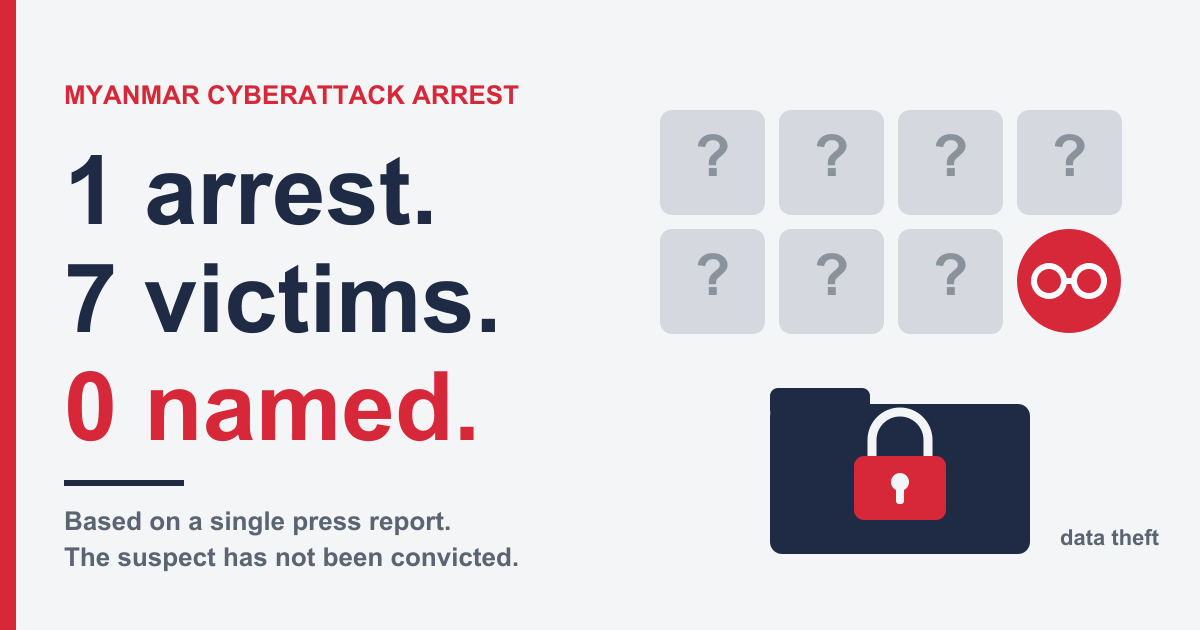
Myanmar authorities have announced the arrest of a man they say was behind a string of data-theft and extortion attacks on government and private online services this year. According to a report credited to Eleven Media and carried by Malaysia’s The Star on 11 October 2026 (via the ANN network), the suspect, Wai Phyo Aung, also known as Aung Myo, was arrested on 10 September 2026. Search listings also show a story in the state-run Global New Light of Myanmar (GNLM) under the headline “Cybercrime Suspect Held for Attacks on Government, Private Online Services”, but we were unable to open that page ourselves. Everything below rests on the authorities’ account as relayed in that press report; we could not find independent confirmation, and the man has not been convicted of anything. Where this article says “alleged”, it means exactly that.
The announcement lists seven categories of target, from a college to a government online service, but names not one of them. That includes a telecommunications website and the website of a private digital payment system, both reportedly hit in the second week of August. This article looks at what was said, what was left out, and what ordinary users can reasonably do while the gaps remain.
What did Myanmar authorities actually announce?
According to the report, during 2026 government department networks, private online service providers and some private digital payment systems were subjected to cyberattacks. The attackers allegedly threatened to publish users’ personal information online and demanded money in return for handing back the stolen data. The report describes the activity as unauthorised access to data plus extortion. It does not describe a technique such as ransomware or a denial-of-service flood.
The alleged timeline, as given in the report, runs like this:
- First week of June 2026: student accounts at an international college in Myanmar, and a Myanmar-based job-search website.
- Second week of June: student information at a foreign university operating in Myanmar.
- Second week of July: a vehicle-rental brokerage website.
- Second week of August: a telecommunications website and the website of a private digital payment system.
- First week of September: a government online service website.
The report says such attacks “have had a significant impact on the development of the government’s e-Government system”, and it urges the public to report information confidentially to the relevant security agencies.
What is missing from the announcement?
The gaps are the more interesting part, and they are worth listing plainly, because each one affects what a reader can do with the news.
- No victim is named. Not the college, not the job site, not the telecom, not the payment service, not the government service.
- No statute is named. The report refers generally to cybersecurity laws and says legal action is being taken.
- No agency or official is named as the source of the announcement in the version we reviewed.
- No method, amount or outcome. There is no figure for how much was demanded, no statement on whether anyone paid, and no count of how many people’s records were taken.
- A month-long gap. The arrest is dated 10 September, while the report appeared on 11 October. We note the interval without speculating about the reason; it may be routine.
Taken together, this is an arrest announcement that tells the public who was caught but not who was harmed.
Why does it matter that the telecom and payment victims are unnamed?
The college, the job site and the vehicle-rental site each hold personal data, but the telecom and payment services are different in kind. A telecom website typically sits next to subscriber identity and phone-number records. A digital payment website sits next to wallet accounts. In Myanmar, where mobile numbers are tied to registered identities and wallets are widely used for everyday transfers, the data from either kind of service is the sort that makes phishing and impersonation more convincing.
The report says the data of these services was taken in the second week of August. A customer reading the announcement therefore cannot tell whether they are one of the people whose information was alleged to have been stolen, or whether they should change a password, watch for suspicious messages, or do nothing. We are not suggesting which company is involved. The report does not say, and guessing would be unfair to every provider in those sectors.
Is there a duty to tell affected users?
Myanmar’s Cybersecurity Law (Law No. 1/2025) was enacted on 1 January 2025 and, according to Tilleke & Gibbins’ 1 August 2025 update, took effect on 30 July 2025. The firm’s January 2025 summary says “cyber misuse”, including unauthorised control of computer systems or electronic data, carries imprisonment of six months to three years, a fine of MMK 1 million to 20 million, or both.
What the summaries we reviewed do not describe is any obligation on a company to report an incident or to notify the people whose data was exposed. We are not claiming that no such duty exists anywhere in Myanmar’s legal framework; we are saying only that the law summaries we read describe none, and we are not lawyers. The practical consequence is the same either way: as far as we could find, nothing in the public record in this case shows users being told.
The Irrawaddy has separately reported (6 August 2025) that the law criminalises VPN use and gives authorities broad power to access user data. That context matters for how readers weigh official crime announcements: the same law that penalises unauthorised access by hackers also, by The Irrawaddy’s account, gives the authorities wide access to user data.
How does this compare with the bank breach claims earlier this year?
Our 28 September 2026 article on bank ransomware listings covered a different set of events. In June 2026 the group calling itself LAPSUS$ claimed to have taken more than 120GB from AYA Bank, and AYA Bank acknowledged that an old application portal had been compromised, not its core banking, AYA Pay or cards. In late August a group called The Crew listed KBZ Bank and AYA Bank; KBZ Bank denied any breach.
To be clear, no source we found links the man arrested in this case to LAPSUS$, The Crew, AYA Bank or KBZ Bank, and this article does not either. The comparison is about disclosure, not about who did it.
Set side by side, the two episodes show opposite problems. In the bank cases, a named company spoke publicly (one acknowledged a limited breach, one denied). In the arrest case, the authorities have spoken publicly but the companies have not been identified. Readers get half of the picture in each situation. The pattern worth watching is whether any organisation named in future claims, or any of the unnamed seven, ever confirms to its own customers what happened.
What can users do in the meantime?
Without knowing whether you are affected, it is sensible to act as though your details could be in circulation, particularly if you used a telecom or payment website during the summer.
- Change passwords on accounts that share a password with any online service you used in June to September, and turn on two-step verification where it is offered.
- Treat unexpected calls or messages that quote your name, number or wallet details with suspicion, even when they sound well informed. Stolen data is what makes such messages convincing.
- Never pay or negotiate with anyone who claims to hold your data. The report itself describes extortion as the motive.
- If you run a service that may have been involved, tell your users plainly what was taken, even if no rule makes you.
Frequently asked questions
Who was arrested in the Myanmar cyberattack case?
According to the authorities, as reported by Eleven Media/ANN and carried by The Star on 11 October 2026, the suspect is Wai Phyo Aung, also known as Aung Myo, arrested on 10 September 2026. He has not been convicted, and the account has not been independently confirmed.
Which companies were attacked?
The announcement does not say. It describes a college, a job-search website, a foreign university, a vehicle-rental brokerage website, a telecommunications website, a private digital payment system’s website and a government online service. None is named, and we will not guess.
Were passwords or payment details stolen?
The report says attackers threatened to publish users’ personal information and demanded money to return stolen data. It does not specify what kinds of data were taken from which service, or how many people were affected.
Does Myanmar’s Cybersecurity Law require companies to notify affected users?
The law summaries we reviewed, by Tilleke & Gibbins, describe penalties for unauthorised access but no duty to report incidents or notify users. That is a statement about those summaries, not a legal opinion that no such duty exists.
Is this arrest linked to the LAPSUS$ or The Crew claims against banks?
No source we found says so. The two sets of events should be treated as separate unless an authority or a credible report establishes otherwise.
Bottom line
This is a single-source, official account of an alleged arrest, and it should be read that way. It does confirm something useful: extortion over stolen user data, including at a telecom website and a digital payment site, is being treated as a criminal matter. But an arrest announcement that leaves seven victims anonymous gives users nothing to act on. Until the affected organisations, or the authorities, say more, the practical advice is the unglamorous kind: tighten your own account security and be wary of anyone who seems to know too much about you.
Sources: The Star (Malaysia), crediting Eleven Media/ANN, 11 October 2026, Myanmar arrests man for cyberattacks on government networks, private online services and digital payment systems; Global New Light of Myanmar, October 2026 (exact date not confirmed; listed in search results, page could not be opened by us), Cybercrime Suspect Held for Attacks on Government, Private Online Services; Tilleke & Gibbins, 9 January 2025, Myanmar Issues Cybersecurity Law; Tilleke & Gibbins, 1 August 2025, Myanmar Cybersecurity Law Takes Effect; The Irrawaddy, 6 August 2025, Myanmar junta launches street phone checks as Cybersecurity Law takes effect; Myanmar Tech Press, 28 September 2026, Myanmar banks and ransomware listings.