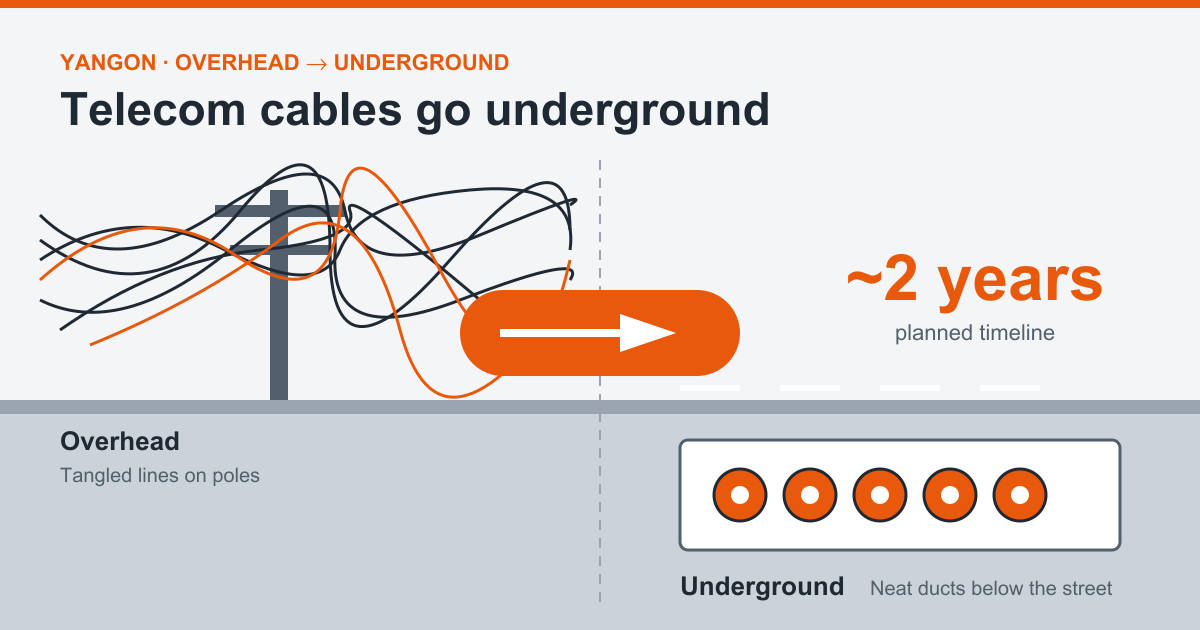
The Ministry of Digital Development and Communications (MoDDC) plans to gradually replace the overhead telecom cable lines across Yangon with underground cable networks over roughly two years, according to a report published by the state-run Global New Light of Myanmar (GNLM) on 24 November 2026. The ministry, as quoted by GNLM, says the aims are to improve the urban landscape, clear tangled wires and reduce fire risk. Work is to begin in areas such as Dagon Myothit (North) and South Okkalapa townships rather than in downtown Yangon.
This is not the first time the idea has surfaced this year. A Yangon Region Government plan was reported in May, a deadline for clearing fiber along Kabar Aye Pagoda Road was set in June, and MPT issued a notice about unauthorized fiber on its poles in February. This article puts the new announcement next to those earlier steps, explains what could change for people who pay for home internet in Yangon, and lists what the announcement does not say. One caution up front: both GNLM and the Myanmar Digital News (MDN) report cited below are state-run media, so what follows describes the authorities’ stated intentions, not independently verified progress.
What exactly did the ministry announce?
According to GNLM, the ministry will phase out overhead telecom lines in Yangon under a long-term plan, replacing them with underground networks. The ministry also instructed telecom operators to use equipment that meets prescribed standards and to follow established procedures when installing cables in the city, and to provide quality services at reasonable and affordable rates.
On sequencing, GNLM reports that the work will start in areas such as Dagon Myothit (North) and South Okkalapa rather than downtown, where limited space and lengthy permit processes could delay implementation. The conversion is expected to take approximately two years. The ministry also said the work will take into account underground drainage systems, building conditions, and the difficulty of locating and repairing faults in underground cables.
Note the wording “areas such as”. The report names two townships as examples. It does not present a closed list, so it would be a mistake to read it as a complete schedule.
How does this compare with the plan reported in May?
MDN reported on 21 May 2026 that the Yangon Region Government planned to convert overhead telecom lines across the region into underground cable networks, following a coordination meeting on 10 May at the Yangon Region Government Office. Relevant departments and telecom companies were to implement it jointly. The reported order was: first the four Dagon Myothit townships, then surrounding townships such as South Okkalapa and North Okkalapa, with authorities also planning to continue the project in downtown Yangon. MDN also said that some existing cables were reportedly substandard, vulnerable to weather damage and at risk of causing fires because of overcrowded installations.
Set side by side, a few differences stand out:
- Lead agency. The May report described a regional government plan. The November report attributes the plan to the Union-level ministry. This may simply reflect coordination between the two, and neither report explains the change, so it is best treated as an open question.
- Downtown. In May, downtown Yangon was a later phase that authorities “also plan to continue”. In November, it is described as a place where limited space and lengthy permits could cause delays. That is a more cautious framing of the same area.
- Starting area. May named four Dagon Myothit townships, then Okkalapa. November names Dagon Myothit (North) and South Okkalapa. Because GNLM says “areas such as”, the starting area may not actually be narrower. The two reports use different levels of detail, and the safest reading is that the broad direction (outer townships first, downtown later) is consistent.
- Timeline. The May report gave no overall duration. The November report adds roughly two years, which is the first time frame attached to the plan in the reports we reviewed.
Is this part of a longer cleanup drive?
It looks like it. Three earlier items fit the same pattern of clearing Yangon’s crowded poles.
MPT’s notice (February 2026). MPT stated on its official site that it had found fiber cables installed without permission on MPT-owned poles in Yangon Region. It noted that a notification on unauthorized fiber deployment had first been issued through the Mirror newspapers on 27 November 2021. Companies with illegally installed fiber in Sauchaung and Tamwe townships were told to remove the cables between 24 February and 10 March 2026; otherwise, MPT said it would remove all illegal fiber cables effective March 2026 and take legal action. So the problem of unpermitted cable on poles dates back at least to 2021.
Kabar Aye Pagoda Road (June 2026). Eleven Media Group reported that a meeting on 8 June 2026 dealt with systematic management of telecom infrastructure in Yangon Region and the removal and underground installation of fiber cables along Kabar Aye Pagoda Road. Attendees included the Yangon Region Minister for Electricity, Energy, Industry and Transport, Dr. Myo Thaw, the Communications Network Expansion Coordination Committee, No. 1 Advanced Signals Battalion, four major telecom operators, Eager Company and ISPs. The minister reportedly told them to split the work into two teams so that the tangled-cable clearance would be finished by the end of June. We found no follow-up report confirming whether that deadline was met.
That last point matters for judging the new two-year target. A short, specific deadline on a single road produced no public confirmation of completion that we could find. A two-year, city-wide program is a far larger undertaking, so readers are entitled to ask how progress will be reported this time.
What could change for subscribers?
The ministry’s stated benefits are visual and safety-related: fewer tangled wires and a lower fire risk. For a household, the practical effects depend on details the announcement does not give, but the ministry has itself acknowledged one trade-off.
Repairs may become harder. GNLM quotes the ministry as saying the work will take into account the difficulty of locating and repairing faults in underground cables. That is a candid admission. With overhead lines, a technician can usually see a damaged span and fix it from a pole. Buried cable has to be located first and then reached. For subscribers, the question is not whether faults will happen but how long an outage will last when they do. The announcement says nothing about repair-time targets or how fault location will be handled.
Disruption during the switch. Moving a customer’s connection from a pole to a duct normally involves some interruption. The announcement does not say whether service will be cut over in stages, how customers will be notified, or what happens to a household that is mid-contract during the work.
Prices. The ministry told operators to offer quality service at reasonable and affordable rates. Yet the same report does not say who will bear the cost of digging and laying ducts. If operators pay, some may try to recover it through tariffs; if the government pays, it is unclear from which budget. Until that is answered, the instruction on affordable rates is a statement of intent, not a guarantee.
A note on outage concerns (separate issue)
Subscriber worries about outages and billing are real in Yangon. In November 2025, home Wi-Fi was unstable for almost a week from around 1 November, which ISPs attributed to damage to undersea fibre cables, as reported by The Star (Malaysia) via ANN. A North Dagon resident quoted in that report complained that bills still arrived on time and wondered about compensation. To be explicit: that outage involved undersea cables, not overhead lines, and it has no direct connection to this underground plan. We mention it only to show the kind of concern subscribers carry into any discussion of faults and repair times.
What does the announcement leave out?
The GNLM report does not state the following:
- A start date. The only time frame is “approximately two years”.
- A budget. No cost figure is given.
- Who pays. It is unclear whether operators and ISPs, the government, or both fund the work, and whether costs could reach subscriber bills.
- Which operators are involved. The June meeting mentioned four major operators and ISPs, but the November report does not name participants.
- The standards. Operators must use equipment “meeting prescribed standards”, but the standards are not listed.
- Whether Kabar Aye Pagoda Road was finished. No follow-up to the June deadline was found.
- What happens to smaller ISPs. The report does not say how providers that currently run cables from poles to homes would reach customers once lines are buried, or whether ducts will be shared on equal terms.
- Service interruptions during migration and any repair-time commitments, as discussed above.
- The full township list. Because the report says “areas such as”, the complete order of work is unknown.
Our view: sensible in direction, thin on accountability
Burying cables is a common way for cities to deal with overloaded poles, and the stated aims of tidier streets and lower fire risk are reasonable. Starting in outer townships where space is available, instead of the congested downtown, is also a pragmatic choice, and the ministry’s own mention of permit delays and tight space downtown is a fair acknowledgment of the hard part.
What is missing is the information that would let the public hold the program to its word: who pays, when it begins, which operators are in, and how progress will be reported. The June deadline with no visible follow-up shows why that matters. We would watch for three things: a published schedule by township, any statement on who funds the ducts, and whether affected households receive notice before cutovers. If the ministry or operators publish more detail, those are the points to check first.
Frequently asked questions
Will my home internet in Yangon be cut when the cables go underground?
The announcement does not say. Moving connections from poles to ducts usually involves some interruption, but the ministry has not described how cutovers will be scheduled or communicated.
Which parts of Yangon will be done first?
According to GNLM, areas such as Dagon Myothit (North) and South Okkalapa townships are first, not downtown. “Areas such as” suggests the list is not complete. In May, the regional government had named the four Dagon Myothit townships, then Okkalapa, with downtown later.
How long will the conversion take?
The ministry expects approximately two years, according to GNLM. No start date was given.
Who is paying for it?
Not stated. The report gives no budget and does not say whether operators, ISPs or the government will fund the work, or whether costs could affect subscriber bills.
Will faults take longer to fix?
The ministry itself says the plan will consider the difficulty of locating and repairing faults in underground cables, which points to a real trade-off. No repair-time targets were announced.
Summary
The ministry’s plan to move Yangon’s telecom cables underground over about two years continues a year of cleanup steps: MPT’s February notice on unauthorized pole fiber, the May regional plan, and the June Kabar Aye Pagoda Road deadline, whose outcome we could not confirm. The November report keeps the same broad direction of outer townships first and downtown later, while adding a time frame and a frank note about harder fault repairs. It leaves out the start date, budget, payer, operator list and standards, which are the details subscribers most need. Both main sources are state-run media, so independent confirmation of progress will be worth looking for.
Sources: Global New Light of Myanmar, “Yangon Phases Out Overhead Telecom Cables”, 24 November 2026, https://www.gnlm.com.mm/yangon-phases-out-overhead-telecom-cables/ (state-run). Myanmar Digital News, “YR to introduce underground telecom cable network across city”, 21 May 2026, https://mdn.gov.mm/my/node/204921 (state-run). Eleven Media Group, “Yangon targets end-of-June deadline for Kabar Aye Pagoda Road fiber cable clearance”, 11 June 2026, https://elevenmyanmar.com/node/312614. MPT, “Notification to Internet Service Providers (Fiber Cable)”, 24 February 2026, https://mpt.com.mm/en/notification-to-internet-service-providers-fiber-cable-en/. The Star (Malaysia)/ANN, “Prolonged Wi-Fi internet disruptions continue in Yangon for nearly a week”, 8 November 2025, https://www.thestar.com.my/aseanplus/aseanplus-news/2025/11/08/prolonged-wi-fi-internet-disruptions-continue-in-yangon-for-nearly-a-week (background on undersea cable outage only).