A commentary published on 23 November 2026 by FULCRUM, the blog of Singapore’s ISEAS – Yusof Ishak Institute, tries to do something Myanmar’s own announcements rarely do: put a series of separate-looking measures into one frame. In “Myanmar’s Foreign Exchange Controls Compound Challenges” (commentary 2026/315), authors Sai Lone of the University of Exeter Business School and Jared Bissinger of the ISEAS Myanmar Studies Programme argue that border-trade limits, restrictions on mobile payment apps abroad, passport rules for citizens overseas and pressure on migrants to remit through the state system all belong to one strategy of economic control.
Myanmar Tech Press has covered several of those threads one at a time since August. This article does not repeat the commentary. It reads it from the payments-technology side, because that is where we think the argument bites hardest: mobile wallets are the channel where the pressure lands. Everything attributed to the commentary below is the authors’ view, not established fact, and we say so each time.
What the commentary actually argues
According to the authors, the regime has intensified a set of measures since August 2026 that “at first glance appear to be unrelated.” They list border-trade restrictions, restrictions on the overseas use of Myanmar mobile payment services, tighter passport procedures for citizens abroad, pressure on migrants to remit via the state-controlled system, and efforts to attract foreign direct investment. Their reading is that the regime is “doubling down on a strategy of economic control,” and that these measures are not likely to address the drivers of the foreign-exchange problem.
On wallets specifically, the authors write that KBZPay, Wave Money, AYA Pay and CB Pay have “reportedly” faced new restrictions on overseas use. They explain that migrant workers and their families use these services to move money outside official banking channels because the services offer better exchange rates, meaning more kyat for the same amount of foreign currency. They write that the restrictions aim to regulate digital payments and “can be seen as part of a broader effort” to prevent foreign exchange from bypassing the regime-controlled financial system.
Why mobile wallets are where the pressure lands
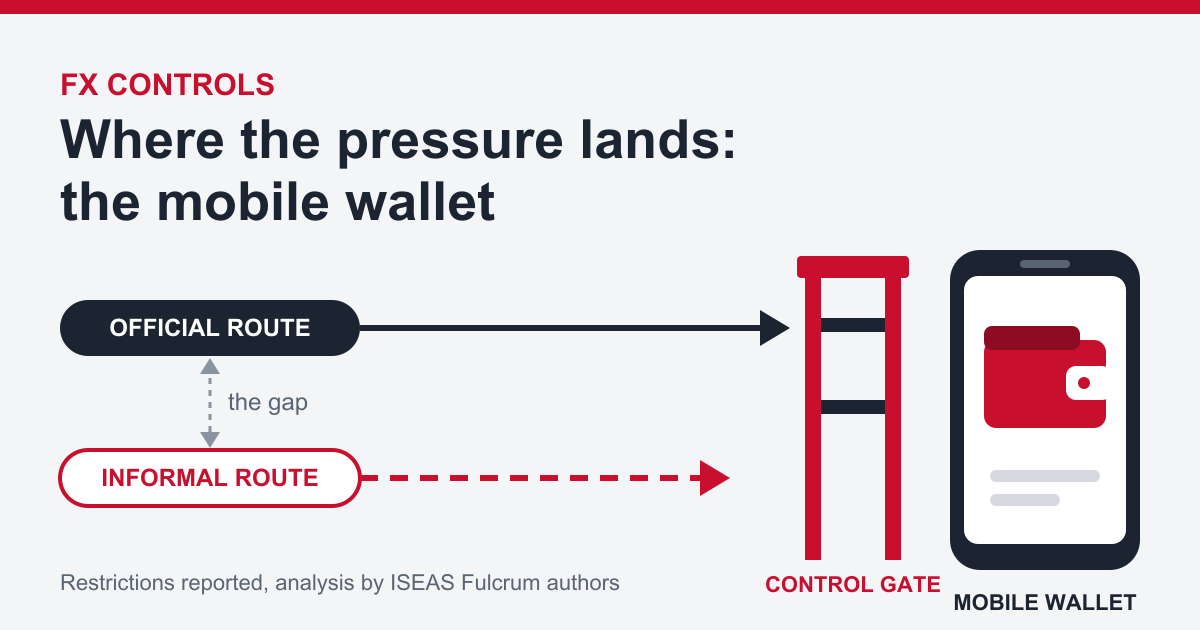
The authors’ logic maps neatly onto how payments actually work. A remittance has to travel on some rail. If the rate on the official rail is unattractive, senders look for another rail, and in Myanmar the most convenient alternative for a household can be an app that is already on the recipient’s phone. That makes wallets the visible, regulated, centrally switchable part of an otherwise informal flow. A bank can be told to block a card or an app; it is much harder to instruct a network of informal money movers.
We reported in September that the Central Bank of Myanmar had reportedly ordered banks to block K-Pay, Wave Money, AYA Pay and CB Pay from working overseas, citing a report from moemaka.net dated 28 August. See our earlier piece, CBM reportedly orders overseas mobile payment apps blocked, for what was and was not confirmed at the time. The commentary now uses the same word, “reportedly,” which suggests that, nearly three months later, there is still no clear public confirmation of how, or whether, the block is being enforced.
Why controls on the channel do not change the incentive
This is the part of the commentary we find most useful. The authors put it this way: the migrant worker remittance rate and the official rate are overvalued by 20% and 120% respectively, and say this discourages sales of foreign currency through official channels, with inflows through the state system declining. We cannot verify those estimates independently, and we are not publishing any market exchange rates of our own. But if the authors’ framing is right, the implication for payments is simple: restricting a channel does not remove the reason people chose it.
If the gap between what the official system pays and what users can get elsewhere persists, blocking one app tends to push the same demand to another route. For a wallet operator, that means the compliance burden and the reputational exposure fall on them, while the underlying incentive stays where it was. The authors also make a broader point that controls can conserve foreign exchange but cannot generate it, giving the example that the garment industry depends on imports for 95% of its inputs.
The 25% remittance proof and the passport rules
The commentary notes that in August the authorities promoted the Family Remittance Management System, run with the Central Bank of Myanmar, banks and licensed overseas employment agencies, to monitor migrants who remit 25% of their salaries through official channels. It also says embassies in Bangkok, Singapore and Australia have suspended or delayed passport services, forcing some applicants to seek clearance from Naypyidaw or return home.
That is a different claim from the one we reported on 16 November. In embassy remittance and passport rules, we covered reports that embassies in Singapore, Hong Kong and Macau require proof of 2% income tax and of 25% of the last three months’ income remitted through official channels to renew Passport for Job (PJ) passports, citing The Irrawaddy and BNI. The two sets of embassies and the two kinds of measure (suspension or delay versus a receipt requirement) are not the same, and we are not merging them.
Where official channels and wallets meet: the formal corridor question
This is where our own reporting adds something the commentary does not. In August we wrote about the Malaysia-to-Myanmar remittance corridor that Wave Money and Merchantrade announced on 1 July: a formal route run by a Malaysian remittance operator and a Myanmar wallet company, not an informal money-transfer network. A migrant worker using it is sending money through a formal provider, yet the transfer can land in a Wave Wallet, the same kind of product the commentary says has faced restrictions abroad.
The question is whether a transfer through a formal wallet corridor like this one would be accepted as proof of the 25% remittance at an embassy. We have not seen the authorities say. The commentary does not address it. Our 16 November article flagged the same open question, and nothing we have found since answers it. For a worker deciding where to send money, that ambiguity is not academic.
The central bank’s FX platform and the FATF backdrop
Two other threads from our archive sit on the same map. On 6 November we wrote about the CBM’s warning against unlicensed foreign-exchange traders, which also reported that roughly US$2.2 billion had been sold to importers through the central bank’s FX Online Trading Platform, a figure carried by Eleven on 6 November. That is the official side of the picture: a state-run channel positioned as the legitimate place to trade.
The other is international. On 4 November we reported that Myanmar remains on the FATF blacklist, and that the FATF has said that, when enhanced due diligence is applied, flows such as remittances should be neither disrupted nor discouraged. The commentary does not make this link, so it is our observation, not the authors’: measures that squeeze remittance channels sit awkwardly beside that FATF language, and it is worth watching how the two are reconciled.
What is still unknown
- Enforcement status of the overseas wallet block. Both our September reporting and the commentary use “reportedly.” We have no confirmed picture of which apps are affected, in which countries, or for which transaction types.
- Whether formal wallet corridors count as “official” for the 25% proof. Wave Money–Merchantrade is the obvious test case. No published guidance that we have seen addresses it.
- Any published numbers. We have found no official data on remittance volumes through wallets, through banks or through the Family Remittance Management System, so the commentary’s claim that state-channel inflows are declining is the authors’ assessment rather than something we can confirm.
- The reason for the wallet restrictions. The authors write that they can be seen as part of an effort to keep foreign exchange inside the controlled system. We have not seen the authorities state a rationale, so that remains the authors’ interpretation.
Frequently asked questions
Are KBZPay and Wave Money restricted abroad?
Reportedly, but we cannot confirm it. The commentary says KBZPay, Wave Money, AYA Pay and CB Pay have “reportedly” faced new restrictions on overseas use, and our September report relied on one original report (MoeMaKa, 28 August). Enforcement has not been publicly confirmed.
Why would the authorities target mobile wallets?
The commentary’s authors argue that wallets are used to move money outside official banking channels because they offer better exchange rates, and that the restrictions can be seen as part of an effort to stop foreign exchange bypassing the regime-controlled system. That is their reading; no official explanation was cited.
Does the 25% remittance rule apply to all migrant workers?
The commentary describes the Family Remittance Management System as a way to monitor migrants remitting 25% of salaries through official channels. Separately, we reported that some embassies ask for proof of 25% of the last three months’ income to renew passports. Details of who is covered and how they are enforced vary by report, so check with your embassy.
Will a transfer through Wave Money’s Malaysia corridor count as official?
Not known. The Wave Money–Merchantrade corridor is a formal service run by two companies, but we have found no statement on whether such transfers are accepted as proof for embassy requirements.
Do controls on the app solve the foreign-exchange shortage?
The authors say no. They write that controls can conserve foreign exchange but cannot generate it, and that the measures are unlikely to address what drives the problem.
What to take from this
The value of the commentary is the frame: border trade, wallets, passports and remittance monitoring read as one policy direction rather than four unrelated stories. The FX platform is a fifth thread from our own archive; the commentary does not discuss it. Our contribution is a narrower observation about technology. Wallets are where the pressure lands because they are the visible, switchable channel for money that users send where the rate is better, and a restriction on the channel does not alter the incentive the authors describe. What would settle the debate is data and clarity, specifically published enforcement status, guidance on formal wallet corridors, and real transfer volumes. Until those appear, workers, families and wallet providers are operating on reports and inference. We will update this page if any of the open questions above get an official answer.
Sources: Sai Lone and Jared Bissinger, “Myanmar’s Foreign Exchange Controls Compound Challenges,” FULCRUM (ISEAS – Yusof Ishak Institute), commentary 2026/315, 23 November 2026, fulcrum.sg. Earlier Myanmar Tech Press reporting: Wave Money and Merchantrade corridor (27 August 2026, citing Wave Money’s media center, 1 July 2026); overseas payment app block (9 September 2026, citing moemaka.net, 28 August 2026); FATF blacklist (4 November 2026); CBM FX platform (6 November 2026, citing Eleven, 6 November 2026); embassy remittance and passport rules (16 November 2026, citing The Irrawaddy, 10 November 2026, and BNI, 14 November 2026).