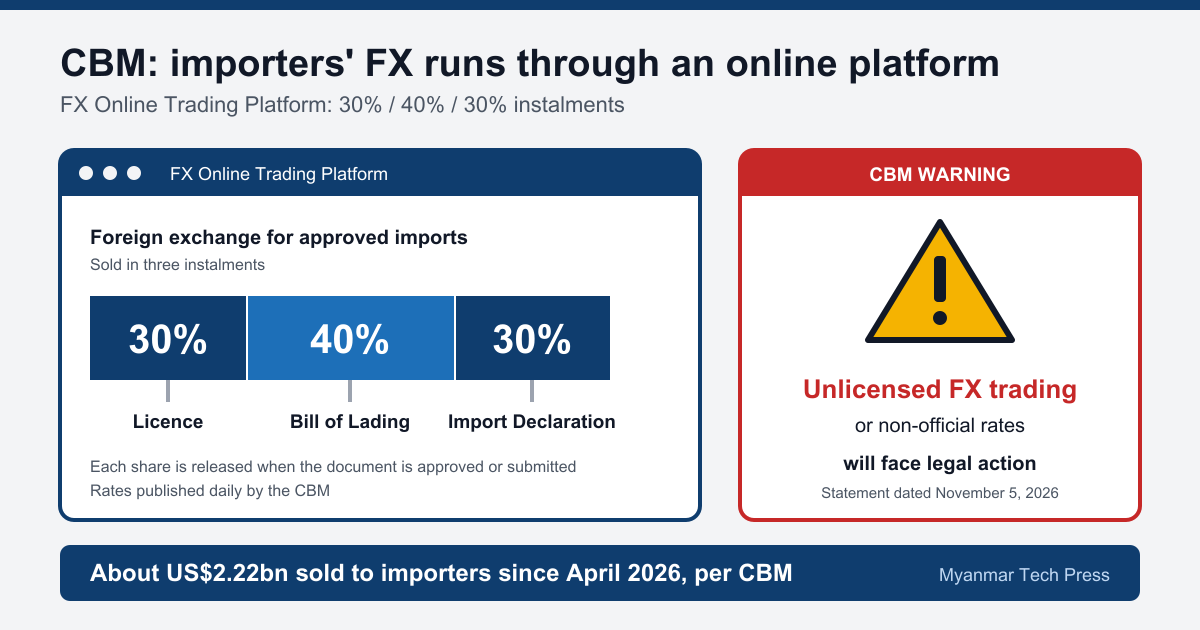
The Central Bank of Myanmar (CBM) issued a statement dated November 5, 2026, warning that anyone buying, selling or exchanging foreign currency without a licence, or at rates other than the official ones, will face legal action. The statement was reported by Eleven Myanmar, whose article carries a publication date of November 6, 2026 (source). A companion Eleven Myanmar report published the same day says the CBM now permits importers to make advance payments and will sell foreign exchange for approved imports in three instalments (source).
A note on sourcing: we did not obtain the CBM’s original statement. Everything below is attributed to the CBM as reported by Eleven Myanmar, and we have not independently verified the figures. This is not a technology story in the narrow sense, but it belongs on a Myanmar tech site for one reason: the exchange rate is now being administered through an online platform, and the warning is aimed at everything that happens outside it. In the past, that has included foreign exchange trading arranged through social media.
What exactly did the CBM announce?
According to the report, the warning applies to “individuals and organizations involved in buying, selling or exchanging foreign currencies without an official licence, or failing to comply with officially prescribed exchange rates.” The CBM said it will take “effective legal action” under the Financial Institutions Law, the Foreign Exchange Management Law and other applicable legislation, “particularly” against those deliberately intended to undermine exchange rate stability. The report also says money changers, banks and customers must use the rates prescribed by the CBM, which are published daily on the CBM website and in state newspapers.
The statement also gave sales totals. From April 2026 to November 5, the CBM says it sold the following to importers through the FX Online Trading Platform and authorised dealer (AD) licensed banks:
- about US$2.2212 billion
- 1.9071 billion yuan
- 6.7128 billion baht
- 74.5 million rupees
Separately, the report cites “approximately US$1.703 billion to support imports of fuel, edible oil, fertilisers and other essential commodities.” The report as we have it does not say how this figure relates to the US$2.2212 billion total, so we are not treating one as part of the other.
What changes for importers: the 30/40/30 instalments
The companion report describes how foreign exchange for imports “deemed necessary for the country will be scrutinized and sold in three instalments”:
- 30% when the import licence is approved
- 40% when the Bill of Lading is submitted
- 30% when the Import Declaration is submitted
The CBM’s stated aims, as reported, are to give importers timely access to foreign exchange, reduce delays in payments to overseas suppliers, prioritise genuine trade, and stabilise the foreign exchange market.
The headline calls this “advance payments”, and the advance element is the first tranche: 30% becomes available at licence approval, the earliest of the three steps and, in our reading, typically before goods ship. That is useful to an importer who must pay a foreign supplier up front. The remaining 70% is released only as shipping and customs paperwork appears.
Our reading: a paper trail built into the release schedule
This section is our interpretation, not something the CBM said. Tying each tranche to a document (licence, Bill of Lading, Import Declaration) means that every dollar sold to an importer can be matched to a step in a real shipment. That makes it harder to buy foreign currency on paper for imports that never arrive. It also produces records that a bank or regulator can audit later.
That matters in the context of our November 4 article on Myanmar remaining on the FATF blacklist. Anti-money-laundering reviews focus on whether funds can be traced to legitimate trade. We do not know whether this was a motive for the change, and the CBM’s stated aims do not mention it. But a document-linked release schedule is the sort of control that examiners tend to look for.
Why a tech site is covering this: platform plus enforcement
The pattern is a two-part structure. Inside the system is an online platform, where importers buy foreign currency at published daily rates through authorised banks. Outside it is everything else: money changers without licences, and trading carried out informally, including via social media.
This is not the first time the CBM has gone after the online side. In January 2025, Eleven Myanmar reported that the CBM was pursuing 12 Facebook groups, 5 pages and 10 individuals over illegal foreign exchange trading on social media, with 9 individuals charged and 6 prosecuted, and that it was also investigating hundi networks (source, January 15, 2025). That report also described the CBM supplying foreign currency to importers through online trading platforms as part of the same effort.
It also fits the direction we covered earlier when the CBM reportedly ordered banks to block mobile payment apps from working overseas. Taken together, the official channel is being made more digital and more traceable, while unofficial digital channels are being treated as enforcement targets. Whether that is a deliberate strategy or a series of separate responses, the outside observer cannot say from public information.
What the announcement does not tell us
Several questions matter to anyone who trades, imports or sends money, and the reports we reviewed do not answer them.
- How far is the official rate from the market rate? The reports give no figure. Any enforcement of “prescribed rates” is only as effective as the gap between official and street prices is small, or the penalty for using the street price is large. We will not guess at a number.
- Can small traders use the platform? The sales are described as going through the platform and AD-licensed banks to importers. The reports do not say what size of business qualifies, or whether a small trader without a bank relationship can participate.
- Does the three-step split slow imports? Releasing 70% only after shipping documents are submitted could create cash-flow gaps for importers who must pay suppliers earlier. The first 30% helps, but we do not know how suppliers will accept those terms in practice.
- What does “advance payment” mean in practice? The reports do not explain how the first tranche interacts with a supplier’s payment terms, such as deposits or letters of credit.
- What counts as “necessary” imports? The “deemed necessary” language implies prioritisation. The criteria were not given.
Frequently asked questions
What is the CBM FX Online Trading Platform?
Per the CBM statement as reported, it is the channel through which the central bank sells foreign currency to importers, working with authorised dealer (AD) licensed banks. The reports do not describe its technical operation.
Is it illegal to exchange foreign currency in Myanmar without a licence?
The CBM’s warning says buying, selling or exchanging foreign currency without an official licence, or not following the prescribed rates, can lead to legal action under the Financial Institutions Law, the Foreign Exchange Management Law and other legislation. This article is not legal advice, and readers with specific concerns should consult a qualified lawyer.
How much foreign currency has the CBM sold to importers?
From April 2026 to November 5, the CBM says about US$2.2212 billion, 1.9071 billion yuan, 6.7128 billion baht and 74.5 million rupees. Separately it cited about US$1.703 billion for fuel, edible oil, fertilisers and other essentials.
What is the 30/40/30 rule?
Foreign exchange for approved imports is sold in three parts: 30% at import licence approval, 40% at submission of the Bill of Lading, and 30% at submission of the Import Declaration.
Where can I find the official exchange rate?
The CBM says it publishes rates daily on its website and in state newspapers.
Summary
The CBM is pairing two things: a controlled online channel that sold billions of dollars of foreign currency to importers since April, and a public warning that anything outside that channel risks prosecution. The new 30/40/30 schedule adds an advance element for importers while keeping most of the money tied to shipping and customs documents, which, in our reading, builds a paper trail into every sale. What remains unclear is the size of the gap between the official and market rates, who can actually access the platform, and how the instalments affect real trading terms. We will update this piece if the CBM’s original statement or further details become available.
Sources: Eleven Myanmar, “CBM warns of action against unlicensed foreign currency trading” (November 6, 2026; CBM statement dated November 5, 2026), https://elevenmyanmar.com/news/cbm-warns-of-action-against-unlicensed-foreign-currency-trading. Eleven Myanmar, “CBM allows importers to make advance payments for imported goods” (November 6, 2026), https://elevenmyanmar.com/news/cbm-allows-importers-to-make-advance-payments-for-imported-goods. Eleven Myanmar, report on CBM action against illegal FX trading on social media (January 15, 2025), https://elevenmyanmar.com/node/299315. Myanmar Tech Press, “Myanmar Stays on the FATF Blacklist, and the Deadline Has Moved to February 2027” (November 4, 2026), https://en.myanmartechpress.com/myanmar-fatf-blacklist-february-2027/. Myanmar Tech Press, “Myanmar’s Central Bank Reportedly Orders Banks to Block K-Pay, Wave Money and Other Payment Apps From Working Overseas” (September 9, 2026), https://en.myanmartechpress.com/cbm-blocks-overseas-mobile-payment-apps/. The CBM’s original statement was not obtained; all CBM claims are as reported by Eleven Myanmar.