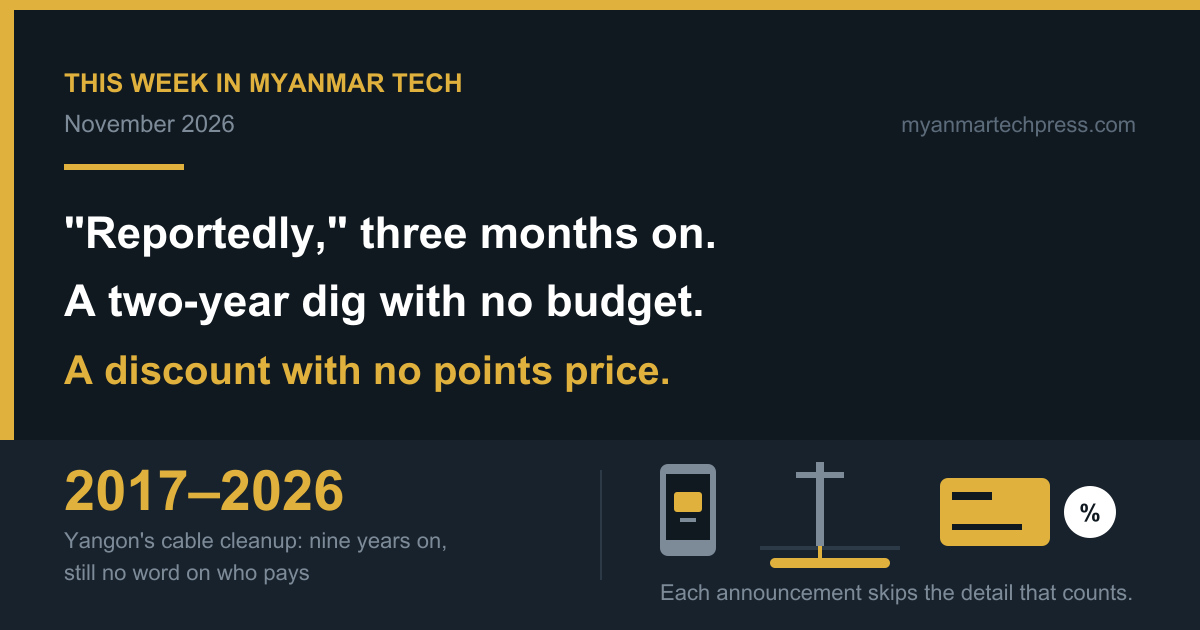
Once a week, this column puts the stories we published side by side, checks them against our archive, and names a few things that can be verified later. This edition covers the past week. The three stories come from different corners: currency controls, street infrastructure and a telecom loyalty scheme. Each one is an announcement, or a reading of announcements, that leaves out the one detail you would need to hold it to account.
Foreign exchange controls, read from the wallet side
A FULCRUM commentary from Singapore’s ISEAS – Yusof Ishak Institute, published on 23 November, argues that border-trade limits, restrictions on mobile payment apps abroad, passport rules and pressure on migrants to remit through the state system form one strategy of economic control. We read it from the payments side. In the authors’ account, KBZPay, Wave Money, AYA Pay and CB Pay have “reportedly” faced restrictions on overseas use. They put the migrant worker remittance rate and the official rate as overvalued by 20% and 120% respectively, figures we cannot verify.
What we would add now: The word that matters is “reportedly”. Our own September report on the overseas block relied on a single MoeMaKa report from 28 August. Nearly three months later, a commentary by two researchers who follow this closely still cannot use a firmer word. That is an answer of sorts to an item we have carried since September: there is still no official confirmation of how, or whether, the block is enforced. The other open question is in our article too. A transfer through the formal Wave Money–Merchantrade corridor from Malaysia lands in a Wave Wallet. Does it count as “official” for the 25% remittance proof that embassies now check? A web search on 28 November found nothing that says.
Yangon’s cables are to go underground in about two years
According to the state-run Global New Light of Myanmar on 24 November, the Ministry of Digital Development and Communications plans to replace Yangon’s overhead telecom lines with underground networks over roughly two years. Work is to begin in areas such as Dagon Myothit (North) and South Okkalapa, not downtown. The ministry told operators to use standard equipment and offer service at “reasonable and affordable rates”. It also acknowledged that faults in buried cable are harder to locate and repair.
What we would add now: Our article listed what the report leaves out, and the most important item is the one that links to the instruction on prices: nobody is named as paying for the ducts. If operators pay, the “affordable rates” line is asking them not to pass on a cost the plan creates. If the government pays, there is no budget. There is also a small precedent for the repair question. In March 2021, MPT announced a 20% discount on FTTH and ADSL invoices to make up for an internet outage at the time. So a compensation mechanism has existed before. The underground plan says nothing about one, or about repair-time targets, even though the ministry itself raised the repair problem.
Read the full article · MPT’s 2021 outage discount
ATOM STAR points meet a hospital
A Burmese press release dated 19 November, sent to us through ATOM’s PR agency, says ATOM STAR members can redeem points for 5% off lab tests, ECG, ultrasound and X-rays at Asia Royal Hospital in Sanchaung, and 10% for Titanium members, who also get an extra 5% on stress tests, Echo and CT. The release does not say how many points a voucher costs, how to reach Titanium, or when the offer ends. MPT had published a tier-by-tier table for the same hospital, with a period that ran to 29 September 2026.
What we would add now: Set this beside the ATOM Viber data packs we covered earlier in November, and a pattern appears. In both cases the offer reached us as a release, and in both cases we could not find a page on ATOM’s own site with the full terms. We are not saying the offers are not real; they may well be available in the ATOM Store app. But a perk that can only be checked through a forwarded release is hard for a customer to compare. MPT’s page is easier to judge only because the tiers and exclusions are written down. The other detail worth repeating: MPT’s published period ended in September and ATOM’s starts in October. That is timing, not evidence that the hospital switched, and we have nothing that says it did.
From the archive: the cable cleanup we wrote about in 2017
In June 2017 we published “Where should the communication tower from Yangon be moved?”. It reported that the Yangon Region minister responsible for communications had said unlicensed fiber cables were being removed from street lamp posts, partly because their colour resembled electric cables, and that permission for posts would be given later. Our writer at the time was sceptical. The piece argued that placing new posts across the whole city would be too expensive for the government budget, hard even with all companies working together, and that “the price for the service will also rise”.
Nine years later, the checks are mixed. The problem did not go away: MPT’s February 2026 notice cites a 2021 warning about unpermitted fiber on its poles, and gave companies in two townships until 10 March to remove it. The cost question our 2017 writer raised is exactly the one this week’s announcement leaves unanswered. On prices, we cannot say the prediction came true. Fixed broadband providers have announced increases this year, but the notices we covered gave no reason, and we have no evidence linking any of them to cable cleanup. What the 2017 piece got right was the shape of the problem: the hard part is not deciding to tidy the poles but deciding who pays to do it.
One thing worth watching
Three new items:
- By the end of the first quarter of 2027, will the ministry or the Yangon Region Government publish a township-by-township schedule, a budget, or a statement of who funds the underground ducts? The November report gave none of the three.
- By the end of 2026, will ATOM publish the STAR Points cost of the Asia Royal Hospital voucher, or its STAR tier thresholds, on atom.com.mm? This joins our open item on the Viber pack terms.
- Will MPT update its Asia Royal Hospital page with a new period, or remove it? As of 27 November it still showed the period that ended on 29 September.
Checking earlier items: the overseas wallet block is still described as “reportedly”, now by ISEAS as well as by us, so the confirmation item stays open. On whether wallet transfers count as remittance proof, a search on 28 November found no embassy statement. On the Yangon-Bagan train, the same day’s search found official ORTP coverage only for Yangon-Mandalay services, and nothing confirming online booking for trains 61 and 62. We found no new SpaceX statement specific to Myanmar and no new PUBG MOBILE release. The other carried-over items, from the FATF action plan to 5G base-station counts, had no updates we could find.
About this column
This is a weekly roundup from Myanmar Tech Press. It links the past week’s stories to each other and to our archive, which goes back to 2017, and it ends with items that can be checked in later editions. We publish around two to three news articles a week; this column is where we look back at them with a few more days of context. Earlier editions are in the Articles section.