This is Myanmar Tech Press’s weekly column. We connect recent coverage, check back on things we flagged earlier, and add the analysis a single news article doesn’t have room for. The past week brought three stories that look unrelated: a diplomatic trip, a commerce rule and a police raid. They share one feature. In each, the first and fullest account came from the state itself, through state media or a police announcement. In two of the three, an independent outlet told the same story differently within a day or two.
This Week’s Articles
Myanmar Co-Chairs a Russia-ASEAN Security Dialogue in Moscow
A delegation led by Deputy Minister U Min Zeyar Hlaing attended the 2nd Global Digital Forum in Moscow from 8 to 10 October. According to the state-run Global New Light of Myanmar (GNLM), Myanmar co-chaired the 6th Russia-ASEAN Dialogue on ICT Security-Related Issues on ASEAN’s behalf, and the deputy minister discussed digital government, cybersecurity frameworks and training with his Russian counterpart. No agreement was reported. By our count it was the fourth public Russia-Myanmar tech contact in about five months. Read the full piece.
What we would add now: read next to the other two stories this week, the forum’s vocabulary stops being abstract. The Russian side spoke of sovereign equality and non-interference, and the 2023 agreement we cited affirms each state’s right to set its own internet policy. Within days, Myanmar’s government used that right twice: once to decide that gold may not be sold through registered online shops, and once in a raid that put Starlink terminals on a seizure list. We are not saying Moscow had anything to do with either. The point is narrower. “Cybersecurity frameworks” in this context seems to mean the state deciding which digital channels are allowed. This week gave two concrete examples of that power being used, so it is worth asking what a framework built with Russian help would add to it.
The Commerce Ministry Bars Online Gold Sales
The Ministry of Commerce says it does not grant e-commerce registration certificates for online trading of gold, gold jewellery, or artistic works and accessories made of gold. It cites possible speculation and market instability. GNLM framed this as a description of existing practice. The Irrawaddy reported it as a suspension, said expired permits were not being renewed, and said enforcement was expected at the end of October. The ministry’s original notice could not be found online. Read the full piece.
What we would add now: two numbers in the article are worth putting side by side. The Irrawaddy reports that more than 700 businesses have applied to sell gold and jewellery online. It also cites a 24-karat reference price of 7.1 million kyats per tical against a market price above 10 million, which puts the market more than 40% above the reference. The first number is one the ministry could confirm or correct exactly, because it runs the registration system. It has not published one. The second is the gap the ministry says it wants to stabilise. A livestream that shows real prices to thousands of viewers makes that gap public, and a registration ban does nothing to close it. If the ban works, the gap will still be there, just harder to see.
Four Starlink Sets in a Tarpaulin Camp
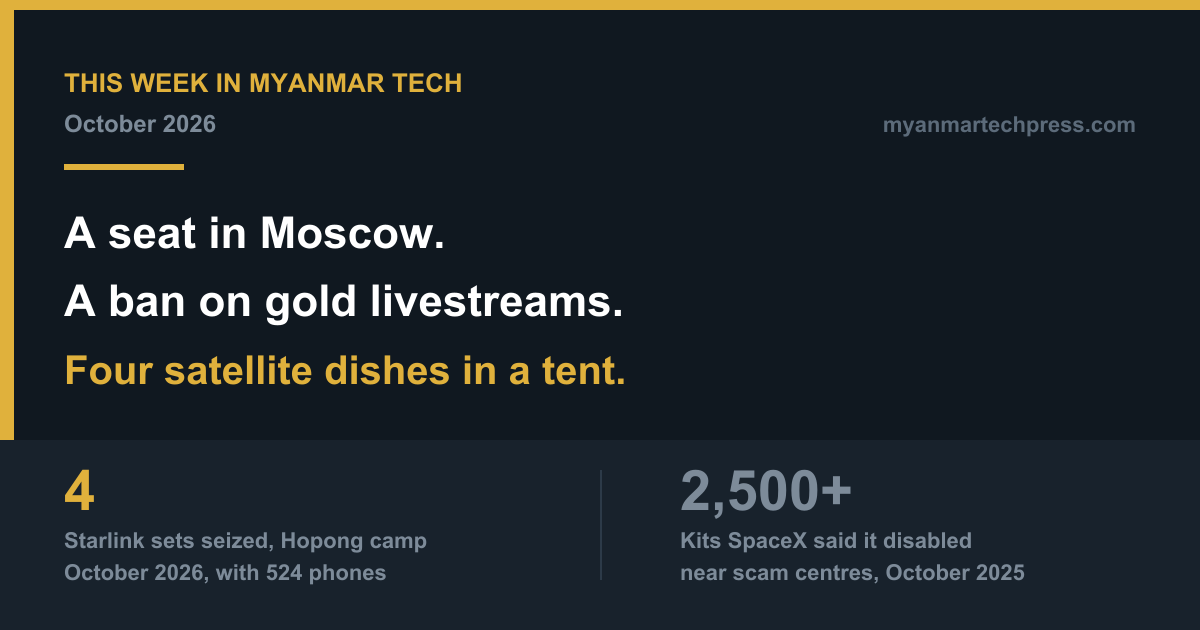
On 5 October, police raided a makeshift camp in Hopong Township, southern Shan State, and arrested 87 people on suspicion of online fraud: 75 Chinese nationals and 12 Myanmar nationals. The seized items included tarpaulin tents, four Starlink sets, 19 computers and 524 mobile phones. Police did not say whether the terminals were active. A year earlier, SpaceX said it had disabled more than 2,500 kits near suspected scam centres in Myanmar. Read the full piece.
What we would add now: one ratio from the seizure list: 524 phones for 87 people is about six phones per detainee. Police did not say how the phones were used, but six each looks more like work equipment than personal belongings. On that reading the operation’s real infrastructure was the phones, and the satellite link was only the way out. There is also a contrast with our own coverage. In August we wrote about MPT deploying satellite terminals for flood response. Satellite connectivity is welcome in Myanmar when it runs through a licensed operator. The line being drawn is about who controls the link, not the technology. That is why a clinic’s Starlink dish and a scam camp’s dish end up in the same unlicensed category.
From the Archive: When Starlink Was a Phone Rumour
In October 2022 we published an article on the rumoured Tesla “Pi” phone, said to be coming in December 2022. Among the specifications it repeated was Starlink support. Starlink appeared there as a futuristic feature, with the note that it was available in 36 countries. The phone never appeared. Tesla never announced it, and we have since added an editor’s note telling readers to treat the specifications as unverified rumour. That part of the answer is straightforward: we passed on a rumour, and it was wrong.
The Starlink part turned out to be more interesting than the rumour. Within three years, by AFP’s account of APNIC data, Starlink had briefly become Myanmar’s top internet provider by user share, in June 2025. It reached Myanmar without a licence, a local office or a phone. It came as dishes carried across borders, and it is now listed among the seized items in police reports. In 2022 we treated satellite internet as a gadget feature. The real story was about who gets to connect, and on whose terms.
One Thing Worth Watching
Still open, carried over: nothing in this week’s coverage moves any earlier item. No operator count of dedicated 5G base stations, no public comment on the Norwegian charges against Telenor ASA, no official confirmation of the central bank’s reported geo-block on payment apps, no World Cup audience figures from Mytel or TV360, no stated reason for Myanmar Net’s 2026 price changes, no PUBG MOBILE release with a final placing, and no statement from AYA Bank on The Crew’s August listing.
New this week: first, will the enforcement The Irrawaddy expects at the end of October actually be reported, by state media or anyone else? And will it reach livestream sellers on Facebook and TikTok, or stop at registered shops? This one should be checkable in the next few weeks. Second, by the end of 2026, will Myanmar authorities say whether the four Hopong terminals were active, or will SpaceX make any Myanmar-specific statement? We could find none since October 2025.
About This Column
This is a recurring column from Myanmar Tech Press. It steps back from single-story coverage to connect recent articles with our own archive, and it tracks specific claims until they are confirmed or quietly dropped. Our regular reporting continues alongside it at the usual pace.