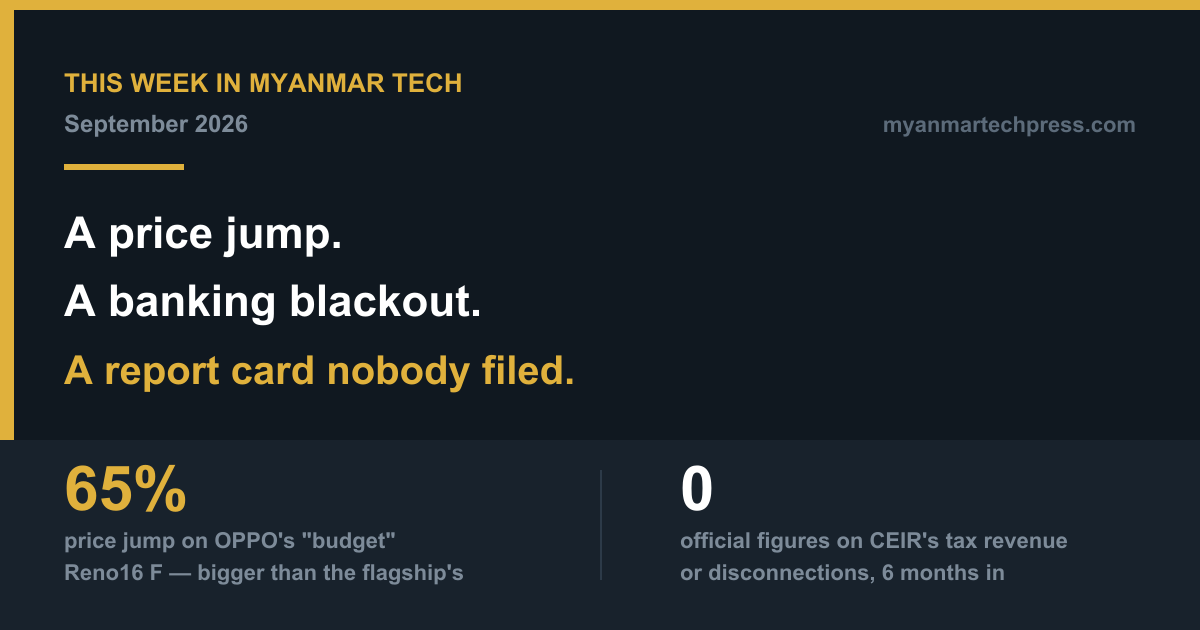
This is Myanmar Tech Press’s weekly column, where we connect the past several days of coverage, check back on things we flagged earlier, and add the analysis that a single news article doesn’t have room for. This time, that means a phone that finally has a price tag, a banking order that may or may not actually be working, and a six-month-old registration system whose own paperwork still has no numbers in it.
This Week’s Articles
A Six-Month Check on CEIR Phone Registration
We went back to Myanmar’s CEIR (Central Equipment Identity Register) system, which linked every phone’s IMEI to its SIM and national ID starting in March 2026. The government’s own framing was narrow — standards compliance and tax collection, nothing about theft or fraud. What we could actually verify, six months on, was broader: phones cost 30–37% more, travelers are capped at two devices a year with a 30-day tax clock, and a digital rights researcher told Burma News International the system hands the state a meaningfully stronger ability to tie a device to a location and an identity. No official body has published a single figure on tax collected, devices disconnected, or standards violations caught. Read the full piece.
What we would add now: the article itself names the pattern — this is the third time in recent months we’ve covered the gap between an announcement’s stated goal and what can actually be checked. What’s worth adding is that the gap keeps appearing in the same shape every time: a specific, modest justification up front, and then silence on the metric that would prove or disprove it. Nobody has asked CEIR’s operators directly, on the record, for a year-one number. Until someone does, “we have no data” will keep functioning as its own kind of answer.
Myanmar’s Central Bank Reportedly Orders a Geo-Block on Mobile Payment Apps
According to MoeMaKa’s August 28 report, the Central Bank of Myanmar instructed banks to block K-Pay, Wave Money, AYA Pay and CB Pay from working outside the country, effective that same day. The catch: MoeMaKa’s own reporting, published the morning the block was supposed to start, found the apps still working from abroad and some banks saying they hadn’t received formal instructions yet. Read the full piece.
What we would add now: the detail that deserves more attention is the VPN problem. Even a fully operational geo-block is a location check, not an identity check — and a basic IP-country filter, the cheapest thing to deploy across four separate banking platforms in a hurry, is also the easiest one for a VPN to defeat. If the goal really is to cut off a specific category of funds rather than just inconvenience migrant workers sending money home, a geo-block is a blunt tool for a precise problem. That mismatch between the apparent goal and the chosen method is worth watching as much as whether the block is “on” at all.
OPPO Reno16 Finally Gets a Price in Myanmar
Six days after a price-free teaser, OPPO’s September 8 press release confirmed the Reno16 5G at 3,699,900 MMK and the Reno16 F 5G at 2,799,900 MMK — increases of roughly 48% and 65% over their Reno15 equivalents from January. The launch-incentive bundle more than doubled in declared value over the same period, growing faster than the sticker price itself. As of our September 11 check, OPPO’s own Myanmar product pages still showed both models “Out of Stock” with no price listed. Read the full piece.
What we would add now: put next to the CEIR and CBM stories above, this is a useful reminder that not every verification gap in Myanmar’s tech coverage is about the state. OPPO’s own retail pages not matching its own press release, six days before a public launch event, is a small-scale version of the same habit: an official channel making a claim, and the most obvious way to check it — the company’s own website — not yet lining up.
From the Archive: The Teaser That Became This Week’s Price Reveal
Last week’s roundup listed a specific watch item: would OPPO confirm Reno16 pricing and a release date for Myanmar before the gap from the global June 2026 launch stretched past three months? Our September 4 piece on the price-free teaser was the starting point for that question. The answer arrived on September 8 — just inside the three-month window, and with a launch event scheduled for September 20 in Yangon. Reading the teaser and the launch side by side is itself informative: the six-day gap between “coming soon” and “here’s the exact price and incentive schedule” makes clear the numbers were locked in well before the teaser ever went out. The teaser wasn’t a real reveal; it was a countdown clock OPPO had already set.
One Thing Worth Watching
Answered from last time: OPPO did confirm Reno16 pricing for Myanmar before the three-month mark from its global launch — see above.
Still open, carried over again: neither Mytel nor TV360 has published any viewership or attendance figures tied to Mytel’s exclusive World Cup broadcast rights, and no telecom operator has disclosed a count of dedicated 5G base stations, despite both being the kind of number a company would normally want to publicize if the figures were flattering. Three weeks of silence on the first, several months on the second.
New this week: will the Central Bank of Myanmar, or any of the four named payment operators, ever confirm on the record whether the overseas geo-block on K-Pay, Wave Money, AYA Pay and CB Pay actually went into effect — and if it did, whether VPN users were blocked along with everyone else? Right now the only public information comes from unnamed banking sources speaking to one outlet. We’ll check back on this the next time we cover Myanmar’s mobile payment sector.
About This Column
This is a recurring column from Myanmar Tech Press that steps back from single-story coverage to connect what we’ve published recently with our own archive, and to track specific claims forward until they’re either confirmed or quietly dropped. If you’re new here, our regular reporting continues alongside this column at our usual pace.