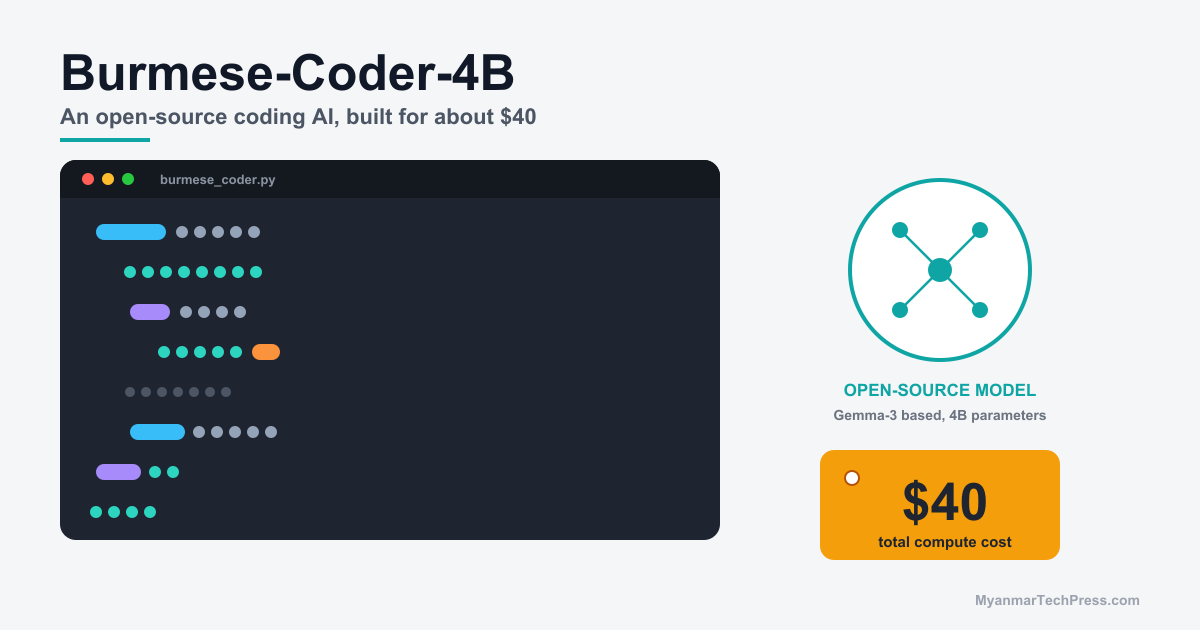
In April 2026, a Myanmar-born AI researcher published a project that, on paper, sounds like exactly the kind of story a Myanmar tech outlet should have been first to tell: an open-source large language model that writes and explains code in Burmese. It didn’t come from a government ministry, a telecom operator, or a well-funded startup. It came from one person, working with a single GPU rental, for a compute bill of roughly $40. According to a contributor article published on HackerNoon on April 13, 2026, Dr. Wai Yan Nyein Naing — now a senior research scientist at Robert Bosch in the United States — built and released Burmese-Coder-4B, an open-source coding-focused language model fine-tuned specifically for Burmese-language programming instructions and explanations.
Five months on, a search for Myanmar-language or Myanmar-based tech coverage of this project turns up essentially nothing. That absence, as much as the model itself, is the story worth writing about.
What Burmese-Coder-4B Actually Is
According to the HackerNoon write-up, Burmese-Coder-4B is built on top of Google’s Gemma-3 4B base model — a 4-billion-parameter open model small enough to run on consumer-grade hardware once quantized. Dr. Wai Yan Nyein Naing fine-tuned it on a dataset of 974 Burmese-language programming exercises that he calls burmese-mbpp (modeled on the well-known MBPP — “Mostly Basic Python Problems” — benchmark format used across the AI research community, translated and adapted into Burmese). After supervised fine-tuning, he applied Direct Preference Optimization (DPO) specifically to reduce language code-switching — the tendency of a fine-tuned model to slip back into English mid-explanation, which is a well-documented failure mode for low-resource-language models layered on top of English-dominant base models.
The reported results, per the source article, are notable mainly for what they preserve rather than what they add: a Pass@1 score of 62.0% on the evaluation set, which the author states is roughly on par with the base Gemma-3 4B model’s own coding performance — in other words, the Burmese-language fine-tuning did not come at a meaningful cost to raw coding ability. The full training run, using a rented H100 GPU via RunPod, reportedly took about 2.75 hours and cost around $40 in total compute. The model is distributed in quantized form and is compatible with Ollama, meaning it can run offline, locally, without a live API connection — a detail that matters more in Myanmar than in most other markets, given the country’s uneven internet connectivity.
Why a $40 Model Is a Bigger Story Than It Looks
It is easy to read “$40 in compute” as a novelty statistic and move on. But set alongside the kind of Myanmar tech stories that dominate headlines — multi-year 5G rollout plans, national digital ID systems, CEIR device-registration mandates, telecom licensing shake-ups — the contrast is worth sitting with. Those are institutional projects: state-backed, capital-intensive, measured in years and in millions of dollars of infrastructure spend. Burmese-Coder-4B was built by one person, outside any institutional Myanmar tech ecosystem, for less than the cost of a mid-range smartphone case, in under three hours of GPU time.
That doesn’t make it more important than 5G infrastructure — a coding assistant doesn’t get a village connected to the internet. But it is a useful reminder that “AI for Myanmar” isn’t gated exclusively behind the kind of resources only governments, telecoms, or large NGOs can marshal. The barrier for a technically skilled diaspora engineer to build a working, freely licensed Burmese-language tool has dropped to the point where it fits inside a personal hobby budget. That is a genuinely new condition, and it changes who gets to be a plausible actor in Myanmar’s digital-language space — not just Ooredoo, MPT, or a ministry, but any individual developer with the right skills and a credit card.
This Isn’t a One-Off — It’s an Emerging Pipeline
Burmese-Coder-4B is not Dr. Wai Yan Nyein Naing’s only Burmese-language AI project, and treating it in isolation understates what is actually happening. Based on his personal project portfolio, he has been building a connected stack of Burmese-language AI tools over time:
- Burmese GPT — an earlier foundation model built on mGPT-XL, with roughly 1 billion parameters, trained on Burmese Wikipedia, literature, and news text and released under an MIT license on Hugging Face (model card: WYNN747/Burmese-GPT).
- Padauk — described on his personal site as a Gemma-based, tool-using Burmese-language assistant aimed at practical, everyday use rather than pure research benchmarking.
- Burmese-Coder-4B — the coding-specific model covered in the HackerNoon piece.
- burmese-coding-eval — a companion evaluation benchmark and dataset (including burmese-mbpp and a Burmese human-eval set) intended to let other researchers actually measure Burmese-language coding performance, rather than relying on English-language benchmarks that say nothing about how a model performs in Burmese.
Taken together, this looks less like a single side project and more like someone deliberately building the missing infrastructure layer — base model, applied assistant, specialized coding model, and shared evaluation tooling — for Burmese-language AI, largely alone. Whether or not any individual model in that stack becomes widely used, the eval benchmark in particular is the kind of shared infrastructure that lowers the cost for the next person who tries to build something similar.
A Coverage Gap, Not Just a News Gap
It’s worth being precise about what “undercovered” means here. This is not a case of Myanmar Tech Press missing a fast-breaking story — the HackerNoon piece is five months old, and treating it as breaking news would be misleading. The more useful framing is that a genuinely relevant piece of Myanmar-connected AI development was published on a platform built for a global developer audience, in a format (a contributor blog post) that isn’t designed to travel into Myanmar’s own tech conversation, and as of this writing there is no visible trace of it having been picked up by Myanmar-focused tech coverage. HackerNoon is a legitimate outlet for developer-authored technical writing, but a self-published contributor article is not the same as independent, peer-reviewed, or third-party-verified reporting — a distinction worth keeping in mind when reading its claims at face value.
Separately, and worth flagging with real caution: search results referencing a public-interest initiative called “AI for Myanmar” suggest the existence of a comparable project, sometimes referred to as “Shwenyan LLM.” We were not able to independently verify this — the organization’s website did not render retrievable content through the fetch methods available for this research, and no other verifiable source could confirm the claim. We’re noting it only as an unconfirmed signal that Burmese-Coder-4B may not be operating in a total vacuum, not as a verified fact. If that project is real and active, it would be worth its own separate, independently verified story rather than a passing mention here.
What the Announcement Doesn’t Tell Us
Reading the HackerNoon article closely, several practical questions go unanswered — and they matter more to a Myanmar audience than to the model’s original technical audience:
- No usage or adoption figures. The article describes how the model was built and how it performs on its own benchmark, but says nothing about download counts, active users, or whether any Myanmar developer or organization has actually integrated it into a workflow.
- No independent benchmark verification. The 62.0% Pass@1 figure comes from the author’s own evaluation set (burmese-mbpp), which the same author also built. That’s a reasonable way to measure progress on a genuinely new benchmark, but it is not the same as third-party validation.
- No discussion of real-world accessibility inside Myanmar. Running a quantized 4B model via Ollama is realistic on a decent laptop, but says nothing about whether the intended Burmese-speaking developer audience has the hardware, stable electricity, or technical background to actually set it up — constraints that are far more binding in Myanmar than in the markets where most open-source AI tooling is built and tested.
- No mention of ongoing maintenance or support. Open-source model releases from individual researchers frequently go unmaintained after the initial release. There’s no stated commitment, in the source article, to keep updating the model or dataset.
None of this diminishes what was actually built. It’s a reminder that a technically impressive release and a widely useful tool are not automatically the same thing, and that gap tends to be where Myanmar-specific technology stories are decided — not at the moment of release, but months later, based on whether anyone locally actually picked it up.
Frequently Asked Questions
What is Burmese-Coder-4B?
It is an open-source, 4-billion-parameter language model, built on Google’s Gemma-3 4B, that has been fine-tuned to generate and explain code using Burmese-language instructions. It was developed by Dr. Wai Yan Nyein Naing and detailed in a HackerNoon contributor article published on April 13, 2026.
Who built it, and is this an official Myanmar government or company project?
No — it is an independent project by a Myanmar-born AI researcher currently working as a senior research scientist at Robert Bosch in the United States. It was not commissioned or funded by a Myanmar government body, telecom operator, or corporation, based on everything disclosed in the source article and the developer’s own project pages.
Is Burmese-Coder-4B free to use?
Based on the developer’s personal site and Hugging Face listings, his released models, including the earlier Burmese GPT, have been distributed under open licenses (MIT-style) at no cost. The HackerNoon article states the model weights and code for Burmese-Coder-4B are similarly published for public access.
How is this different from just using ChatGPT or GitHub Copilot in Burmese?
General-purpose coding assistants can often respond to Burmese-language prompts, but they are not specifically trained or evaluated on Burmese-language programming instruction data, and are prone to code-switching back into English mid-explanation. Burmese-Coder-4B was specifically fine-tuned and then adjusted with DPO to address that code-switching problem, and it can run fully offline and locally rather than depending on a hosted API.
Does a $40 open-source model mean Myanmar doesn’t need larger, institutional AI investment?
No — the two aren’t substitutes. A single fine-tuned 4B model, however resourceful, doesn’t replace the need for broader digital infrastructure, language-resource datasets, or policy attention to low-resource-language AI in Myanmar. What it does demonstrate is that individual, low-budget contributions can meaningfully add to that ecosystem while larger institutional efforts remain slow to materialize.
The Bottom Line
Burmese-Coder-4B is a small, specific, and genuinely verifiable technical achievement: an open coding model, fine-tuned for Burmese, built for roughly the price of a few coffee orders. What makes it worth writing about in September isn’t the novelty of the release — that news is months old — but the fact that it sits at the intersection of two things Myanmar’s tech conversation doesn’t have enough of: homegrown, Burmese-language AI tooling, and technology media that actually covers it. We publish articles like this a few times a week, and closing gaps like this one — stories that are real, verifiable, and relevant to Myanmar, but that fell through the cracks between a global developer platform and a local audience — is exactly the kind of story this coverage should be catching earlier next time.
Sources: Dr. Wai Yan Nyein Naing, “Burmese-Coder-4B: A Burmese Coding LLM for Low-Resource Language AI,” HackerNoon, published April 13, 2026 — https://hackernoon.com/burmese-coder-4b-a-burmese-coding-llm-for-low-resource-language-ai. Background (undated, used only for project/technical context, not for publication-date claims): Dr. Wai Yan Nyein Naing’s personal site, https://waiyannyeinnaing.com/, and the Burmese-GPT model card on Hugging Face, https://huggingface.co/WYNN747/Burmese-GPT. This article was compiled and researched on September 16, 2026.