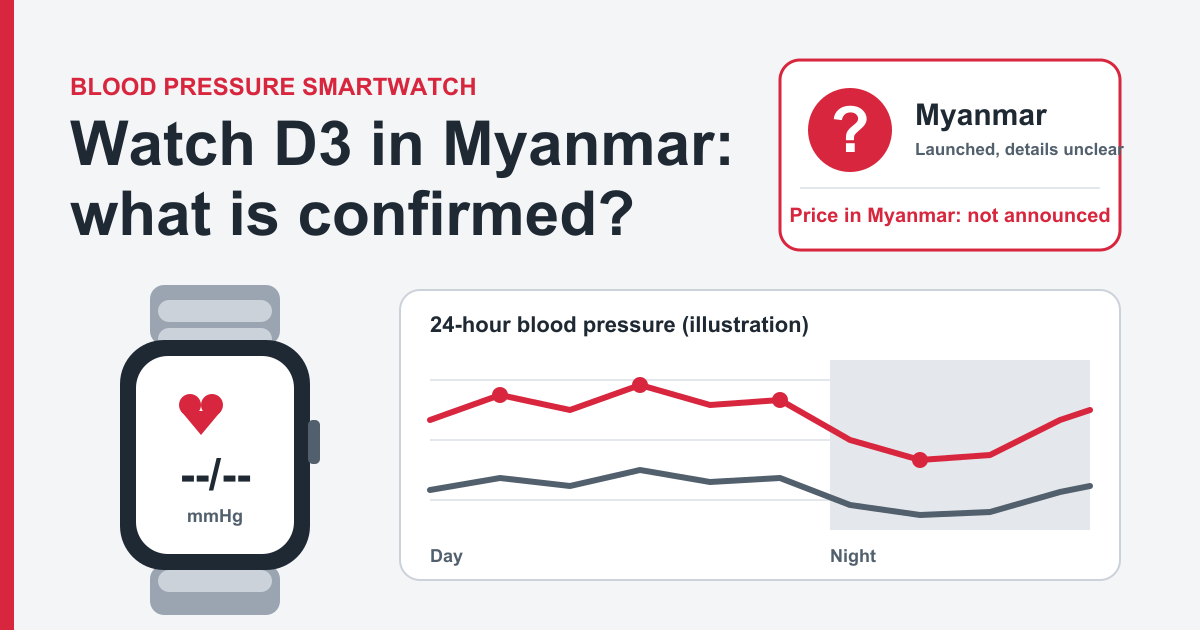
Huawei Myanmar has announced the official introduction of the HUAWEI WATCH D3 to the Myanmar market, according to a Burmese-language press release dated 16 October 2026 (the “Huawei Myanmar press release, 16 October 2026”). The D3 is a smartwatch with a small inflatable cuff built into the strap, so it can take blood pressure readings the way a conventional upper-arm monitor does, only on the wrist. Huawei’s headline calls it the “world’s first 24Hr blood pressure monitoring” watch.
The product is interesting. The release, however, tells a Myanmar buyer very little about what they need before spending money: how much it costs here, when and where it is sold, and which of the advertised health features actually work in Myanmar. This article goes through what Huawei says, what it leaves out, and what to ask before you buy.
What Huawei says the Watch D3 does
According to the release, the D3 uses mechanical airbag technology and offers resting blood pressure readings, readings before and after exercise, and 24-hour ambulatory blood pressure monitoring (ABPM). In ABPM mode, users set measurement intervals for the day, and the watch measures automatically at night. A “Minimally Disruptive ABPM Study” is described as using seven readings, four in the day and three at night, processed by what Huawei calls TruSense “Fusion Computing”.
The release also lists an ECG function, a Coronary Heart Disease Risk Study, a Diabetes Risk Study, sleep breathing awareness, heart rate variability, an emotional wellbeing feature, and “Health Glance”, which Huawei says reports 13 health indicators in about a minute. A “Health Community” feature lets users view family members’ blood pressure, heart rate and SpO2 and receive alerts. On the hardware side, Huawei lists Black and Mocha Gold colours, a thickness of 11.3 mm, a weight of 40 g and a 25.5 mm ultra-narrow airbag strap. Independent UK outlet Wareable gave the same dimensions when the watch launched in Europe.
Cuff versus optical estimation: why the airbag matters
Most smartwatches that mention blood pressure estimate it from optical sensors, the green lights on the back that read pulse. That is an indirect estimate, and many such watches need to be calibrated against a real cuff. Wareable, in its 24 September 2026 coverage of the European launch, contrasts the D3’s physical micro-pump and airbag with that approach.
Huawei’s own Myanmar product page says the D3 uses the oscillometric method, the same principle as most home blood pressure monitors: a cuff inflates, and a pressure sensor detects the tiny oscillations in the artery as it releases. Because it physically squeezes the wrist, it is closer to a real measurement than an optical guess. That is the genuine selling point, and it is why the D3 sits in a different category from an ordinary fitness band.
There is a practical catch that Huawei’s page itself states: the user has to hold the device at heart level while measuring. Wrist position changes the reading, because blood pressure measured above or below the heart is distorted by gravity. If you rest your arm on a desk with the watch lower than your chest, or let your hand hang, the number will not be comparable to a proper reading. A 24-hour mode is also harder to use correctly: the watch can’t make you hold your wrist at heart level while you sleep or walk around, so readings taken in those moments depend on how the cuff and your posture happen to line up. Treat single readings with caution and look at patterns over days.
What the release does not tell Myanmar buyers
No price, no on-sale date, no shops
The full release contains no Myanmar retail price, no on-sale date and no list of shops. Huawei Myanmar’s official product page at consumer.huawei.com/mm lists the D3 but shows no price in kyat either. For context only, the watch went on sale in the UK and Europe at £399.99 and €399.99, according to Wareable. That is not a Myanmar price, and we are not converting it: local pricing depends on import costs, the exchange rate used by the seller and the shop’s own margin, and none of that has been published.
Several headline features carry “some markets” footnotes
This is the most important omission. The footnotes on Huawei Myanmar’s own product page, written in Burmese, say the following:
- The multi-scenario medical-grade blood pressure feature is “only available in some markets”.
- Health Glance is “only supported in some markets”, and the available health items vary by country or region.
- The Coronary Heart Disease Risk Study and Diabetes Risk Study require joining through the HUAWEI Research app, are “only available in some markets”, and for those features “this product is not a medical device”, with results for reference only.
- Health Insights is delivered through an OTA (over-the-air) update, so it may not be there on day one.
- The weekly, monthly and yearly blood pressure average trend charts are not available on iOS devices.
The page does not say whether Myanmar is one of the “some markets”. We are not claiming the features are unavailable here. We are saying Huawei’s own page does not tell you, and the press release does not either. Since the blood pressure functions are the reason to buy this watch rather than a cheaper one, that is a gap a buyer should close before paying.
Certifications cited are European and Chinese
The release says the D3’s blood pressure functions and ECG carry CE certification, and refers to EU MDR and China NMPA certifications, with the caveat that coverage depends on the model and the feature. Huawei’s product page describes the watch as “CE-MDR-Certified as a Medical Device”. The release also says the exercise blood pressure function is the “world’s first ISO-certified”, attributing this to Huawei’s product information. All of these are Huawei’s claims, and we have not independently verified them.
What the release does not mention is any Myanmar regulatory approval. We are not making any claim about what Myanmar rules require for a device like this. The point is simpler: the approvals Huawei cites were granted by European and Chinese authorities, and a Myanmar reader cannot tell from the release whether anything local applies. The release itself ends with the usual disclaimer that the health features are not a substitute for a doctor’s examination, diagnosis or treatment. That disclaimer is worth taking literally.
“World’s first” again: how this echoes the WATCH D2 launch
This is not the first time Huawei Myanmar has used this framing. When we covered the WATCH D2 announcement on 27 December 2024, Huawei described that watch as the world’s first wrist-worn 24-hour ambulatory blood pressure monitoring device, recognised by both NMPA and MDR. That article also gave no Myanmar price, and it listed pre-orders at the HUAWEI Brand Shop at Junction City, the HUAWEI Hledan Showroom and the HUAWEI Branded Shop in Mandalay.
Nearly two years later, the D3 is described as the “world’s first 24Hr blood pressure monitoring” watch. Both can hardly be literally the first of the same thing. The more sensible reading is that “world’s first” is a product-line slogan, with each generation redefined by a slightly different qualifier (24-hour, exercise, ISO-certified). That doesn’t make the technology unimportant, but it is a reason to read the superlatives as marketing and look at specifics instead. It also shows a pattern: two launches in Myanmar, two releases heavy on certifications and light on local pricing and availability.
Questions to ask in the shop before you buy
- What is the price in kyat, and is it fixed? Ask whether warranty is included and what it covers.
- Which health features work in Myanmar today? Ask specifically about 24-hour ABPM, exercise blood pressure, Health Glance, and the heart disease and diabetes risk studies. Ask the seller to demonstrate them on a display unit.
- Is this the Myanmar-market version? Ask whether the unit, software and warranty are the same as those sold by Huawei Myanmar, or a grey-market import.
- What phone do I need? The trend charts are not available on iOS, so check compatibility with your phone before you pay.
- Can I compare it against a cuff monitor I trust? Take one reading with the watch, held at heart level, and one with a conventional upper-arm monitor. If you are buying it because of a medical condition, ask your doctor which one to rely on.
- Which updates are still to come? Features delivered by OTA update (such as Health Insights) may arrive later or differ by region.
Frequently asked questions
How much does the Huawei Watch D3 cost in Myanmar?
No Myanmar price has been published in the press release or on Huawei Myanmar’s product page. In the UK and Europe it was priced at £399.99 / €399.99, according to Wareable, but that figure should not be read as a Myanmar price.
Where can I buy the Huawei Watch D3 in Myanmar?
The release names no retailers. For the earlier WATCH D2, Huawei Myanmar listed its Junction City brand shop, its Hledan showroom and its Mandalay branded shop. Check with Huawei Myanmar for the D3.
Does the Watch D3 measure blood pressure like a normal cuff monitor?
It uses a small airbag and the oscillometric method, which is the same principle as most home cuff monitors, rather than estimating from optical sensors. You must hold the watch at heart level while measuring. Huawei says the feature is medical-grade and CE-MDR-certified, but those are Huawei’s claims, and the watch is not a replacement for a doctor’s examination.
Are all of the Watch D3’s health features available in Myanmar?
Huawei does not say. Its Myanmar product page footnotes the blood pressure feature, Health Glance and the heart disease and diabetes risk studies as “only available in some markets” without naming those markets.
Is the Watch D3 approved for use in Myanmar?
The release cites CE (EU MDR) and China NMPA certifications and mentions no Myanmar approval. We make no claim about Myanmar’s rules; ask Huawei Myanmar directly if this matters to you.
Our take
The Watch D3 appears to be a serious attempt at putting a real blood pressure cuff on the wrist, and that is more substantive than the usual optical “estimates”. But a launch announcement for Myanmar should answer Myanmar questions, and this one does not: no price, no date, no shops, and a product page that quietly says several headline features are available only in some markets. Until Huawei Myanmar says which features are enabled here, treat the D3 as a promising device with unconfirmed local functionality, ask the questions above, and do not buy it as a substitute for medical advice.
Sources: Huawei Myanmar press release (email, Burmese), 16 October 2026; HUAWEI WATCH D3, HUAWEI Myanmar (accessed 26 October 2026); Huawei Watch D3 lands in UK & Europe with improved blood pressure tracking, Wareable (24 September 2026); HUAWEI WATCH D2 Sets New Standard in Health Monitoring with 24-Hour Blood Pressure Readings, Myanmar Tech Press (27 December 2024). The press release email has no public URL. Health claims and certifications are Huawei’s own and were not independently verified.