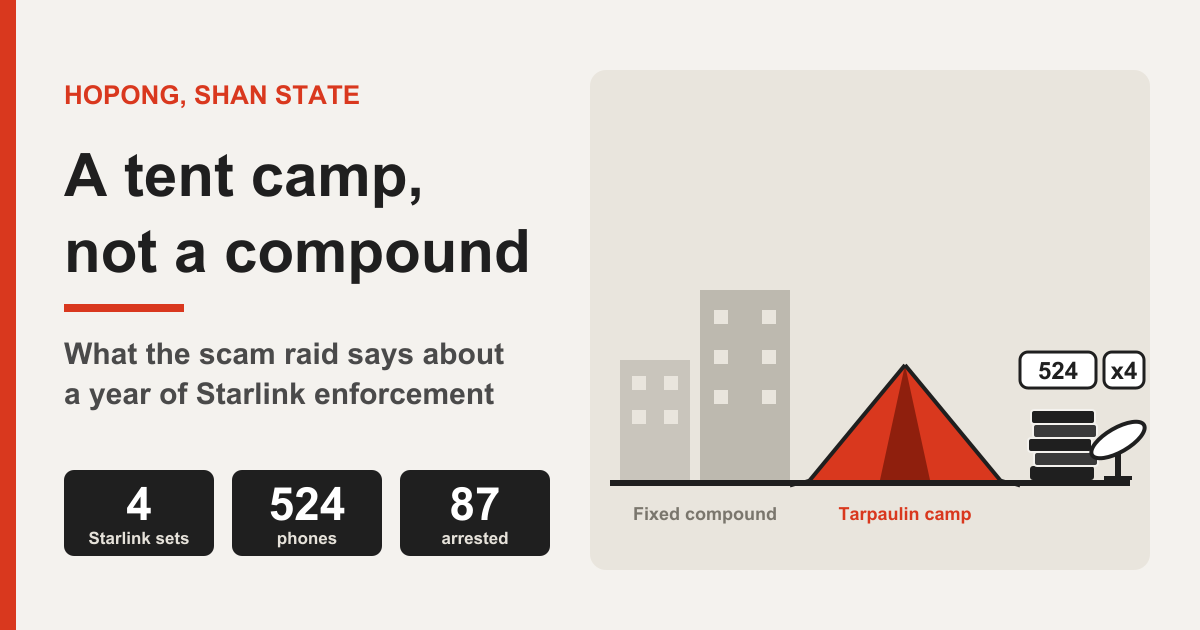
On the morning of 5 October 2026, Myanmar police raided a makeshift camp near Na Long village, about 21 km southwest of Maingpun in Hopong Township, southern Shan State, and arrested 87 people on suspicion of online fraudulent gambling. According to the Myanmar Police Force announcement as carried by One News (7 October 2026), 75 of those arrested were Chinese nationals who allegedly entered the country illegally, and 12 were Myanmar nationals. Police listed the seized items as temporary tarpaulin tents, four Starlink sets, 17 all-in-one computers, two laptops and 524 mobile phones.
The Irrawaddy also covered the raid in its China briefing of 9 October 2026. This article draws on both reports, plus AFP coverage from the past year. The raid itself is a routine-looking police story. What makes it worth a closer look is the equipment list: it sits at the end of a year in which Starlink enforcement in Myanmar has repeatedly hit ordinary users far from any scam site.
What the police announcement actually says (and what it leaves out)
The facts in the announcement are narrow. Police say the arrests took place on the morning of 5 October. The detainees will face legal action after interrogation, the seized items will be handled according to procedure, the illegal structures will be demolished, and anti-scam efforts will continue.
The Irrawaddy adds colour that the police statement does not. It describes the site as “makeshift huts” in a “remote valley” and says police seized more than 500 phones and Starlink satellite dishes. Note that these descriptions come from the Irrawaddy, not from the police text, and the Irrawaddy does not give a count of dishes. The figure of four comes only from the police announcement.
Several things are not stated anywhere we could find:
- Whether the four Starlink sets were active. Police list them as seized equipment. They do not say whether the terminals were online, how long they had been in use, or what the camp used them for.
- How the terminals got there. Starlink is not licensed or officially sold in Myanmar, so the kits came from somewhere. Whether they were registered in another country, and under whose account, is not disclosed.
- Whether SpaceX was informed. Nothing in the reports says the company was contacted or had already flagged these terminals.
- How the camp operated. How the 75 Chinese nationals crossed the border, and how long the camp existed, are not explained.
We are deliberately not claiming the dishes were working. It would be easy to write “scammers used Starlink in the jungle”, and it may well be true, but the announcement does not establish it. Treat the equipment list as what it is: a list of things found at the site.
Why a tent camp is the opposite of KK Park
The most useful comparison is with the raids of late 2025. In October 2025, Radio Free Asia reported that the junta said it had seized 30 Starlink receivers at KK Park, a large fixed compound on the Thai border. Two days later, AFP reported that SpaceX vice president Lauren Dreyer said on X that the company had “disabled over 2,500 Starlink Kits in the vicinity of suspected scam centers” in Myanmar. She did not say when the disabling took place.
Set the numbers side by side. SpaceX’s announced cutoff: more than 2,500 kits near suspected scam centres. KK Park: 30 receivers seized, by the junta’s own count (AFP noted this was a small fraction of what independent analysts had documented there). Hopong: four sets, in a tarpaulin camp where police say illegally built structures will be demolished. These figures measure different things and should not be read as a neat trend line, but the form of the target is clearly different: a large fixed compound with permanent buildings in one case, tents in the other.
That matters because enforcement tools work differently against different targets. A big compound is a fixed address. You can geofence it, flag every terminal near it, and cut them all at once. That is the kind of approach SpaceX’s description of disabling kits “in the vicinity of” suspected scam centres implies, though the company has not explained its method. A tent camp in a remote valley can be struck in a day and rebuilt elsewhere. Four terminals and 524 phones fit in the back of a truck. Detection built around large clusters of kits in one place is poorly matched to that.
This is consistent with a pattern others have noted. AFP reported in late July 2026, via Courthouse News, that a UN report that month said enforcement had “displaced and dispersed” scam networks rather than dismantled them. In the same period, according to AFP, Min Aung Hlaing told parliament that foreign nationals had illegally imported communication equipment, including Starlink, for online fraud. Dispersal would look like this on the ground: a few big sites turning into many small ones. A camp of 87 people in a valley in southern Shan fits that description, though one raid cannot prove a trend.
Where this fits in the Starlink-in-Myanmar timeline
It helps to line up what has happened to Starlink in Myanmar since mid-2025:
- June 2025. According to APNIC figures reported by AFP in November 2025, Starlink became Myanmar’s top internet provider by user share on 26 June 2025, peaking at up to 14% in the summer.
- October 2025. The KK Park raid and SpaceX’s announcement of 2,500+ disabled kits. By 10 November, per the same APNIC data, Starlink’s share had fallen below 7%, and it dropped to fourth place on 9 November.
- July 2026. Civil society groups asked SpaceX to stop deactivating terminals. As DVB reported, local groups said more than 20% of Starlink terminals operating inside Myanmar had recently been deactivated, with nationwide disruptions reported since 2 July 2026. A separate joint statement by 306 organisations, covered in our 27 July 2026 article on Starlink’s roaming rules, named Magway, Sagaing and Rakhine; that article also noted that roughly 13.3 million people in Myanmar rely on satellite connectivity.
- 17 August 2026. SpaceX ended Global Roam for existing customers, according to SCMP’s 22 August report as cited in our earlier article.
- 5 October 2026. The Hopong raid.
The asymmetry is the point. Over the past year, according to the 306-organisation statement we covered in July, much of the visible cost of Starlink enforcement has fallen on civilians: schools, clinics and community networks in places where terrestrial service is poor or gone. Our 5 October 2026 article on the Dawei flood disruptions looked at what happens to connectivity when conventional networks fail. Yet a camp assembled from tarpaulin in a junta-allied zone still turned up with four Starlink sets.
We should be careful about the inference. Four seized sets do not show that enforcement failed, and we cannot say these four were ever active. They could equally be proof that the pressure works, with operators reduced to a handful of terminals. What the raid does show is that the enforcement debate cannot be settled by raid counts alone. The question is whether the measures that cut off civilians are the ones that actually constrain mobile, small-scale operators.
The political setting: Hopong and the Pa-O zone
The Irrawaddy places Hopong in the Pa-O Self-Administered Zone, alongside Hsihseng and Pinlaung. It says the zone is controlled by the Pa-O National Army, which is allied with the military, and that its leaders, including Aung Kham Hti, have close ties to Min Aung Hlaing. The Irrawaddy also reports that a CCTV docuseries aired that week said scam centres once based in northern Shan had relocated to Myawaddy after the late-2023 crackdown, and that the Institute for Strategy and Policy-Myanmar (ISP-Myanmar) has identified scam operations in at least 17 Shan townships, including Tangyan, Laihka, Tachileik and Muse. It also noted a fresh Taiwanese travel warning that cited scam centres.
These are the Irrawaddy’s reporting and framing, and we have not independently verified them. They do raise an obvious question that none of the reports answers: how a camp of this size operated in an area under a military-aligned force until police arrived. We do not know whether it was operating openly, hidden, or only recently set up. Without that, it is not possible to say whether the raid reflects new pressure, a negotiated crackdown, or routine enforcement.
What SpaceX has said, and what we could not find
Since Dreyer’s October 2025 post, MTP could not find a Myanmar-specific statement from SpaceX. That is a limit of our search, not a claim that none exists. It means the public record we can point to still consists of one X post, a general AFP-reported figure with no date for the disabling, and the civil society letters that followed. SpaceX has not, as far as we can find, explained its detection method, how affected users can appeal a deactivation, or how it distinguishes a clinic dish from a camp dish when both sit in a conflict zone.
For readers in Myanmar who rely on satellite service, that gap is the practical problem. A terminal that is wrongly switched off cannot be fixed through any local channel, since Starlink has no licensed presence in the country.
Frequently asked questions
How many Starlink sets were seized in the Hopong raid?
Four, according to the Myanmar Police Force announcement carried by One News on 7 October 2026. The Irrawaddy mentions Starlink dishes without giving a number.
Were the seized Starlink terminals active?
The police statement does not say. It lists them as seized equipment only, so it would be wrong to assume they were online at the time of the raid.
Is Starlink legal in Myanmar?
Starlink is not licensed or officially sold in Myanmar. Terminals in the country are brought in outside any formal channel, which is also why users have no local route to appeal if SpaceX deactivates a terminal.
What did SpaceX do about scam centres in Myanmar?
In October 2025, SpaceX vice president Lauren Dreyer said on X that the company had disabled over 2,500 Starlink kits in the vicinity of suspected scam centres in Myanmar, as reported by AFP. She did not say when. We could not find a Myanmar-specific SpaceX statement since then.
Does one raid show that scam networks are moving into small camps?
Not by itself. But AFP reported in late July 2026 that a UN report said enforcement had “displaced and dispersed” scam networks rather than ending them, and the Hopong camp, built from tarpaulin tents, is consistent with that description.
Bottom line
The Hopong raid gives us a small, concrete data point: four Starlink sets, 524 phones, 87 arrests, and a camp that could be dismantled by pulling down tarpaulin. It does not tell us whether the dishes were working, who supplied them, or whether SpaceX knew. What it does show is that the target has changed shape, from a fixed compound that terminal geofencing can reach to something small enough to move. A year of Starlink enforcement in Myanmar has had real, documented costs for ordinary users, so the fair question is whether those costs are buying results against the operators who are left. The public record does not yet answer it.
Watch item: whether Myanmar authorities say if the four seized terminals were active at the time of the raid, and whether SpaceX comments on Myanmar. We will revisit this if either happens.
Sources: One News, “87 individuals arrested for online fraudulent gambling in Hopong” (7 October 2026) — onenewstvchannel.com; The Irrawaddy, China briefing (9 October 2026) — irrawaddy.com; AFP via France 24, SpaceX disabled 2,500 Starlink devices (22 October 2025) — france24.com; AFP via France 24, Starlink usage falls nationwide (13 November 2025) — france24.com; Radio Free Asia, KK Park raid (20 October 2025) — rfa.org; AFP via Courthouse News, Min Aung Hlaing on Starlink (late July 2026) — courthousenews.com; DVB, civil society groups urge SpaceX to halt Starlink shutdowns (19 July 2026) — dvb.no; Myanmar Tech Press (27 July 2026) — Starlink roaming rules; Myanmar Tech Press (5 October 2026) — Dawei flood blackout.