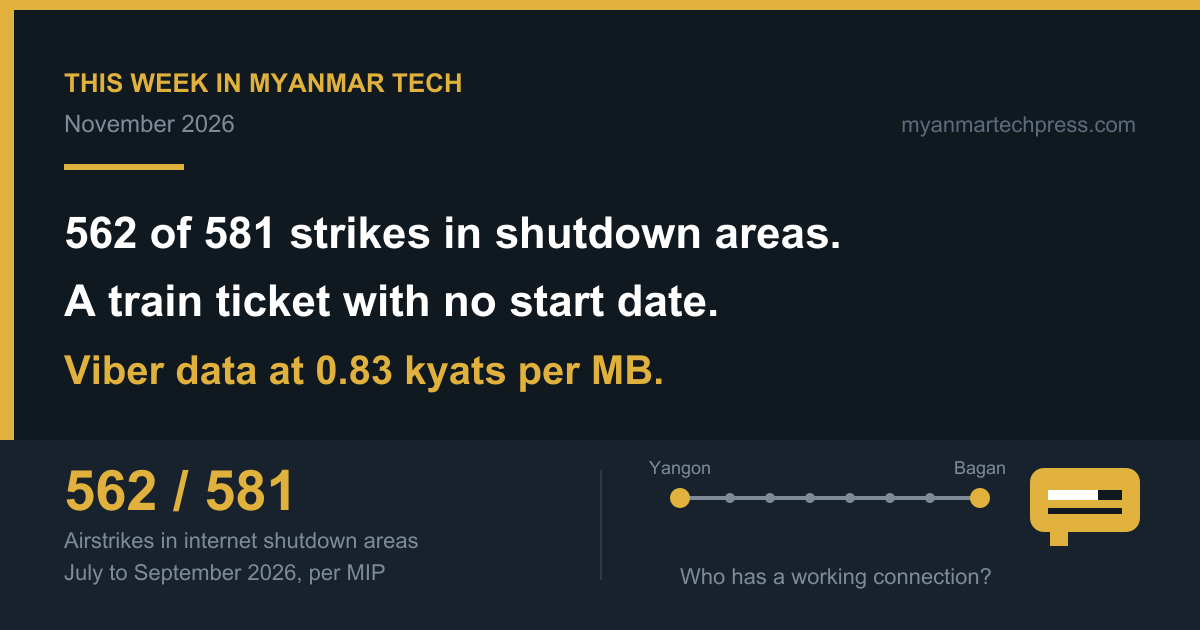
Once a week, this column puts the stories we published side by side, checks them against our archive, and names a few things that can be verified later. This edition covers the past week. The three stories look unrelated: a quarterly report on airstrikes, a railway ticketing change and a mobile data offer. Read together, they all turn on the same question, which is who has a working connection and who does not.
562 of 581 airstrikes landed in internet shutdown areas
The Myanmar Internet Project (MIP) reported 581 airstrikes between July and September 2026, 562 of them (96.88%) in areas experiencing internet shutdowns, and at least 353 civilians killed. Compared with April to June, strikes rose from 520 to 581 and townships hit from 87 to 99. Rakhine (151), Sagaing (107) and Magway (106) took about 62.65% of the total. Our article noted what the report does not show: it does not define a “shutdown area”, and an overlap of this size shows coincidence of place, not cause.
What we would add now: Two days later we wrote about the Yangon-Bagan train, and the two maps overlap in a way we did not point out at the time. Aunglan, Taungdwingyi and Natmauk, three of the intermediate stops MR listed, are in Magway Region, which MIP ranks among the three most-hit regions this quarter. MIP’s figures are by region and township count, so they do not tell us whether those particular towns were cut off, and we are not saying they were. But it means the question “can passengers at small stations buy tickets online?” is not only about smartphones and bank accounts. On parts of this line, it may also be about whether there is a network at all.
The Yangon-Bagan train is moving to online tickets, “soon”
Myanma Railways told the Global New Light of Myanmar that tickets for trains No. 61 Up and No. 62 Down will move to its ORTP system soon, with no date given. When we checked the portal the day after, stations on the line were already in its menus, and its general rules allow booking up to seven days ahead (five for intermediate stations), against one to three days at the counter today. Fees are 200 kyats per passenger plus an unstated bank transaction fee.
What we would add now: Our article said the risky part is the small stations. Placed next to the MIP report, that risk has a second layer, as described above. There is also a link to the Viber story. ORTP’s homepage names a “bank transaction fee” but no banks or wallets, and ATOM’s announcement names a dial code but no validity period. In both cases the thing a user most needs to know before paying is the thing left out. That is becoming a pattern in our coverage: the headline number arrives first, and the terms arrive later or not at all.
ATOM and Rakuten Viber launched Viber-only data packs
According to a press release, ATOM’s Viber packs cost 549 kyats (200MB plus 24 minutes of on-net calls), 1,299 kyats (1,400MB plus 100% cashback) and 4,999 kyats (6,000MB plus 200% cashback). On our arithmetic that is about 2.7, 0.93 and 0.83 kyats per MB, against about 3.8 for MPT’s 1GB general plan and 15 for ATOM pay-as-you-go. We could not confirm the packs on ATOM’s own site, and the release does not state validity or how the cashback is calculated.
What we would add now: The release mentions ChatGPT inside Viber as a reason to buy. That gives our archive something to say, below. It also connects to the week’s first story in a plain way: an app-only pack is a good deal where the network works, and irrelevant where it has been cut. For readers in the 99 townships MIP counted, the price of a megabyte is not the first question.
From the archive: a different AI in Viber, and a cheaper megabyte
In April 2024 we published Rakuten Viber’s announcement that it had partnered with the AI studio Inflection to bring its assistant Pi to Viber users, described then as “a friend to turn to” and powered by the Inflection-2.5 model. Two and a half years later, the AI that Viber and ATOM name as a reason to buy data is ChatGPT, and the new release does not mention Pi. We have not checked whether Pi is still available in Viber, so we do not claim it was removed. The point is narrower: the AI partner named in Viber’s Myanmar marketing has changed within two years, while the selling line, that AI is a reason to spend more time inside the app, has stayed the same.
The second piece is about price. In August 2024 we reported that MPT offered 10GB of general data for 1,000 kyats as a 10th-anniversary promotion. Treating 10GB as 10,240MB, that is roughly 0.1 kyats per MB, for data usable in any app. ATOM’s best Viber pack today is about 0.83 kyats per MB, usable in one app. That is not a fair comparison: one was a time-limited anniversary promotion, and our 2024 article did not state its validity period. But it is a useful reminder of scale. A Viber-only megabyte that looks cheap against 2026’s regular prices is still about eight times the price of a general megabyte that MPT was selling as a promotion two years ago.
One thing worth watching
Three new items:
- Will Myanma Railways publish a start date, the accepted payment methods, and whether counters stay open for trains 61 and 62, by the end of 2026? Any one of the three would settle part of what “soon” means.
- Will ATOM publish the full terms of its Viber packs on its own website by the end of 2026? Specifically, validity periods and what the 100% and 200% cashback percentages apply to.
- Will MIP’s next quarterly report, covering October to December, define how a “shutdown area” is determined, or give an absolute number of deaths in shutdown areas? The two reports we compared did neither.
Checking earlier items: last week we asked whether anyone would name the two outstanding FATF action items before the February 2027 plenary. A web search on 14 November found no new reporting on that, nor on criteria for the central bank’s FX platform. Yangon’s parking zones also stay open: we found no November reporting on payment methods. The remaining carried-over items, from the Starlink terminals seized in Hopong to 5G base-station counts, had no updates we could find.
About this column
This is a weekly roundup from Myanmar Tech Press. It links the past week’s stories to each other and to our archive, which goes back to 2017, and it ends with items that can be checked in later editions. We publish around two to three news articles a week; this column is where we look back at them with a few more days of context. Earlier editions are in the Articles section.