Radio Free Asia (RFA) reported on 10 November 2026 that a military bombing in Sagaing Region killed eleven people, including four children, and a resident told the broadcaster that a warning failed to arrive because there was no Starlink connection. According to RFA, three gyrocopters approached Nyaung Pin Lay village in Kani Township just before noon, and a school and the surrounding residential area were bombed. Vision Times, citing Myanmar Now, dates the attack to 7 November and says eight people died immediately and three children the next day.
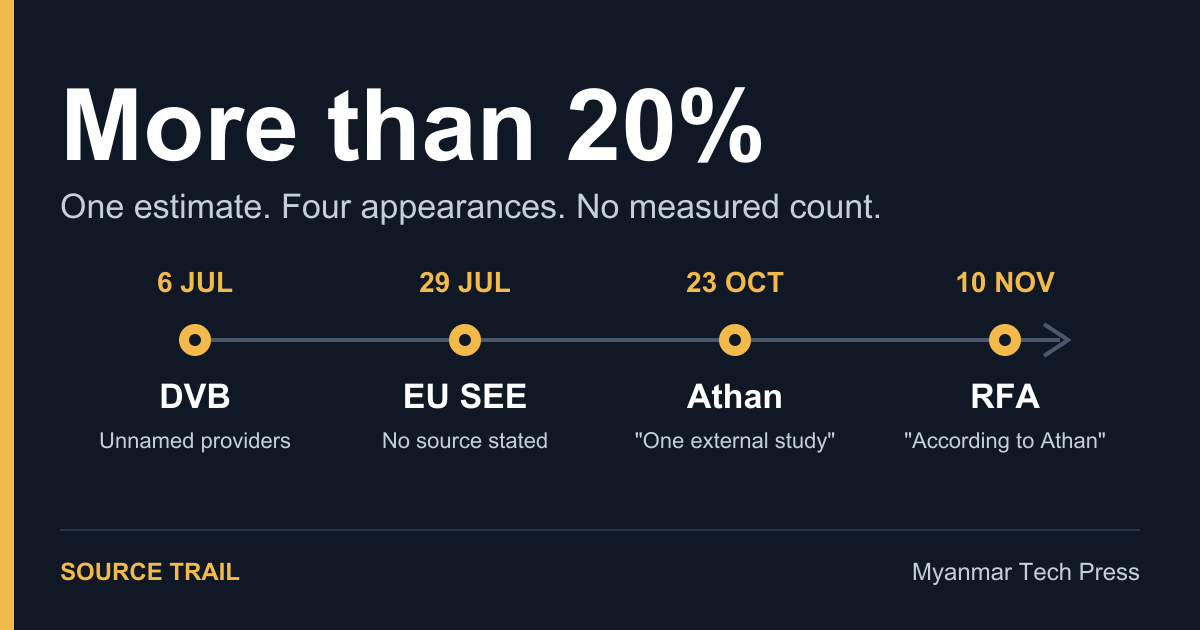
RFA’s article also repeats a number that has been travelling for months: that more than 20 percent of Starlink devices in Myanmar have had their service cut off, “according to a report released on Oct. 23 by the group Athan.” This article follows that number back to its start. The cut-offs are real. What nobody appears to have measured is how large they are now.
What the Kani account does and does not establish
The account of the warning failure comes from one anonymous Kani Township resident, and MTP has not verified it independently. RFA reports that the local People’s Defense Force received a tip about the attack, but that the warning could not reach the village in time. The resident told RFA: “Information that this would be bombed was sent online to everyone. They did inform us.” The same person said: “But because there was no Starlink communication, casualties were high as a result.” About a month earlier, the resident said, residents of another village received the exact location of a planned strike, cleared the area, and there were no casualties.
The resident did not say why there was no connection in the village. RFA places the case within SpaceX’s restrictions, but nothing quoted in the article establishes that a SpaceX deactivation caused this outage. Athan’s report is explicit that loss of communication “cannot be attributed to a single cause”. It lists military-controlled network shutdowns, towers and lines damaged by fighting, resistance groups temporarily restricting public Starlink access for operational security, and SpaceX plan and eligibility decisions.
RFA asked SpaceX about the civilian impact and had no response at publication. A spokesperson for the military-appointed president’s office, Khaing Khaing Soe, referred RFA to the Ministry of Digital Development and Communications when asked when service might be restored.
The “more than 20 percent” figure, step by step
MTP traced the figure through four publications. None of them adds a new measurement.
| Date | Source | What it says | Basis given |
|---|---|---|---|
| 6 July 2026 | DVB English | “Service providers estimate that more than 20 percent of the Starlink terminals currently active in Myanmar have been deactivated.” | Unnamed service providers, no method. Earliest appearance MTP found. |
| 29 July 2026 | EU SEE | Tighter enforcement “has already resulted in the deactivation of over 20 percent of active terminals inside the country.” | No source stated. |
| 23 October 2026 | Athan, Dead Air, printed page 31 | “One external study reported that service had been suspended for more than (20) percent of the Starlink terminals that had remained active in Myanmar.” | Footnote 45 cites the EU SEE alert. Athan’s own survey did not measure this. |
| 10 November 2026 | RFA | “Since June, more than 20 percent of Starlink internet devices used in Myanmar have had their services cut off, according to a report released on Oct. 23 by the group Athan.” | Attributed to Athan. |
A few points on fairness. EU SEE gives no source, so MTP cannot show that it took the figure from DVB; the wording and timing are consistent with that, and DVB is simply the earliest appearance we found. RFA’s attribution is understandable, because the sentence does sit in Athan’s report. But Athan cites it as an external study, not as its own finding. Athan’s text also describes the disruption period as June through July 2026, so the phrase “by October” in RFA’s later sentence is not in Athan’s wording.
The timing matters most. The estimate dates from July, before the Roam rule reached existing customers on 17 August 2026. Under that rule, as Athan describes it, a terminal cannot be used outside its country of registration for more than 30 consecutive days without re-registering or moving to a Global Priority plan. Studies cited by Athan estimate that this could raise a terminal’s monthly operating cost from about MMK 500,000 to MMK 3,000,000, although the actual amount varies. The July estimate therefore cannot show the rule’s full effect, although EU SEE did link the deactivations to tighter enforcement under the Roam policy. The current number of cut-off terminals is unknown. MTP covered the Roam rules in an earlier article on Starlink’s new roaming rules.
None of this means the cut-offs are exaggerated or unimportant. SpaceX said in October 2025 that it had disabled more than 2,500 terminals, and Athan documents devices showing “Region Restricted” and “Country Restricted” messages. Only the size is unmeasured.
What Athan’s survey does measure
Athan’s Dead Air report is based on a 43-question survey of 130 respondents in 24 purposively selected townships (21 in Sagaing, 3 in northern Mandalay), carried out from 30 August to 12 September 2026, plus one key-informant interview. Athan states that because townships and respondents were not randomly selected, the findings cannot be generalized to everyone in the study area. Within that limit, it shows how people in these areas actually receive information.
- Network access. The headline 92.3 percent means respondents who did not have full access. Only 10 of 130 (7.7 percent) had full access; 72 (55.4 percent) had partial access, 35 (26.9 percent) occasional access and 13 (10.0 percent) none.
- Timely warnings. 60 respondents (46.2 percent) said they received warnings in time, 42 (32.3 percent) were uncertain, and 26 (20.0 percent) said they did not receive them in time. Two did not answer. This 20.0 percent is a different number from the terminal figure above, and the two should not be confused.
- Lost information. 93 respondents (71.5 percent) lost access to warnings about airstrikes or military operations after networks were shut down, and 96 (73.8 percent) said the lack of information affected decisions about leaving home, evacuating or staying.
- Channels during shutdowns (multiple answers allowed). ICOM two-way radios were used by 106 (81.5 percent), Starlink or other satellite by 79 (60.8 percent), travelling to areas with coverage by 33 (25.4 percent), and community leaders by 26 (20.0 percent). ICOM users rose from 27 before the shutdowns to 106 during them.
- How threats are learned (multiple answers allowed). Word of mouth 81 (62.3 percent), community early-warning networks 61 (46.9 percent), hearing aircraft or gunfire 51 (39.2 percent), sentries 27 (20.8 percent), and no reliable method 10 (7.7 percent).
Read together, these numbers describe a chain rather than a single dependency. Radios and satellite internet both carry much of the load, and word of mouth passes the message on. Hearing aircraft or gunfire was the third most common answer, and Athan points out that this is not an advance warning at all.
Why one disabled terminal can reach many people
Athan asked who owns the terminal people actually use. Of 127 respondents who answered, only 14 (11.0 percent) named their own household. Commercial Starlink shops accounted for 46 (36.2 percent), community access points 28 (22.0 percent), civil society organisations 18 (14.2 percent), a neighbour 8 (6.3 percent), resistance forces 6 (4.7 percent), unnamed organisations 5 (3.9 percent), and other or unknown 2 (1.6 percent).
One local education official estimated that Starlink access cost about MMK 500 to 2,000 per hour in some surveyed areas in early 2026. Among 114 respondents who answered a question on travel, 51 (44.7 percent) travelled at least two hours to reach connectivity, while 32 (28.1 percent) could reach it within 30 minutes.
This is MTP’s reading, not a finding of the report: if most access is shared, a single deactivated terminal is not one household losing service. It may be a shop or community point that many people rely on. Even a reliable count of terminals would therefore say little about how many people lost access.
The trade-off SpaceX has not explained
Enforcement against scam operations is a legitimate aim, and MTP has reported on it before in our article on the Hopong raid. The difficulty is that restrictions aimed at one use can fall on another, and from the outside it is hard to tell which has happened. Civilian users also have little room to respond. Athan notes that Starlink is not officially licensed or sold as an authorized service in Myanmar, so owners and service providers face legal and security risks.
Athan makes several recommendations to SpaceX: an affordable humanitarian service plan, advance notice of changes, a clear explanation of why a device is “Region Restricted” or “Country Restricted”, an appeals process for civilian, humanitarian and media users, assessment of individual devices rather than blanket restrictions on every device in an area, and a dedicated support channel for verified civil society and humanitarian organisations. It also urges donors to support integrated systems that connect satellite internet, ICOM radios, loudspeakers and community warning networks “to avoid dependence on Starlink alone.”
Opinion. Of these, explaining restrictions and offering an appeals process look the cheapest for SpaceX to start with, since neither requires a new product. Publishing even an aggregate count of restricted terminals in Myanmar would settle the 20 percent question that has been passed from report to report. Until then, the figure is likely to keep being repeated without a measurement behind it.
What to watch
- Whether SpaceX publishes numbers, explanations of restrictions or an appeals route.
- Whether the Ministry of Digital Development and Communications gives any timeline for restoring service.
- A measured count of active and restricted terminals, from any source that states its method.
For wider context on shutdown patterns, see MTP’s earlier article on the MIP Q3 shutdown data.
Frequently asked questions
How many Starlink terminals have been cut off in Myanmar?
No current measured figure is public as far as MTP can find. The widely quoted “more than 20 percent” traces to a July estimate attributed to unnamed service providers, and it predates the Roam rule’s 17 August effective date. The cut-offs are documented; their present scale is not.
Is Starlink legal in Myanmar?
According to Athan, Starlink is not officially licensed or sold as an authorized service in Myanmar, and terminal owners and service providers face legal and security risks. The report cites a military raid on a Starlink shop in Chaung-U Township on 12 May 2025, in which 27 people were arrested, as documented by the Myanmar Internet Project.
Why do people in Sagaing rely on ICOM radios?
In Athan’s survey, ICOM radios were the most-used channel during shutdowns, at 106 of 130 respondents (81.5 percent), up from 27 users before the shutdowns. A local education official estimated a household radio at about MMK 280,000 to 400,000, and a village system with radio, loudspeakers, wiring and power at MMK 4 to 5 million.
What did Athan’s Dead Air report find?
That 92.3 percent of respondents lacked full network access, that 71.5 percent lost access to warnings after networks were shut down, and that only 46.2 percent said they received warnings in time. The sample was 130 purposively selected respondents, so it is not generalizable.
Takeaway
The Kani account, if accurate, shows what a missed warning can cost, but it does not say why the connection was down. The 20 percent figure is a July estimate with thin sourcing that has gained authority through repetition. The stronger evidence is Athan’s survey: among its respondents in Sagaing and northern Mandalay, warnings depend on radios, shared terminals and word of mouth together, and Starlink is one link in that chain.
Sources: Radio Free Asia (RFA Burmese), “No internet, no advance warning: 11 killed in Myanmar military bombing in Sagaing”, 10 November 2026, rfa.org. Athan, “Dead Air: A Study of Communication Shutdowns in Conflict-Affected Areas of Sagaing Region and Northern Mandalay Region”, 23 October 2026, English PDF (landing page: athanmyanmar.org/dead-air). EU SEE, “SpaceX enforces stricter Starlink Roam policies, triggering widespread internet disruptions and civil society pushback”, 29 July 2026, eusee.hivos.org. DVB English, “Starlink disruptions hit Myanmar amid crackdown on cyber scam hubs”, 6 July 2026, english.dvb.no. Vision Times, “Myanmar Junta Strikes Kill 11 in Sagaing as Starlink Outages Isolate Communities”, 16 November 2026, visiontimes.com, used only for the 7 November date and the toll breakdown, which it attributes to Myanmar Now. MTP read the English PDF of Athan’s report and did not read the Myanmar Now article.