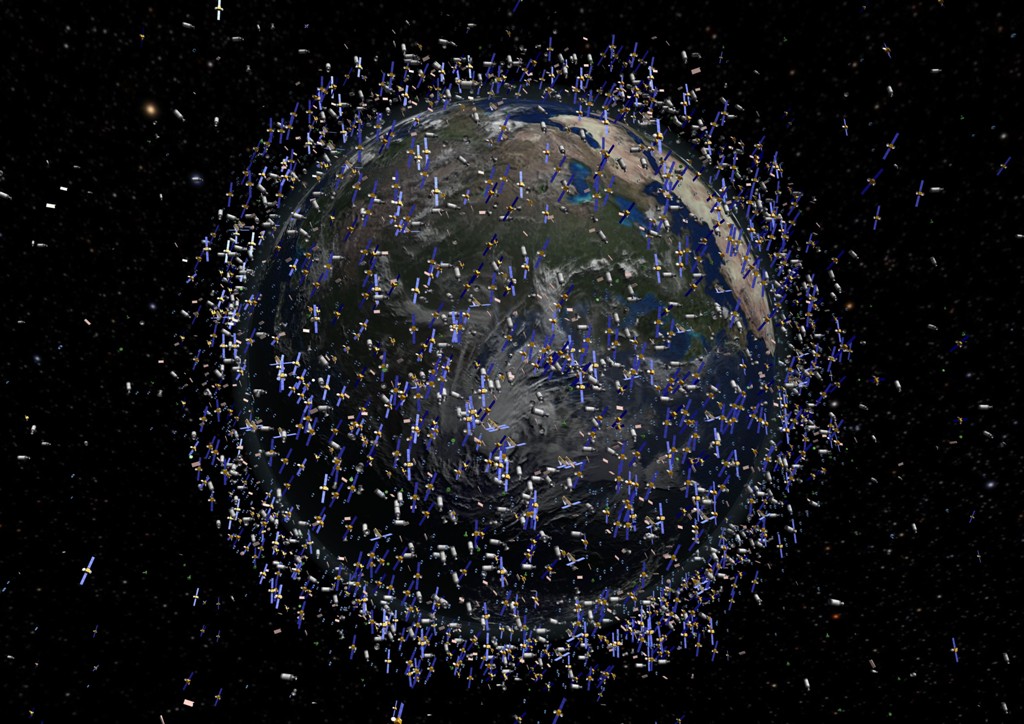
Image Source: https://www.universetoday.com
Garbage is whatever people throw away because they no longer need it. How we dispose of it and manage it varies depending on how developed a society is. Without proper systems for disposal and management, the environment gets dirty first, and over time that pollution starts affecting people’s health. That’s exactly why both individuals and government bodies need to keep up regular, systematic waste management.
But that’s only talking about the garbage here on Earth, the kind that affects us directly. Out beyond what most people ever see — in outer space — there’s also a huge amount of garbage. It has no direct contact with humans, but at times it can still cause us real harm. Based on a report from Internet Journal, here’s a closer look at this space garbage problem.
Broadly speaking, garbage refers to all sorts of objects and materials discarded because people no longer need them. If you added up everything humans throw away every single day across the planet, it would come to millions of tons. We deal with it through incineration, recycling for energy, and landfilling, but as material goods keep advancing, the percentage of waste we generate keeps climbing too.
Environmentalists working toward a cleaner, garbage-free Earth have made real progress here on the ground. But look beyond Earth — into outer space — and you’ll find our planet surrounded by what’s called “space junk”: debris and defunct satellite fragments.
Ever since the Soviet Union launched Sputnik in 1957, kicking off the era of human space exploration, hazardous debris has been accumulating in orbit — for nearly 60 years now. Scientists estimate there are more than 100 million pieces of space debris, a number that keeps growing every day, and they warn it poses a serious threat to future space missions. Scientists say collisions and damage caused by space debris are now something we deal with multiple times every year.
Space debris — also called “space junk” — includes old, defunct satellites, leftover pieces from rocket launches, and any fragments created when these objects collide with each other. According to a July 2013 estimate, roughly 170 million pieces of debris smaller than 1 centimeter, about 670,000 pieces between 1 and 10 centimeters, and around 29,000 larger pieces were orbiting the Earth.
Currently, about 19,000 pieces larger than 5 centimeters and roughly 300,000 pieces smaller than 1 centimeter have been tracked at around 2,000 km above Earth’s surface. Spacecraft can maneuver to avoid objects larger than 10 centimeters. But if a spacecraft weighing 1,000 kg were struck by a piece of debris weighing just 1 kg traveling at 10 km per second, it would be shattered to pieces. So while space debris doesn’t directly harm Earth itself, it poses a serious risk to the many satellites humans rely on for communications.
Back in 1946, Fred Whipple proposed that small objects entering Earth’s atmosphere from space lose their velocity due to friction and can fall to the ground as metal or rock fragments. Building on that idea, researchers went on to discover that debris was steadily accumulating outside Earth’s atmosphere. Much of it isn’t meteorite fragments from asteroids or comets, but defunct satellites and discarded rocket parts that people no longer needed — plus fragments created when those objects collide with one another. The longest-surviving piece of debris is the U.S. Vanguard 1 satellite, launched in 1958, which remains in Earth’s medium orbit as space junk to this day.
Looking at documented incidents attributed to space debris: on July 24, 1981, Russia’s Kosmos-1275 satellite lost contact just a month after launch, leaving behind around 300 fragments. On August 11, 1993, the European Space Agency’s Olympus-1 satellite was struck by a meteoroid and drifted out of its orbit. On July 24, 2006, France’s Cerise satellite was disabled after being hit by debris from an Ariane-1 rocket engine. And in 2009, Russia’s Kosmos-2251 and the U.S.’s Iridium 33 collided head-on, creating a large debris field.
Looking at all this, it’s easy to see how space debris can indirectly affect us. If space debris really does surround the planet along its orbits like this, you might wonder why we never see it in photos taken of Earth by satellites and spacecraft. It’s a fair question, and one worth answering. The reason is simple: the debris is extremely far from the international space stations and cameras taking those photos, the debris itself is extremely small, and Earth is enormous by comparison — all of which makes it invisible in images.
Even photographing a reasonably large piece of debris would only show it as an indistinct object, not something you could identify in detail. And despite being small, these fragments are moving at extremely high speed, making them genuinely dangerous. So what, if anything, is being done about this hazardous debris?
Ground-based radar and laser instruments are used to track debris, capable of detecting fragments as small as 1 centimeter. NASA also searches for debris using a 3-meter mercury-mirror telescope and studies the surrounding debris environment by observing the surface condition of the Hubble Space Telescope’s solar panels.
Over the past 50 years, the rate of human-made debris re-entering the atmosphere has averaged only about one piece per day. There’s still no comprehensive international agreement on space debris, but the UN’s Committee on the Peaceful Uses of Outer Space does have a set of space debris mitigation guidelines. NASA, the European Space Agency, and international standards bodies are also working together to reduce the amount of debris we send into space.
On top of that, Japan’s space agency, JAXA, launched a cargo spacecraft called Kounotori (meaning “white stork” in Japanese) aboard an H-IIB rocket late last year from the Tanegashima Space Center in southern Japan. Reports noted that the spacecraft was also carrying a space junk collector designed to help clear debris from orbit.
The space junk collector works by using a specially made electromagnetic tether to clear out debris from old satellites and rocket fragments in orbit. The tether — a very thin strip made of stainless steel and aluminum — generates an electrical charge when it comes near a piece of debris. The interaction between that charge and Earth’s magnetic field creates a very gradual drag force on the debris, slowly pulling it down into a lower orbit. Eventually the debris re-enters the atmosphere and burns up completely before it can reach the ground and put anyone at risk, JAXA said in its announcement.
JAXA has been working with Nitto Seimo, a Japanese company that manufactures nets and cords, for about 10 years to develop this specialized electromagnetic tether. The tether is woven from extremely thin stainless steel and aluminum strands and measures about 700 meters (roughly 2,300 feet) long, according to Nitto Seimo engineer Katsuya Suzuki, who spoke to AFP.
JAXA currently considers its space junk collector to still be in the testing phase, but a JAXA spokesperson said the agency expects the technology to see widespread adoption among leading spacefaring nations by around the middle of the next decade, roughly 2025. Taking the lead on any effort is often the best approach, and being able to clear hazardous space debris sooner rather than later also helps prevent unwanted problems down the road.
Given how much money goes into launching the many satellites that our society relies on for so many things, losing one to a single worthless piece of debris would come at a real economic cost. That’s part of why experts have called for countries to openly share their debris-clearing technologies internationally, rather than keeping them to themselves — which is worth keeping in mind as we think about the dangers posed by space debris.