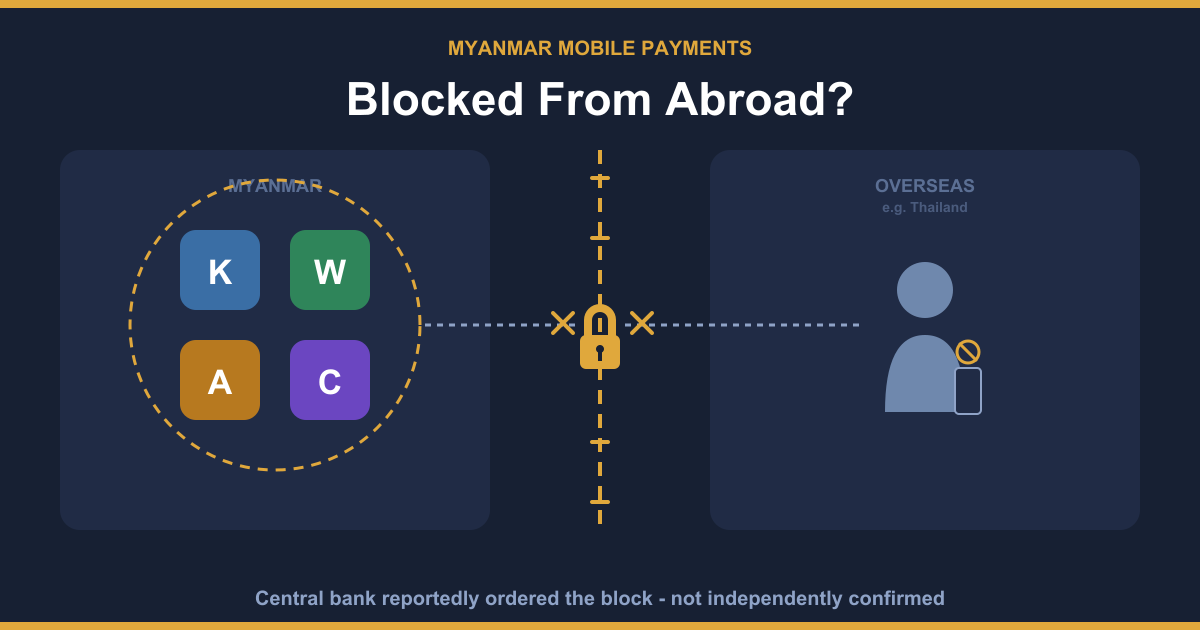
Myanmar’s central bank has instructed local banks and mobile payment operators to introduce technical restrictions that would prevent apps such as K-Pay, Wave Money, AYA Pay and CB Pay from being accessed outside the country, according to a report published by MoeMaKa on August 28, 2026. The restrictions are reported to have been set to begin that same day. A day later, the Arakan-focused outlet Development Media Group (DMG) published a follow-up describing how residents in Rakhine State fear losing access to remittances from relatives working abroad. Frontier Myanmar’s financial services desk also covered the same story around the same period, though that report sits behind a paywall.
What follows is what has actually been confirmed by these reports, what remains unverified, and why this fits a pattern that has been building since at least last year.
What the Central Bank of Myanmar (CBM) Reportedly Instructed Banks to Do
According to MoeMaKa’s sourcing, the Central Bank of Myanmar told commercial banks and payment service providers to implement technical measures — commonly known as geo-blocking — so that their mobile banking and e-wallet apps would refuse connections originating from outside Myanmar. The apps named in the report are K-Pay (operated by Kanbawza Bank, Myanmar’s largest mobile payment platform by user base), Wave Money (linked to Yoma Bank), CB Pay and AYA Pay, along with other banks’ mobile banking apps more broadly. The instruction reportedly set August 28, 2026 as the start date for the restriction.
That is the extent of what has been reported about the order itself. Neither the Central Bank nor any of the named payment operators has issued a public statement confirming the instruction, its scope, or its timeline, based on the sources reviewed for this article.
Announcement, Not Confirmed Enforcement — Here’s the Distinction That Matters
This is the point that is easiest to lose in a story like this, so it’s worth stating plainly: as of MoeMaKa’s reporting on the morning of August 28, 2026 — the same day the restriction was supposed to take effect — the apps in question were still accessible from outside Myanmar, and some banks told the outlet they had not yet received formal instructions from the central bank at all.
In other words, at the moment this story broke, the order existed as a directive that had reportedly been issued, not as a measure that had been verified to be operating. Whether the geo-blocking was subsequently rolled out, partially rolled out, delayed, or quietly dropped is not something any of the sources reviewed here can confirm. Readers should treat “CBM orders block” and “CBM has blocked” as two different claims, and only the first one is currently supported by reporting.
This Isn’t Myanmar’s First Move Against Overseas Access to Mobile Payments
Here is where the story connects to something that happened well before August 2026. In March 2025, KBZPay — a separate wallet from the ones named in this latest order, but run by the same bank group as K-Pay — suspended transfer functions for accounts that had been opened using Thai phone numbers, and told affected users to switch to Myanmar-registered numbers if they wanted to keep sending money.
That earlier move was narrower in three ways: it targeted one operator rather than the whole sector, it targeted accounts registered with foreign SIM numbers rather than foreign IP addresses or physical location, and it appears to have been a decision made by the bank itself rather than a directive issued by the central bank to the entire industry. The August 2026 order, if implemented as reported, would be broader on all three counts — multiple apps, location-based rather than SIM-based, and centrally mandated.
Reading the two events side by side suggests a trajectory rather than an isolated policy: from one bank restricting a subset of foreign-registered accounts, to the central bank apparently directing the whole sector to fence off cross-border access outright. Whether that reading holds will depend on whether the August 2026 order is confirmed and, if so, whether more restrictions follow it. At this stage it is a pattern worth watching, not a conclusion.
Who Would Actually Be Affected: Migrant Workers in Thailand
The population most directly exposed by this kind of restriction is Myanmar migrant workers in Thailand, a group commonly described as numbering in the millions, though — as MoeMaKa itself notes — no precise, verifiable count exists. A significant share of this population relies on apps like K-Pay and Wave Money to send money home to family members, since they offer lower fees and faster transfers than traditional remittance channels for many users.
DMG’s follow-up reporting from Rakhine State puts a human face on this: residents interviewed there described depending on remittances from relatives working overseas to cover living costs, school fees and medical expenses, and expressed concern that losing app-based transfers would also disrupt how humanitarian assistance groups make payments locally. If a broad geo-block is implemented and enforced, an obvious secondary effect — flagged in MoeMaKa’s reporting as a concern among users — is that remittances could be pushed toward higher-cost informal channels (such as hundi-style money transfer networks) rather than disappearing altogether, since the underlying need to send money home doesn’t go away just because the app does.
Why Might the Central Bank Be Doing This? The Motive Is Speculation, Not Confirmed Fact
MoeMaKa’s report describes a suspected motive circulating among observers: cutting off financial channels that fund Myanmar’s anti-junta resistance movement, including the National Unity Government (NUG) and allied groups, some of which have reportedly relied on diaspora and overseas-based supporters moving funds through domestic mobile wallets. This would fit a broader pattern since the 2021 coup of authorities freezing or scrutinizing accounts suspected of funding opposition activity.
It is important to be precise about the status of this explanation: it is attributed to observers and analysts in the reporting, not to any statement from the Central Bank of Myanmar or the named payment operators. No official has publicly confirmed this as the rationale for the order, and no source reviewed for this article provides data on how much resistance-linked funding, if any, actually moves through these specific apps. Readers should treat the funding-disruption motive as the leading theory in circulation, not as an established fact.
Can Geo-Blocking Even Stop a Determined User? The VPN Problem
Even taking the order at face value, its technical effectiveness is an open question. Geo-blocking typically works by checking the IP address or network location a connection originates from, which means a user connecting through a VPN that makes their traffic appear to originate from inside Myanmar could plausibly route around the restriction. IT specialists quoted by MoeMaKa raised exactly this concern — noting that VPN users might still be blocked if the systems performing the geo-check are sophisticated enough to detect and flag VPN traffic specifically, but that this capability is not guaranteed and depends on implementation choices banks haven’t disclosed.
In practice, this means the order’s real-world effectiveness will likely depend on details that haven’t been reported: whether the banks deploy basic IP-country checks (which VPNs can defeat easily) or more advanced detection that also flags known VPN exit nodes (which is harder to defeat but also harder and more expensive to build and maintain across four or more separate banking platforms in a short window). None of the reporting reviewed here indicates which approach, if any, has actually been deployed.
What the Reporting Doesn’t Tell Us
To be transparent about the limits of what’s known at the time of writing:
- Neither the Central Bank of Myanmar nor K-Pay, Wave Money, AYA Pay or CB Pay has issued a public statement confirming, denying, or detailing the order.
- There is no independent confirmation that the geo-blocking was actually switched on for any app as of the reports reviewed here — only that it was reported to have been instructed to begin on August 28, 2026.
- There is no data on transaction or remittance volumes that would be affected, making it impossible to quantify the financial impact.
- The technical method (basic IP geo-check vs. VPN-aware detection) has not been disclosed by any operator.
- The stated motive is attributed to unnamed observers, not to any official source.
Given these gaps, this article will need a follow-up once — or if — banks, the central bank, or affected users confirm whether the block is actually in effect.
Frequently Asked Questions
Has Myanmar’s central bank actually blocked overseas access to K-Pay and Wave Money?
As of the reporting reviewed here (MoeMaKa, August 28, 2026), the order had reportedly been issued with a same-day start date, but at the time of that report the apps were still accessible from abroad and some banks said they had not yet received formal instructions. No source confirms the block is currently active and enforced.
Which apps are named in the order?
K-Pay, Wave Money, AYA Pay and CB Pay are specifically named, alongside other banks’ mobile banking apps more generally, according to MoeMaKa’s report.
Can I still use K-Pay or Wave Money from Thailand right now?
This article cannot confirm current app access, since the sourced reporting only covers the situation as of late August 2026 and no CBM or company statement has clarified the rollout status since. Users affected by this issue should check directly with their bank or the app itself for the current status.
Is this related to the 2025 KBZPay restriction on Thai phone numbers?
Not the same measure, but arguably part of the same trend. In March 2025, KBZPay separately suspended transfers for accounts registered with Thai phone numbers. This August 2026 order, if implemented, would be broader — covering multiple apps and using location rather than SIM registration as the trigger.
Why would Myanmar’s central bank want to block overseas access to payment apps?
The Central Bank of Myanmar has not stated a reason. Observers cited by MoeMaKa speculate it may be intended to disrupt financial channels used to fund anti-junta resistance groups, but this is an unconfirmed theory, not an official explanation.
The Bottom Line
What can be said with confidence right now is narrower than the headline suggests: Myanmar’s central bank appears to have instructed banks to geo-block mobile payment apps from overseas use starting August 28, 2026, but as of the most detailed reporting available, that instruction had not yet been confirmed as operational, no official body had commented on it, and its likely effectiveness against VPN users is itself uncertain. Set against the March 2025 KBZPay restriction, it reads as another step in a gradual tightening of who gets to move money in and out of Myanmar’s mobile finance system — but with real uncertainty about how far, or how effectively, this particular step has actually been carried out. The clearest fact in this story may be the one least discussed in the reports themselves: millions of Myanmar workers in Thailand who rely on these apps to send money home are currently watching a policy whose real-world status even the banks handling their money say they can’t confirm.
Sources: MoeMaKa, “Central Bank instructs banks to prevent Myanmar banking apps from being used abroad,” published August 28, 2026 (moemaka.net). Development Media Group, published August 29, 2026 (dmediag.com). Frontier Myanmar Financial Services Monitor, published August 27, 2026, headline and publication date confirmed; full article behind paywall (finance.frontiermyanmar.com). Eleven Myanmar, “KBZ Pay says only local phone numbers can be used with accounts,” published March 21, 2025 (elevenmyanmar.com).