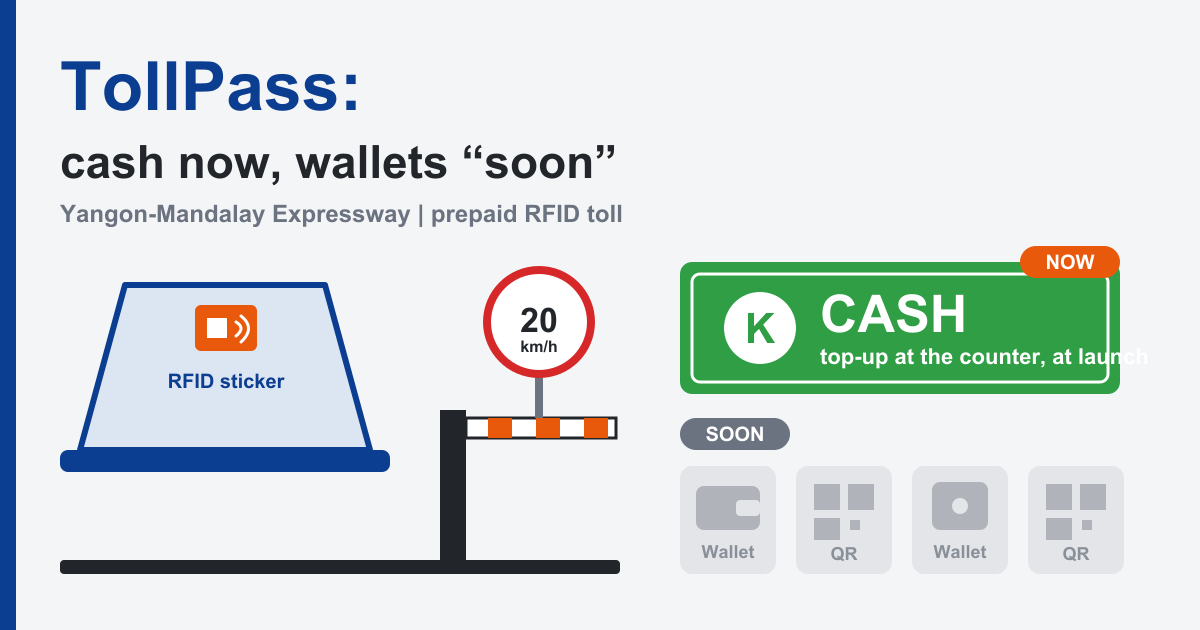
On 17 September 2026, a new prepaid RFID toll system called TollPass began selling and installing stickers on the Yangon-Mandalay Expressway, replacing the older Ez Go electronic toll system. Eleven Media Group, citing the Expressway Maintenance, Repair and Supervision Team, reported the plan on 17 September, and One News Myanmar, citing the Ministry of Construction, followed on 18 September. On 30 September the state-run Global New Light of Myanmar (GNLM) said 567 vehicles had been fitted between 17 and 25 September.
The launch itself is a fairly ordinary infrastructure upgrade. What makes it interesting for a technology and payments site is the detail buried in the announcements: at launch, payment was accepted in cash only, while MMQR, KBZ Pay, AYA Pay and WAVE Pay were said to be “available soon”, with no date. This article looks at about three weeks in what has been delivered against what was promised, who the prepaid model suits, and what the app’s trip history means for drivers.
What TollPass actually changes for drivers
According to the coverage, the process is as follows. Owners go to one of three counters, bring a smartphone, the vehicle and the vehicle registration card (the Wheel Tax card issued by the Road Transport Administration Department), install the app, record the vehicle’s information, have an RFID sticker attached, and make an initial top-up. Counters are open 9:30am to 4:30pm every day, with no holidays, according to Eleven and GNLM.
The three initial counters are Toll Gate No. 3 (milepost 0, 7 furlongs), C Junction Toll Gate (201 miles 3 furlongs) and Sakar In (Zagar Inn) Toll Gate (352 miles 4 furlongs). Eleven reports that vehicles use a dedicated TollPass lane at a maximum of 20 km/h, and the barrier opens automatically, so there is no queuing to pay at the booth.
A fee of K20,000 covers the RFID sticker plus one year of service, and it must be paid each time a new sticker is installed (Eleven, One News and GNLM all give this figure). Tolls are then deducted according to Road Transport Administration Department rates, by vehicle class and the distance between gates. Eleven gives one worked example: a Class 1 vehicle entering at Toll Gate No. 3 from Yangon and travelling to Phyu Toll Gate (milepost 115) would have 1,500 Toll Pass Units (TPU) deducted.
The payment gap: a digital toll that launched on cash
Both Eleven and One News say that at launch only cash is accepted, with four online methods, MMQR, KBZ Pay, AYA Pay and WAVE Pay, to follow “soon”. Neither gives a date. The GNLM report of 30 September does not mention online top-ups at all. As of 10 October 2026, MTP searched for an announcement that any of the four has gone live and did not find one. That is not the same as saying they are unavailable, since an operator could switch on a method without a press notice, but a driver reading the coverage would have no way to know.
This matters because mobile wallets are the everyday payment rails for a large share of people in Myanmar, and a system whose pitch is convenience (“no queuing, no manual card top-up”) loses part of that pitch if the first top-up and every later one still means finding a counter with cash. The old Ez Go system, per Eleven, required an onboard unit and a visit to a counter to top up cards manually. If TollPass top-ups are also counter-and-cash for the foreseeable future, the visible gain is the hardware and the lane, not the payment experience.
It also fits a pattern MTP has been tracking. Wallets are central to daily life, yet their reach into state services and cross-border use depends on regulators and integration work that lags behind. We covered one side of that in our report on the Central Bank of Myanmar reportedly ordering banks to block K-Pay, Wave, AYA Pay and CB Pay overseas on 9 September 2026. The toll story is the domestic mirror image: nobody is blocking the wallets here, but a government service has launched without them. “Soon” with no date is the thing to watch.
Is a closed-loop, non-refundable prepaid balance a good fit for you?
Eleven reports that money deposited is converted into TPU, cannot be withdrawn as a refund, and is valid for one year from the date the RFID sticker is issued. That is a closed-loop prepaid model: the balance is only good for this one purpose, and only for a limited time.
For a commuter, a freight operator or a bus company that drives the expressway often, that is probably fine, since the balance will be spent well within a year. For an occasional driver who makes a couple of trips a year, the trade-offs are sharper. Money sits idle in a balance that cannot be returned, and the K20,000 sticker-plus-service fee is paid up front regardless of how often the car travels. The sticker fee covers one year of service, and the reports do not say what continuing after that first year will cost.
Whether that is a bad deal depends heavily on the minimum first top-up, and here the coverage disagrees. One News and GNLM say the minimum initial top-up is 50,000 kyats. Eleven says “at least 5,000 Toll Pass Units (TPU)”. MTP could not confirm which is correct, and none of the reports states the official TPU-to-kyat conversion rate. The Eleven worked example (1,500 TPU for the Yangon to Phyu run) at least suggests the unit is sized for real trips, but without a rate we cannot turn that into a kyat figure. If the minimum is 50,000 kyats, an occasional driver is tying up a considerable sum; if it is 5,000 TPU at an unknown rate, the picture could be very different. Before paying, ask the counter staff to state the minimum in kyats and get it in writing or in the app.
From an in-car unit to a sticker: why the hardware shift probably matters
Eleven describes Ez Go as needing an Onboard Unit (OBU), while TollPass uses an RFID sticker. GNLM’s stated reason for the change is that Ez Go “had become outdated with aging equipment”, and Eleven calls TollPass more convenient, compact and secure.
The following is MTP’s analysis, not an official statement: a sticker is generally cheaper to produce and easier to install than a powered in-vehicle unit, which makes it far simpler to fit thousands of vehicles quickly. The reported 567 fitted vehicles in the first nine days is consistent with a sticker-based approach being quick to roll out. The coverage does not say who built TollPass, how much it cost, or when Ez Go launched or how many users it had, so we cannot say whether the replacement is mainly about cost, reliability or something else.
What the app records, and what the coverage does not say
Eleven and GNLM both say the app (GNLM calls it the MyTollPass Application) shows the vehicle’s TPU balance and usage history: the gate passed, the timestamp and the toll deducted. In practice that means the account holds a log of where a registered vehicle entered and left the expressway and when, linked to a vehicle registration and a smartphone.
For the driver this is useful, because it makes disputed deductions checkable. It is also a data set. None of the coverage we found mentions a privacy policy, how long trip records are retained, or who can access them. MTP is not suggesting misuse; this is simply a gap in the published information, and it is one worth noticing as more services tie a person or vehicle to a digital identity. We looked at a related thread in our reports on the UID digital ID pilot (14 September 2026) and on CEIR phone registration (7 September 2026). Each new system that asks you to register a device or a vehicle is a good moment to ask what is stored and for how long.
Three weeks in: delivered versus promised
Delivered: sticker sales and installation began on the announced date, 17 September, at all three announced counters; GNLM reported 567 vehicles fitted by 25 September; the dedicated-lane and automatic-barrier approach is operating.
Still open: no announced date for wallet and QR top-ups; a disputed minimum top-up figure; no stated TPU-to-kyat rate; no word in the coverage on what happens to remaining Ez Go card balances; and no published data-handling policy. The operators themselves describe the system as being in a trial phase. GNLM says the technical team is fixing minor errors and asks users to tell on-duty staff, while Eleven reports the operator asking for patience over possible software or barrier glitches and listing hotlines.
One caution on scale: no source gives the total number of vehicles using the expressway, so we cannot say what share of traffic the 567 represents, and we are not going to guess.
FAQ
How do I get a TollPass sticker on the Yangon-Mandalay Expressway?
Go to one of the three counters (Toll Gate No. 3, C Junction or Sakar In) with a smartphone, your vehicle and your vehicle registration card. You install the app, record the vehicle details, have the sticker attached and make the first top-up. Counters open 9:30am to 4:30pm daily, per the reports.
How much does TollPass cost?
The sticker and one year of service cost K20,000, payable each time a new sticker is installed. Tolls are deducted from your balance by vehicle class and distance between gates. The minimum first top-up is reported as 50,000 kyats by One News and GNLM, and as 5,000 TPU by Eleven. MTP could not confirm which is right.
Can I top up TollPass with KBZ Pay, AYA Pay, WAVE Pay or MMQR?
These were described as “available soon” at launch, with no date. As of 10 October 2026, MTP found no announcement that they have launched. Early coverage said payment at launch was cash only. Check with the counter or in the app before relying on a wallet.
Can I get a refund of my unused TollPass balance?
Per Eleven, no. Deposits are converted to TPU, cannot be withdrawn as a refund, and are valid for one year from the date the sticker is issued.
Is Ez Go still in use?
TollPass replaces Ez Go, according to the coverage, but the reports do not say when Ez Go lanes will be retired or what happens to balances remaining on Ez Go cards. Ask at a counter if you hold one.
What to watch next
The takeaway after about three weeks: TollPass is a sensible hardware upgrade that arrived on schedule, but as a digital payments story it is unfinished. A prepaid, non-refundable, one-year balance suits frequent expressway users, and it is a harder sell to occasional ones, especially while the minimum top-up is unclear and wallet top-ups have no date. The watch items:
- Whether MMQR, KBZ Pay, AYA Pay and WAVE Pay top-ups are announced and switched on, and whether they arrive together or one at a time.
- A single, official statement of the minimum first top-up in kyats and the TPU-to-kyat rate.
- Whether counters expand beyond the three initial ones, and whether sales volumes beyond the 567 reported to 25 September are published.
- Whether old Ez Go lanes and cards are retired, and what happens to leftover Ez Go balances.
- Whether any privacy or data-retention information is published for the app’s trip history.
Sources: Eleven Media Group (Eleven Myanmar), “Prepaid automatic toll collection system to be introduced on Yangon-Mandalay Expressway from September 17”, published 17 September 2026 – elevenmyanmar.com. One News Myanmar, “TollPass RFID sales to launch on expressway”, published 18 September 2026 – onenewstvchannel.com. Global New Light of Myanmar, “Over 500 vehicles fitted with RFID-based TollPass System on Yangon-Mandalay Expressway”, published 30 September 2026 – gnlm.com.mm. Related MTP coverage: CBM and overseas mobile payment apps (9 September 2026); Myanmar UID digital ID pilot (14 September 2026); Myanmar CEIR phone registration (7 September 2026). Wallet availability status checked by MTP on 10 October 2026. Analysis of the sticker-versus-OBU shift is MTP’s own and is not an official statement.