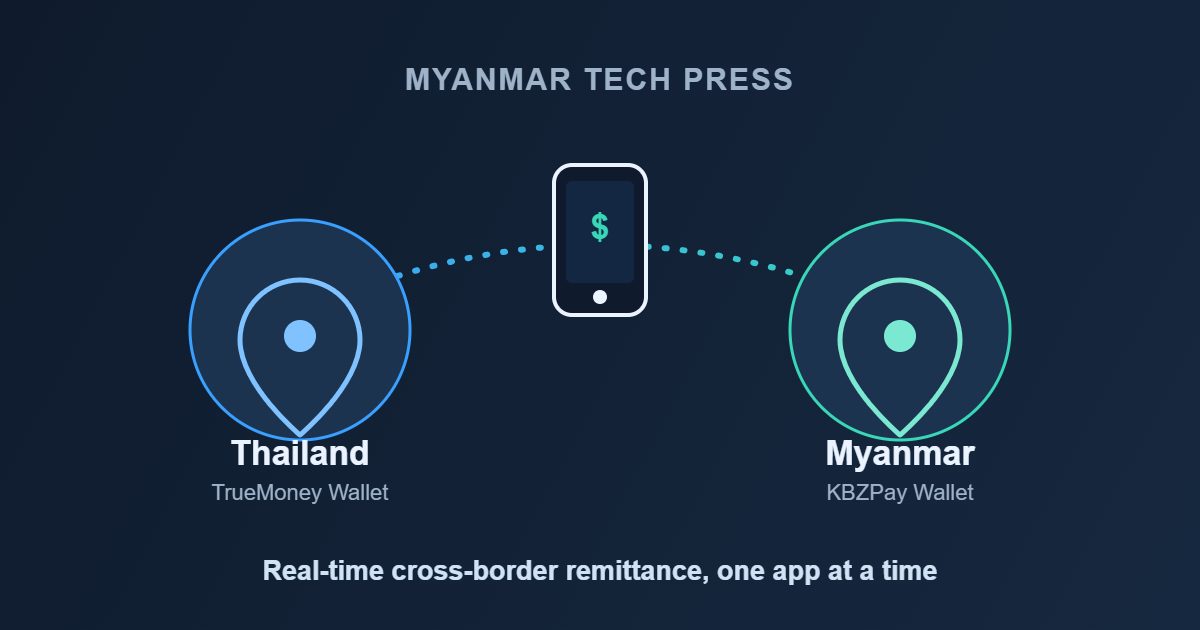
KBZ Bank announced on May 15, 2026 that its mobile wallet KBZPay has partnered with Thailand’s TrueMoney Wallet to let Myanmar migrant workers send money home in real time, with recipients able to withdraw the funds free of charge at KBZ Bank branches and KBZPay Centers across Myanmar. On its own, that’s a modest-sounding update — one more line in the endless stream of fintech “partnership” press releases. But it’s worth pausing on, because this is the third Thailand-to-Myanmar digital remittance tie-up in three years. The pattern says more about Myanmar’s economy right now than any single deal does.
Why this corridor matters
The number of Myanmar nationals in Thailand isn’t a rounding error — it’s one of the largest cross-border migrant populations in Southeast Asia. According to Thailand’s International Organization for Migration (IOM) office, roughly 687,000 Myanmar citizens crossed into Thailand between January and April 2026 alone, mostly through border checkpoints in Tak, Kanchanaburi, Ranong, and Chiang Mai. A separate study by the Thai consultancy Happio, cited in the same IOM-linked reporting, estimates that around 4 million Myanmar nationals now live in Thailand, spending more than 221 billion baht (roughly US$6.7 billion) annually — over 520,000 of them in Bangkok alone.
Every one of those workers is a potential remittance customer. For years, the default way to send money home has been informal and lossy: hundi-style broker networks, cash handed to a bus driver, or fee-heavy money-transfer counters that quietly take a cut out of wages that were often modest to begin with. Digital wallet partnerships are, in effect, a bet that instant app-to-app transfers can pull that volume out of informal channels and into rails both sides can see, track, and — eventually — regulate.
Three deals, three years, one corridor
The KBZPay–TrueMoney tie-up didn’t come out of nowhere. It’s the latest step in a pattern that’s been building since at least 2023:
- August 2023 — KBZPay partnered with Thailand’s K PLUS (Kasikornbank’s mobile banking app) for app-to-app transfers into KBZPay wallets. That deal came with published numbers: transfers of 100,000–5,000,000 MMK per transaction, ATM withdrawal fees of 0–0.5%, and agent/center withdrawal fees of 300–7,800 MMK, with a fee-free promotional window running through October 2023.
- August 2025 — TrueMoney partnered with AYA Pay, a rival Myanmar wallet operated by AYA Bank, offering fee-free withdrawals on the receiving end but disclosing no transaction volume or detailed fee schedule.
- May 2026 — TrueMoney came back around to partner with KBZPay directly, again promising real-time transfers and no withdrawal fee at KBZ locations, again without publishing transaction volumes or a full fee schedule.
Three deals, two Myanmar wallets, two Thai partners, all chasing the same underserved corridor. That’s not coincidence — it’s competition, and competition among remittance providers is usually good news for the people actually sending the money.
What actually changes for a migrant worker
For someone sending part of a Thai wage home every month, the pitch is straightforward: no branch visit in Thailand, funds landing in minutes instead of days, and — per KBZ Bank’s own announcement — no service fee at KBZ’s network on the Myanmar side. Compared with a cash-counter transfer that can take a percentage cut plus a flat fee, removing even a small percentage compounds into real money over a year of monthly transfers.
It’s also a bet on convenience: this deal, like the two before it, is squarely an app-based, phone-in-hand product. For a generation of Myanmar workers already comfortable with KBZPay or AYA Pay for everyday domestic payments, sending money home through the same app they already use — rather than learning a separate remittance service — lowers the barrier to switching away from informal channels.
What the press releases don’t tell you
Read past the announcement, though, and a few gaps stand out:
- No volume data. None of the three deals — 2023, 2025, or this one — has published how much money is actually moving through the corridor. Without that, it’s impossible to tell whether these partnerships are pulling meaningful volume away from informal transfer networks, or mostly serving people who were already banked and already using mobile wallets for other things.
- “Free” still assumes physical infrastructure. Fee-free withdrawal at “KBZ Bank branches and KBZPay Centers” is a much safer assumption in Yangon or Mandalay than in a smaller township. The convenience story is strongest exactly where alternatives were already decent, and weakest where informal networks are most entrenched.
- The fee schedule for the new deal isn’t public. The 2023 K PLUS deal published a full table of limits and fees; this one hasn’t, at least not yet. Migrant workers comparing options have less to go on than they did three years ago.
- Cross-border regulatory risk cuts both ways. Every one of these products depends on a working relationship between a Thai financial institution and a Myanmar one. That relationship — and the compliance and sanctions environment around it — has proven fragile before for Myanmar-linked financial services, and none of these announcements address what happens if it changes.
FAQ: Sending money from Thailand to Myanmar
What’s new in the KBZPay–TrueMoney partnership?
Announced by KBZ Bank on May 15, 2026, it lets users send money from a TrueMoney Wallet in Thailand directly into a KBZ Bank account or KBZPay wallet in Myanmar, in real time, with no withdrawal fee at KBZ’s own branches, ATMs, and KBZPay Centers.
Is this the only way to send money from Thailand to Myanmar digitally?
No. TrueMoney also has a separate partnership with AYA Pay (since August 2025), and KBZPay separately partners with K PLUS (since August 2023) for transfers from Kasikornbank customers in Thailand. Which option is better depends on which wallet the sender in Thailand and the recipient in Myanmar already use.
How much does it cost?
KBZ Bank’s May 2026 announcement doesn’t publish a detailed fee schedule; it states only that withdrawals at KBZ’s own network in Myanmar are free. For comparison, the 2023 K PLUS–KBZPay deal published transfer fees of roughly 50–250 Baht per transaction plus small percentage-based ATM fees, giving a rough sense of what this corridor has cost in the recent past.
Who benefits most?
Migrant workers already using KBZPay or a Thai mobile wallet, and their families in areas with reasonably close access to a KBZ branch, ATM, or KBZPay Center. The benefit is smaller for recipients in more remote areas where cash-out access is limited.
The takeaway
This is genuinely good news for financial inclusion — but it’s progress, not a finish line. With roughly 4 million Myanmar nationals now living and working in Thailand and sending a meaningful share of an estimated $6.7 billion in annual spending back through some channel, the remittance corridor is large enough to deserve more transparency than a stream of press releases currently offers. Actual usage numbers, a public fee schedule, and clarity on cash-out access outside the major cities would tell us whether these partnerships are actually changing behavior — or just giving already-banked customers one more app to choose from.
Sources: KBZ Bank official announcement (May 15, 2026); background on prior partnerships from KBZPay x K PLUS (2023) and TrueMoney x AYA Pay (2025); migrant population and spending figures from Eleven Media Group’s report on IOM data (July 6, 2026).