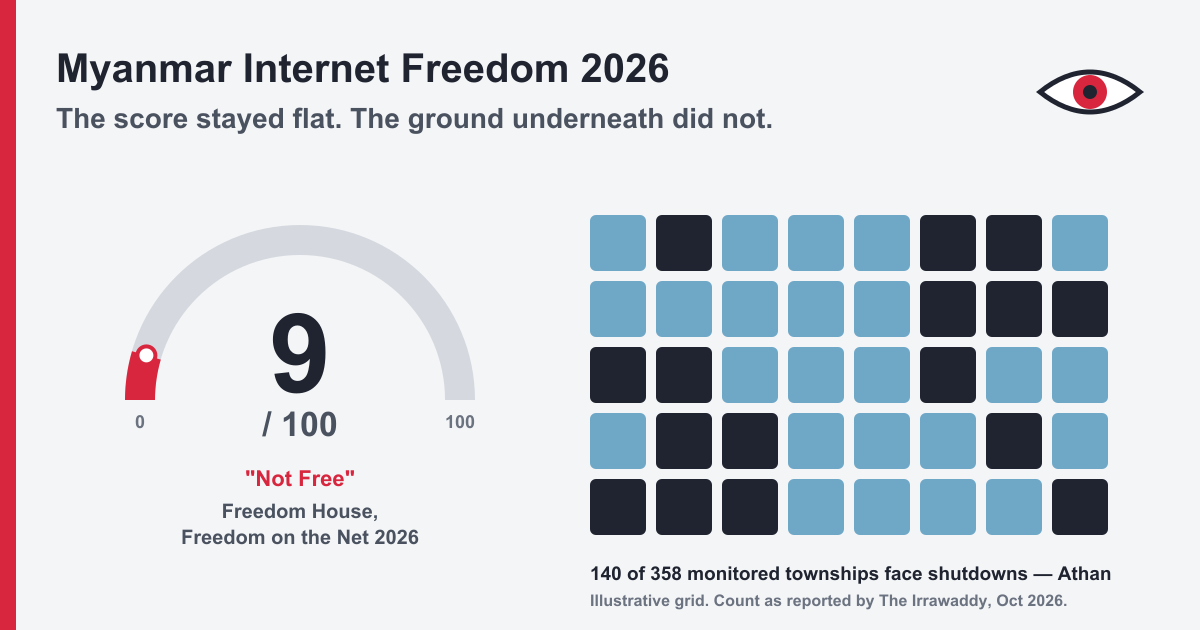
Freedom House has scored Myanmar 9 out of 100 on its Freedom on the Net 2026 assessment, the same figure as the previous year, and its status remains “Not Free”, according to the organisation’s 2026 country page. The Irrawaddy, reporting on the result on 22 October 2026, says this is the third consecutive year at 9 and calls it the world’s worst environment for internet users. Freedom House’s own wording is more careful: “one of the world’s worst”.
A flat score invites a flat headline: “nothing changed.” That would be the wrong reading. Myanmar is already so close to the floor of the scale that the headline number has almost no room left to fall. The more useful question for anyone running a business, a network or a payments product here is what changed underneath it. Three data points from 2026 reporting answer that, and each has a practical meaning for technology readers.
Why a flat 9/100 hides more than it shows
Freedom House breaks the total into three parts. For Myanmar in 2026 it lists Obstacles to Access at 2 out of 25, Limits on Content at 5 out of 35, and Violations of User Rights at 2 out of 40. Two of those three sub-scores are in single digits against ceilings of 25 and 40. There is simply very little left to subtract.
The Irrawaddy puts the history in perspective: the score was 36 in 2019, fell to 17 in 2021 after the coup, and has been 9 from 2024 onward. In other words, most of the measurable decline happened in the first years after the coup, and the index has been pinned near the bottom since. A pinned index is a poor instrument for detecting further deterioration.
There is a second reason for caution. Freedom House marks its 2026 Myanmar report as “abridged” and points readers to the full 2024 and 2025 reports. The 2026 page does not carry a township count or an arrest count. So the figures that show what is getting worse have to come from other sources, which is why the rest of this article draws on Athan, Data for Myanmar and the regime’s own statements, all as reported by The Irrawaddy.
The Freedom House overview does name the main drivers. It says the military retained direct and indirect control over all major service providers, which enables mass censorship and surveillance; that the elections featured increased blocking of news sites, social media platforms and anticensorship tools; that there were localised internet shutdowns; that people were arrested and imprisoned for online expression under a new election law; and that telecom infrastructure continued to sustain damage amid conflict.
Shutdowns: from around 80 townships to 140 of 358 monitored
The clearest sign that conditions worsened is connectivity itself. Athan, a freedom of expression group, said as reported by The Irrawaddy in October 2026 that 140 out of 358 monitored townships face communication shutdowns, and that most of the affected townships are experiencing fighting.
Compare that with Athan’s earlier count. In March 2024, The Irrawaddy reported that, according to Athan, the junta had cut internet and phone lines in around 80 townships, including all 17 Rakhine townships, 27 of 34 Sagaing townships and 5 of 7 Kayah townships. The same report noted that blackouts were not uniform: some places lost both internet and phone, some lost only mobile internet, and some had weak or slow signal.
Going from “around 80” to 140 looks like a sharp rise, but it should be treated as indicative rather than exact. The sources do not say whether the 2024 count used the same set of 358 monitored townships, and The Irrawaddy does not give the date of the newer Athan count. Methodologies and denominators may differ. It would also be wrong to turn 140 of 358 into a national percentage, because 358 is Athan’s monitored set and not necessarily the official total. What can be said safely is that Athan’s reported count of affected townships is much higher in late 2026 than it was in early 2024.
The practical consequence is not abstract. In the 2024 report, Athan said banking services and online financial transfers had ceased in affected parts of Rakhine. Thit Nyan, a digital rights analyst with the Myanmar Internet Project, told The Irrawaddy: “This is a very concerning situation… This is a life-and-death matter for the public.” He pointed out that people rely on mobile and internet access for airstrike information and for basic services such as health, education and money transfers.
Not every outage is a political decision. Floods, storms and conflict damage also take networks down; we covered one such case in Dawei Floods Disrupt Phone and Internet Service. But for a business owner the distinction matters less than the result: if your customers, branches or suppliers sit in an affected township, your connectivity assumptions fail either way.
The 24/7 monitoring committee, and why it includes the Central Bank
The second change is institutional. According to a Irrawaddy report dated 30 June 2026, the regime formed a committee to monitor online activity around the clock. It is led by Deputy Home Affairs Minister Maj. Gen. Min Thu, and the Information Ministry said it was established on 28 April 2026. Officials described its purpose as monitoring for “fake news, misinformation, inappropriate content and political attacks”.
For tech readers, the membership list is the interesting part. The Irrawaddy says members include senior officials from the ministries of Communications, Legal Affairs and Information, from Military Intelligence, and from the Central Bank. The same report states that telecom operators and banks are legally required to cooperate with the regime’s directives.
A central bank on an internet-monitoring committee is not a typical pairing. We cannot say from the available reporting what the Central Bank’s role on the committee is, and the sources do not describe it. What the combination does show is that the people responsible for the payment system and the people responsible for online content now sit at the same table. Two threads that readers may have treated as separate stories, internet control and financial control, share an institutional link.
That connects to something we reported earlier. In September, we covered a report that the Central Bank ordered banks to block K-Pay, Wave Money and other payment apps from working overseas. We do not claim the two developments are linked; the sources do not say so. But if banks and telecom operators are both legally bound to follow directives, then a change decided at one end, whether a block, a restriction or a data request, can reach customers through either channel.
The same logic applies to platform restrictions. Our piece on reported TikTok restrictions set out what is known and what is not. The legal duty on operators to cooperate is the mechanism that makes such restrictions enforceable at the network level, though we have no evidence about how any specific restriction was implemented.
21,369 versus 2,000-plus: why two arrest numbers can both be true
The third data point is the one most likely to be misread. On 18 June 2026, according to the same Irrawaddy report, Min Thu told the Lower House that the regime had taken action against 21,369 online users between 2024 and May 2026 for “posting political attacks, inappropriate content, fake news and misinformation”. The Irrawaddy reports that nearly 20,000 were prosecuted under counter-terrorism charges, accused of funding or supporting resistance groups, while others faced sedition charges under the Penal Code.
Meanwhile, Data for Myanmar said, as reported by The Irrawaddy in October, that more than 2,000 netizens had been detained as of September 2026 since the 2021 coup for sharing posts or comments criticising the regime or supporting anti-regime movements, mostly on Facebook. The Irrawaddy adds that the regime relies mostly on Penal Code Section 505A, the counter-terrorism law and the telecommunications law to arrest online critics. Data for Myanmar said that in 2026 the regime expanded its scope to target people who merely express political views online.
These two numbers look contradictory, but the available reporting does not establish that either is wrong. They differ in at least three ways:
- Time period. The regime’s figure covers 2024 to May 2026. Data for Myanmar’s count runs from the 2021 coup to September 2026.
- What is being counted. “Took action against” is a broad administrative phrase and is not the same as “detained”. The regime’s figure is for people it says it acted against; Data for Myanmar counts people documented as detained for posts or comments.
- Who counts. One is a government statement to a legislative chamber; the other is a monitoring group’s documented cases. Neither can be independently verified from outside, and the reporting does not reconcile them.
The honest summary is that the regime’s own figure is an order of magnitude larger than the documented detentions, and the gap most likely reflects different periods and definitions rather than an error on either side. What is notable is that the regime itself volunteers a number in the tens of thousands, and, according to The Irrawaddy, nearly all of those cases involved counter-terrorism charges.
What this means for mobile money, VPN users and connectivity-dependent businesses
None of what follows is legal advice. It is a reading of risk based on the reported facts.
Mobile money and banking. If operators and banks must cooperate with directives, and the Central Bank sits on a committee that watches online activity, then payment services depend on the same chain of control as connectivity. In the 2024 Rakhine example, Athan said financial transfers stopped along with the network. A business that relies on mobile wallets for collections or payroll should assume that a township-level shutdown also means a payments outage, and keep a non-digital fallback.
VPN users. The Irrawaddy says users need VPNs to reach Facebook and other widely used platforms, and that the regime has criminalised VPN use. Freedom House says the election period brought more blocking of anticensorship tools. The combination means the workaround most people use to reach blocked services is itself under pressure, and because VPN use has been criminalised, according to The Irrawaddy, the risk is legal and not only technical. Readers who depend on such tools for work should understand that exposure for themselves and their staff.
Businesses that need connectivity. Cloud tools, online marketplaces, remote teams and delivery apps all assume a stable connection. Athan’s 140-of-358 figure, however imprecise, tells operators that the geography of unreliable service is wide and largely overlaps with areas of fighting. Planning around that means offline modes, retry-friendly design and sensible expectations for service-level promises outside major cities.
Security and cyber incidents. Our report on the cyberattack arrest, where seven targets were hit and none of the victims is named, shows how little public detail accompanies official statements in this area. The same pattern, with large numbers and few definitions, appears in the monitoring and arrest figures above.
What the announcements leave out
Several things are missing from the reporting, and they limit how far any conclusion can go.
- The regime’s committee statement does not say how “fake news” or “inappropriate content” is defined.
- No source describes the Central Bank’s specific role on the committee.
- The date and methodology of Athan’s 140-township count are not given, and the 2024 and 2026 counts may not be like-for-like.
- Freedom House’s 2026 Myanmar page is abridged and contains no township or arrest numbers.
- The 21,369 and 2,000-plus figures cannot be reconciled from public information.
Frequently asked questions
What is Myanmar’s Freedom House internet freedom score in 2026?
According to Freedom House’s Freedom on the Net 2026 country page, Myanmar scores 9 out of 100 and is rated “Not Free”. The sub-scores are 2 out of 25 for Obstacles to Access, 5 out of 35 for Limits on Content and 2 out of 40 for Violations of User Rights. The previous year’s score was also 9.
Is Myanmar really the worst country for internet freedom?
Freedom House describes the environment as “one of the world’s worst”. The Irrawaddy goes further and calls it the world’s worst. We attribute each wording to its source and do not claim a strict ranking.
How many townships in Myanmar have internet or phone shutdowns?
Athan, as reported by The Irrawaddy in October 2026, said 140 out of 358 monitored townships face communication shutdowns. In March 2024 Athan reported around 80 townships. The two counts may not use the same method, so treat the comparison as indicative.
Why do the regime’s and Data for Myanmar’s numbers on online arrests differ?
The regime said it took action against 21,369 online users between 2024 and May 2026. Data for Myanmar said more than 2,000 people had been detained since the 2021 coup for posts or comments. The periods and definitions differ, and neither figure can be independently verified from the sources available.
Are banks and telecom operators required to follow the regime’s directives?
The Irrawaddy reports that telecom operators and banks are legally required to cooperate with the regime’s directives, and that the Central Bank is among the members of the new 24/7 online monitoring committee.
The takeaway
A score of 9 out of 100 for the third year running is not good news and not new news. The more important story is that the ground under it is moving: Athan’s reported count of townships under shutdown is much higher than in 2024, a monitoring committee that includes the Central Bank has been in place since late April, and the regime itself cites an arrest-and-action figure in the tens of thousands. For people who build, run or depend on digital services in Myanmar, the lesson is to plan for connectivity and payments that can fail together, to understand the legal exposure around tools like VPNs, and to treat headline indices as a floor, not a full picture.
Sources: Freedom House, Freedom on the Net 2026: Myanmar (release date not shown on the page; reported by The Irrawaddy on 22 October 2026). The Irrawaddy, Myanmar ranks worst in world for internet freedom, 22 October 2026. The Irrawaddy, Regime launches committee to monitor Myanmar’s internet 24/7, 30 June 2026. The Irrawaddy, Myanmar junta cuts communications in around 80 townships, 14 March 2024. Earlier Myanmar Tech Press coverage: TikTok restrictions (7 October 2026), Central Bank and overseas payment apps (9 September 2026), cyberattack arrest (21 October 2026), Dawei flood blackout (5 October 2026).