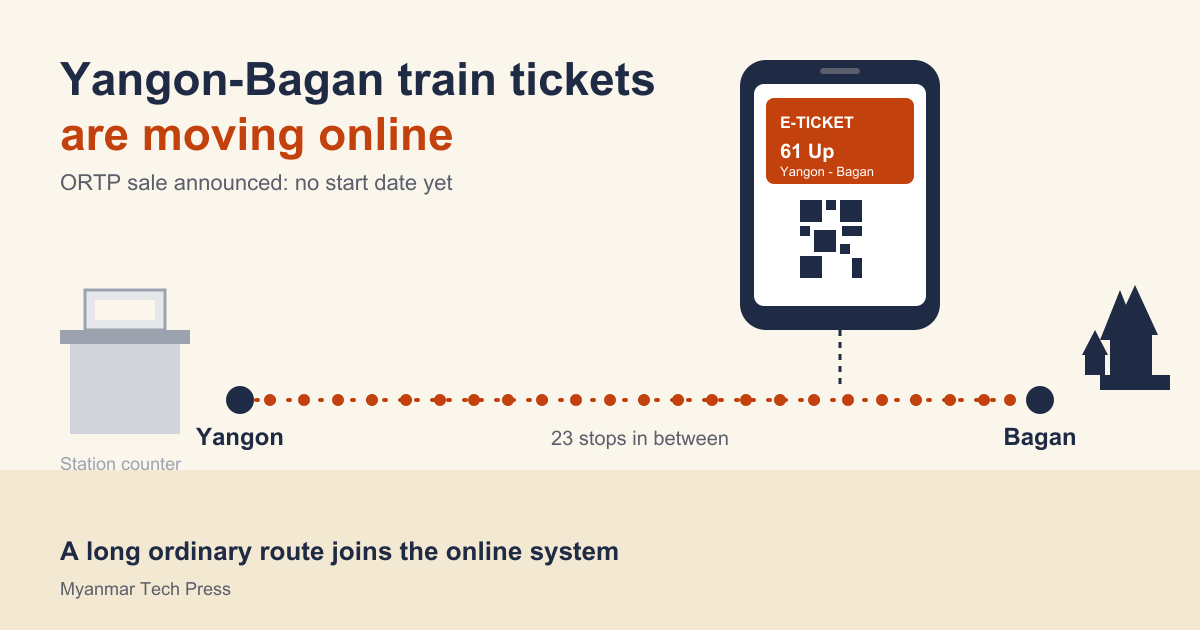
Myanma Railways (MR) says tickets for the Yangon-Bagan train, No. 61 Up and No. 62 Down, will “soon” be sold through its Online Railways Ticketing and Payment system (ORTP). The announcement was reported by the Global New Light of Myanmar on 10 November 2026. It gives no start date.
Myanmar Tech Press has followed ORTP since its pilot. Our 23 October article covered MR dropping the paper-ticket exchange for Thadingyut travellers. This is the next step on the same path: a long ordinary-train route, not a flagship express or DEMU service, is being brought into the online system. Below we set out what the announcement says, what we found when we checked the ORTP portal on 11 November 2026, and what passengers still cannot find out.
What did Myanma Railways announce?
According to the GNLM report, the key points are:
- Ticket sales for trains No. 61 Up and No. 62 Down between Yangon and Bagan will move to the ORTP website “soon”.
- Tickets are currently sold only at the counters at Yangon Railway Station and Bagan Station.
- At the counters, ordinary-class seats go on sale one day before departure. Upper-class seats and sleepers go on sale three days before departure.
- The train stops at 23 intermediate stations, including Tharyawady, Letpadan, Paungde, Pyay, Aunglan, Taungdwingyi, Natmauk and Kyaukpadaung.
- MR says it has no plan, for now, to run DEMU trains on this route.
That is the whole announcement. It does not give a launch date, fares, payment methods, or say whether the station counters will keep selling tickets once online sales begin.
Why does this route matter more than it looks?
Until now, the ORTP story has mostly been about express and DEMU trains on busy corridors. The pilot that began on 1 February 2026 covered the Yangon-Mandalay section. In June, Myanmar Digital News reported that Yangon-Mawlamyine DEMU tickets would be sold online for service from 1 July. A station official said those tickets would be sold only online.
The Yangon-Bagan train is different in three ways.
- It is long and slow, with many stops. With 23 intermediate stations, many passengers board or leave somewhere in the middle. Most of those small stations are in towns where buying a ticket has always meant going to the counter.
- It is an ordinary train, not a DEMU. MR has said it will not switch the route to DEMU for now. Moving its tickets online means ORTP is spreading by route, not only arriving with new rolling stock.
- Bagan is a tourist destination. The end of the line is one of the country’s best-known heritage sites, so this route is more likely than most to carry passengers who are not used to buying train tickets at a Myanmar station counter.
Our reading: this is ORTP shifting from a feature of premium trains toward being the default way to buy a long-distance ticket. MR has not said so in those words, and the route-by-route pace so far suggests it is not happening all at once.
What does the ORTP portal already show?
We opened the official ORTP portal on 11 November 2026, the day after the announcement. Three things stood out.
1. The Bagan line stations are already in the station list. The departure and arrival menus already include stations on this line: Tharyawady, Letpadan, Paungde, Pyay, Aunglan, Taungdwingyi, Natmauk, Kyaukpadaung and Bagan, among others. That suggests the setup work is at least partly done. We did not run a search or attempt a booking, so we cannot say whether trains 61 and 62 can actually be booked yet. The appearance of station names should not be read as a launch.
2. The advance-booking window is much longer online. The portal says ORTP tickets can be bought up to seven days ahead for end-to-end journeys and up to five days ahead for intermediate stations. At the counter, according to GNLM, the window on this route is one day for ordinary class and three days for upper class and sleepers. If the portal’s standard rule applies to the Bagan train, the switch would stretch how far ahead passengers can plan: from one day to seven (five for intermediate stations) for ordinary class, and from three days to five or seven for upper class and sleepers. For a traveller coming from outside Yangon, that is the most practical change in the whole announcement. MR has not confirmed which window will apply to this route.
3. The paper-exchange notice we quoted in October is no longer on the front page. On 23 October the portal carried a notice saying an e-Receipt bought online had to be exchanged for a ticket at the station counter at least one hour before departure. On 11 November, the notices section on the homepage no longer showed that line. The remaining notices cover the advance window, ID checks, refunds and fees. We have not seen an announcement explaining the change, so we cannot say whether the exchange step has been dropped for good. But it is consistent with the Thadingyut arrangement being more than a one-off.
What will it cost to buy online?
The portal states that since 4 April 2026, each passenger pays a 200-kyat ticket service fee, plus a bank transaction fee. Children under three who do not take a seat are exempt. If a train does not run because of MR’s own failure, the fare is refunded but the service fee is not.
The Yangon-Bagan announcement does not mention fares, so we cannot give a ticket price for this route. For context, the June report put Yangon-Mawlamyine DEMU fares at about K16,000 for First Class and K22,000 for Upper Class. Those are a different route and train type, and should not be used as an estimate for Bagan.
The portal names a “bank transaction fee” but, on the homepage, does not list which banks or wallets can be used to pay. That is the question most passengers will ask first, and the announcement does not answer it either.
What is still unclear?
- When. “Soon” is the only timing given.
- Whether the counters stay open for this train. On the Mawlamyine DEMU route, tickets were reported as online-only. The Bagan announcement does not say whether Yangon and Bagan stations will keep selling over the counter, or what passengers at the 23 smaller stations should do.
- Payment channels and fees. No specific banks or mobile wallets are named, and the size of the bank transaction fee is not stated.
- Foreign passengers. The portal’s rules say only the person whose name and National Registration Card (NRC) number were entered may travel, and inspectors check the original NRC with the e-ticket. The e-ticket retrieval form on the same page offers a passport number field as well as NRC. The announcement does not say how foreign visitors heading to Bagan should book, and we do not want to guess.
- Which advance window applies. As noted above, the counter and portal rules differ, and MR has not said which will govern this train.
Our take: the useful part is the booking window, the risky part is the small stations
Taken on its own terms, this is a sensible move. MR warned in June that it would take legal action against social-media services that book and resell train tickets, which shows that ticket reselling is a problem the railway itself recognises. Bringing a long-distance route into ORTP, with a name-and-ID check and a published refund rule, makes the process more transparent than a counter that opens one day before departure.
The concern is who gets left at the counter. A route with 23 intermediate stops serves many towns where people are less likely to have a smartphone with a reliable connection or a bank account linked to online payment. The earlier ORTP announcements mentioned help at stations and a 1188 hotline. If MR keeps counter sales on this line, at least during the transition, the change is close to all upside. If it follows the Mawlamyine model and goes online-only, the burden falls on exactly the passengers least able to switch.
The good news is that the questions are easy to answer. MR only needs to publish a start date, list payment methods, and say whether the counters stay. When it does, we will update this article.
Frequently asked questions
Can I buy Yangon-Bagan train tickets online now?
Not yet, as far as the announcement says. Myanma Railways says online sales through ORTP will begin “soon” but has not given a date. Bagan line stations already appear in the portal’s station menus, but we did not confirm that trains 61 and 62 are bookable.
Where are Yangon-Bagan tickets sold today?
According to GNLM, only at Yangon Railway Station and Bagan Station. Ordinary-class seats go on sale one day before departure; upper class and sleepers three days before.
What is the ORTP website?
ORTP is Myanma Railways’ official online ticketing system at ortp.solutionshubmm.com. Its hotline is 1188.
How much is the ORTP fee?
The portal states a 200-kyat service fee per passenger from 4 April 2026, plus a bank transaction fee. Children under three without a seat are exempt.
Will there be a faster DEMU train to Bagan?
Not for now. MR told GNLM there is currently no plan to run DEMU trains on the Yangon-Bagan route.
The Yangon-Bagan move is small news on its own. Read alongside the Mawlamyine online-only sales and the Thadingyut exchange waiver, it shows ORTP becoming the standard way to buy a long-distance train ticket in Myanmar, one route at a time. What will decide whether that is good news for every passenger is not the website but the counter: whether it stays open, and for how long.
Sources: Global New Light of Myanmar, “Yangon-Bagan train ticket to switch to online sale soon”, 10 November 2026 (link); Myanma Railways ORTP portal, checked 11 November 2026 (link); Eleven Media, “MR introduces ORTP system starting February 1”, 29 January 2026 (link); Eleven Media, 11 June 2026 (link); Myanmar Digital News, 24 June 2026 (link). Related Myanmar Tech Press article: Myanma Railways Drops the Paper Ticket Exchange for Thadingyut (23 October 2026).