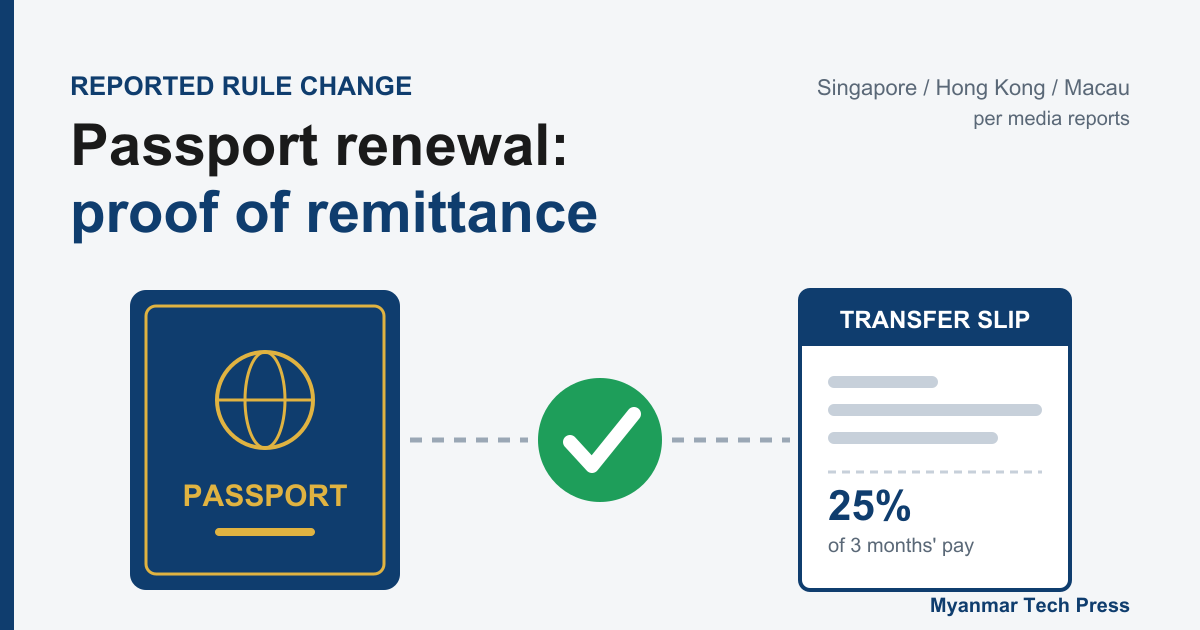
Myanmar embassies in several Asian countries are reportedly asking migrant workers to prove they sent part of their pay home through official channels before their passports can be renewed. According to The Irrawaddy (published 10 November 2026), missions in Singapore, Hong Kong and Macau announced that applicants for the Passport for Job (PJ) category must show proof of 2% income tax payment and proof of remitting 25% of their last three months’ earnings to family. BNI (14 November 2026), crediting the Karen Information Center, adds the Singapore details: a notice dated 9 November, in force from 10 November.
One caveat up front: we have not seen the embassy notice itself. Everything below about its contents rests on The Irrawaddy and BNI, and we attribute it that way. What interests us as a technology and payments outlet is not the politics but the mechanism. A remittance is being turned into a document that an official can check, and that changes who has the leverage.
What exactly are the embassies asking for?
Per The Irrawaddy, the rule is two-part: evidence of 2% income tax paid, and evidence that 25% of earnings over the previous three months was sent to relatives through official channels. The paper says missions have, for about two weeks, repeatedly ordered such evidence to accompany passport applications, and that the embassies in Seoul and Tokyo were among the first to enforce it.
BNI gives the most concrete picture for Singapore. It reports that accepted proof is limited to transaction slips from DBS or OCBC, or records from licensed money transfer services such as Western Union and Ria Money Transfer. It gives example three-month totals for different work passes: S$375 for a Work Permit holder earning S$500 a month, S$1,050 for an S Pass, S$1,350 for Permanent Residents and S$2,250 for Employment Pass holders. BNI also says the embassy will check the recipients’ personal details and warns against forged documents. Embassies in Thailand, Malaysia, South Korea and Japan reportedly have similar requirements, though we have not verified those individually.
Why is this a payments story and not only a migration story?
A 25% remittance obligation on its own is hard to police. Nobody can see money moving through informal networks. Attaching it to a passport renewal solves that problem in a neat, if blunt, way: the worker must bring a bank slip or a licensed operator’s record, and the embassy checks the recipient’s details against it. The compliance evidence is generated by the regulated financial system itself.
That is the shift worth noticing. The rule is not new. The Irrawaddy says the 25% remittance and 2% income tax regime was first enforced in 2023 and is widely seen as an attempt to bolster foreign-exchange reserves. What changed is the enforcement point. A paper rule that is easy to ignore became a gate on a document workers cannot do without, since a passport underpins their work permits and their legal stay.
How does this fit the 2023 to 2026 pattern?
Following the sources, the sequence looks like this. In 2023 the remittance and tax requirement was introduced, according to The Irrawaddy. In late August, DVB (31 August 2026) reported a wider tightening of overseas passport services: the Singapore embassy suspending some applications and requiring clearance from Naypyidaw for category changes, Thailand requiring clearance from 20 August, and Tokyo issuing a 12 August directive on passports expired for more than five years, while same-category renewals were still processed locally. Notably, the DVB report does not mention remittance or tax at all. So by the sources we have, the remittance check is a newer layer added on top of an already tightening process, not part of the August measures.
The same logic shows up elsewhere in our coverage. We reported on the central bank’s foreign-exchange platform and advance-payment requirement, and on the reported order to block overseas use of mobile payment apps. That block was reported as ordered; we have not confirmed that it is being enforced. Taken together, these look like one direction of travel: steer foreign currency into channels that leave a record. The passport check does it from the worker’s side, the app block and FX platform from the financial side.
What do the notices leave out?
Mobile wallets. The sources do not say whether transfers made through wallets such as Wave or KBZPay count as acceptable proof. BNI’s list names bank slips and licensed money transfer operators, and does not mention apps. That is a significant gap, because wallets are how many families receive money. Our earlier piece on Wave Money’s link with Merchantrade in Malaysia shows the kind of corridor that exists. Whether such a transfer would satisfy an embassy official is not stated in anything we have read. A worker who uses a wallet should not assume it is accepted.
The exchange-rate gap. Workers quoted by The Irrawaddy are reluctant to use official channels. A Singapore florist, aged 30, told the paper that “nobody wants to use official remittance channels”, and said people would comply for three months and then return to alternative channels. The florist also said informal channels pay more. BNI reports that workers cite the gap between bank and informal-agent exchange rates as a source of losses. In our reading, that gap is the core of the problem: the more the official channel pays out below the market, the more compliance acts like a tax. The sources we have do not publish rate figures, so we do not quote any. The point to keep is structural: a rule that depends on people choosing the worse rate will depend on enforcement, not on trust.
Processing times and the digital ID. The Irrawaddy quotes a worker saying passport extension waits grew from about two weeks to three months “under the regime’s new digital identification system (UID)”. That is one worker’s account, not a measured figure. We cover the system in our piece on the UID digital ID pilot, but nothing in these sources lets us say what share of the delay, if any, comes from the remittance check versus the ID system.
Scale. The Irrawaddy notes that Myanmar labour data from 2024 suggested migrants in Singapore could reach 200,000. That is a projection, not a count of people affected by this notice.
A note on timing differences between the sources
The two main sources differ slightly. The Irrawaddy says missions declared the requirement shortly before its 10 November report (by our reckoning, on 9 November; the paper does not give the date itself) and had been demanding evidence for about two weeks already. BNI says the Singapore embassy’s announcement was dated 9 November and took effect on 10 November. These are compatible if the formal notice followed practice that had already begun informally, but we cannot confirm that from the sources. BNI’s page also carried no machine-readable date, so the 14 November date comes from the page text.
Frequently asked questions
Do Myanmar workers in Singapore have to prove remittances to renew a passport?
According to BNI, a Singapore embassy notice dated 9 November, in force from 10 November, requires Passport for Job applicants and renewals to show proof of a 25% remittance of the last three months’ earnings and proof of 2% income tax paid. We have not seen the notice itself.
What counts as proof of remittance?
BNI reports transaction slips from DBS or OCBC, or records from licensed operators such as Western Union and Ria Money Transfer. The embassy reportedly checks the recipient’s personal details and warns against forged documents.
Do Wave Money or KBZPay transfers count?
The sources do not say. Neither The Irrawaddy nor BNI, as summarised, mentions mobile wallets. Workers should ask the embassy directly rather than assume.
Is the 25% rule new?
No. The Irrawaddy says the 25% remittance and 2% tax regime was first enforced in 2023. What the report describes as new is the demand for evidence alongside passport applications.
Which embassies are affected?
The Irrawaddy names missions in Singapore, Hong Kong and Macau, and says Seoul and Tokyo were among the first to enforce. BNI says embassies in Thailand, Malaysia, South Korea and Japan reportedly have similar requirements.
The takeaway
The interesting thing about this rule is not the 25% figure, which dates back to 2023, but the way it is now enforced. By tying a remittance receipt to a passport, the system makes a financial transaction into a checkable credential, with banks and licensed operators doing the record-keeping. The open questions are practical ones the notices do not answer: whether wallets count, how much the official-rate gap costs workers, and whether compliance lasts beyond the first renewal. If the worker quoted by The Irrawaddy is right that people will comply for three months and then drift back, the test will come at the next renewal cycle, not this one. For the wider backdrop on financial controls, see our report on Myanmar’s FATF blacklisting.
Sources: The Irrawaddy, “Myanmar Embassies Push Tax, Remittance Rules as Migrant Backlash Grows Across Asia”, 10 November 2026 (https://www.irrawaddy.com/?p=156460). BNI, “Myanmar workers in Singapore must show remittance records to renew passports”, 14 November 2026, crediting Karen Information Center (https://www.bnionline.net/en/news/myanmar-workers-singapore-must-show-remittance-records-renew-passports). DVB, “Myanmar embassies tighten passport renewals and category conversions across overseas missions”, 31 August 2026 (https://english.dvb.no/myanmar-embassies-tighten-passport-renewals-and-category-conversions-across-overseas-missions/). Myanmar Tech Press internal links as cited. We did not see the embassy notice itself.