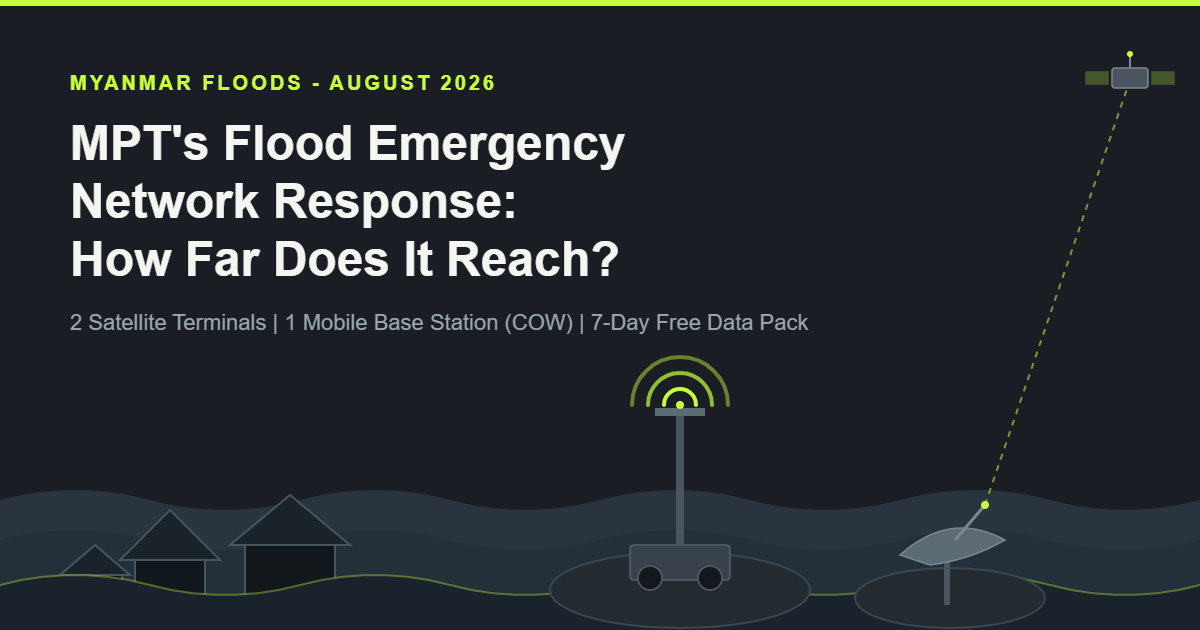
On 2026-08-06, MPT (Myanma Posts and Telecommunications, operated as a joint venture with KDDI/Sumitomo under the KSGM structure) published a press release announcing that it had deployed emergency network equipment to flood-hit communities in Laymyethna (Lemyethna) Township, Ayeyarwady Region, and that from 2026-08-07 it would give affected customers a free seven-day relief pack of 1GB of data, 100 on-net minutes, and 100 SMS. The equipment itself — two B2B satellite terminals and one Cell-on-Wheels (COW) mobile base station — was deployed on 2026-08-05, according to the release.
It’s a genuinely useful, technically sound response to a real emergency. It’s also, on its own numbers, a response sized for one township’s relief camps in a flood crisis that, according to reporting by DVB published 2026-08-11 citing figures from Myanmar’s National Unity Government (NUG), had by that date left 25 people dead, 2 missing, and 441,788 affected across 17 townships in four regions — Sagaing, Magway, Mandalay, and Ayeyarwady. This piece looks at what MPT actually delivered, how it compares to MPT’s own playbook from the 2015 floods, and what the press release leaves unsaid.
What MPT Actually Deployed and Offered
Stripped of PR framing, the concrete facts in MPT’s release are these:
- Two satellite terminals were installed — one at a relief camp at Sit Kwin Monastery in Sar Yay Kwin village tract, and one in Seik Noh Kone village in Thakhwap Chaung village tract, both within Laymyethna Township, Ayeyarwady Region.
- One Cell-on-Wheels (COW) mobile base station was deployed at Sar Yay Kwin to restore local mobile coverage where fixed infrastructure was presumably down or unreachable.
- Deployment happened on 2026-08-05.
- Starting 2026-08-07, MPT customers confirmed to be affected received a free 7-day pack: 1GB of data, 100 on-net minutes, 100 SMS.
- Mikinori Naito, Advisor to the CEO of MPT KSGM JO, is quoted saying: “At MPT, keeping people connected especially during emergencies, is one of our highest priorities. Our teams responded immediately by deploying mobile and satellite communication solutions to support affected communities in Laymyethna Township.”
Technically, satellite backhaul paired with a mobile COW unit is the correct tool for this job. When a river embankment fails and floodwater takes out fixed cell towers or fiber links, you cannot wait for a repair crew — you truck in a self-contained base station and connect it to satellite rather than to a severed terrestrial line. This is a well-understood pattern in disaster telecom response worldwide, and MPT deserves credit for having the equipment and the trained crews to execute it within days of the embankment failure. The question this article is more interested in is not “did MPT do something real?” — it clearly did — but “how much of the actual disaster does that something cover?”
Why the Scale Mismatch Matters
Laymyethna Township, where MPT’s two satellite terminals and one COW unit are located, is one township in Ayeyarwady Region. The flooding behind this crisis, per the DVB figures above, spans 17 townships across Sagaing, Magway, Mandalay, and Ayeyarwady regions, with Sagaing the hardest-hit (23 of the 25 reported deaths), reportedly worsened by controlled water releases from the Thaphan Seik Dam, and Mandalay’s Sedawgyi Dam making its own emergency discharge on 2026-08-08. MPT’s press release does not claim its Laymyethna deployment is a response to the entire four-region disaster — it is explicitly scoped to Laymyethna Township. But because it is also the only network-operator statement on this flood event that we could find (see below), it risks reading, in wire summaries and social shares, as “MPT responds to the Myanmar floods” rather than “MPT responds to two relief camps in one township of one of the four affected regions.” That gap between headline framing and actual coverage footprint is worth naming explicitly, because readers deciding whether to expect help — or donate, or route aid requests — need to know how narrow “deployed” actually is here.
There’s a second, smaller mismatch inside the offer itself. The free relief pack — 1GB of data, 100 minutes, 100 SMS, valid for seven days — is a meaningful gesture for someone who has lost power, is sheltering in a monastery relief camp, and needs to check on family or register for aid. It is not, on its own, a connectivity lifeline for a household that has lost its home, and it lapses in a week regardless of whether displacement does. MPT’s release does not state how many customers actually qualified as “affected” and therefore received the pack, so it’s not possible from the source material to size the benefit against the roughly 39,000-plus residents from about 9,000 households that other reporting has attributed to Laymyethna Township specifically (a figure this article treats as background context rather than an MPT-confirmed number, since it comes from outlets outside MPT’s own release).
A Familiar Playbook, Eleven Years Apart
This is not the first time MPT has responded to major Myanmar flooding with a SIM-centric relief mechanism. In an MPT press release from 2015-08-05, covering the 2015 Myanmar floods, the operator ran an SMS-based donation scheme — customers texted “500” to short code 2001, with the amount deducted from their balance and repeatable — and donated satellite phones to the then Ministry of Communications and Information Technology (MCIT) for use at emergency base camps.
Set the two responses side by side and the underlying toolkit has barely changed: SIM/mobile-account mechanics plus satellite equipment, deployed to government or relief-camp partners, publicized through a single corporate press release. What has changed is the delivery mechanism (a self-donating SMS code in 2015 versus a free data/voice/SMS pack pushed directly to affected numbers in 2026) and, presumably, the underlying network hardware. What hasn’t changed, on the evidence available, is the scale of ambition: both responses are camp- and township-level gestures rather than region-wide connectivity restoration plans, even though both floods were reported as multi-region disasters. Eleven years on, it’s a fair question — one this article can’t answer from MPT’s release alone — whether Myanmar’s telecom disaster-response capacity has actually grown in proportion to how often and how severely these floods now recur, or whether operators are running the same narrow playbook against a bigger and bigger problem each cycle.
The Notable Silence From ATOM, Ooredoo, and Mytel
As of this writing (2026-08-13), a search of ATOM’s and other Myanmar operators’ own press-release and statement pages turned up no dated public statement specific to the August 2026 floods. The most recent ATOM statement about flooding that we could verify was from 2024-09-13, describing a different flood event entirely — not the current crisis. That doesn’t necessarily mean other operators are doing nothing on the ground; it means that, at least in terms of public communications, MPT currently appears to be the only Myanmar mobile operator with a dated, verifiable statement about its response to this specific flood event. For a state-linked/joint-venture operator like MPT, that visibility gap is notable both ways: it’s either a genuine first-mover advantage in disaster response, or a sign that MPT is simply more inclined than its competitors to turn relief work into a press release — a distinction the source material doesn’t let us settle either way.
The Satellite Question, and What the Press Release Doesn’t Say
MPT’s release calls the deployed hardware “B2B Satellite Terminals” without naming the satellite network or provider behind them. That’s a relevant gap for Myanmar readers right now: this comes only weeks after MTP’s own coverage of new roaming restrictions affecting Starlink-style satellite connectivity in the region (published around 2026-07-27), a story that made satellite access itself — not just terrestrial towers — a live policy question in Myanmar. Whose satellite capacity MPT’s terminals ride on, whether that capacity is licensed for this kind of emergency civilian deployment at scale, and whether future roaming or spectrum restrictions could complicate rapid emergency rollouts like this one, are all questions the press release simply doesn’t address. Also unaddressed: how MPT verifies which customers count as “affected” and therefore qualify for the free pack; whether the relief pack is renewable if flood displacement outlasts seven days; and any total cost or subscriber count for the program, which would let readers judge its scale against MPT’s overall size. We should also flag, rather than assert, a claim we could not independently verify for this piece: some outlets have reported broader criticism from aid workers and residents that government-coordinated flood relief across Sagaing, Mandalay, and Ayeyarwady has been slow or inadequate. We are not treating that claim as confirmed here — it comes from a source we were not able to independently fetch and verify — but it is the kind of context against which any single operator’s emergency-response press release should be read.
Frequently Asked Questions
What exactly did MPT announce on 2026-08-06?
MPT announced it had deployed two satellite terminals and one Cell-on-Wheels mobile base station to Laymyethna Township, Ayeyarwady Region, on 2026-08-05, and that from 2026-08-07 affected customers would receive a free 7-day pack of 1GB data, 100 minutes, and 100 SMS.
Does MPT’s response cover all four flood-hit regions?
No. Based on MPT’s own press release, the deployment described is specific to Laymyethna Township in Ayeyarwady Region. The broader flooding, per DVB’s 2026-08-11 report of NUG figures, spans 17 townships across Sagaing, Magway, Mandalay, and Ayeyarwady.
How does this compare to what MPT did during the 2015 Myanmar floods?
In 2015, MPT ran an SMS-based donation scheme (texting “500” to 2001) and donated satellite phones to the Ministry of Communications and Information Technology for emergency base camps. The 2026 response swaps a donation mechanism for a free data/voice/SMS pack, but both rely on the same basic combination of SIM-based mechanics and satellite hardware, deployed at camp/township scale.
Have other Myanmar operators like ATOM, Ooredoo, or Mytel responded to the same floods?
As of 2026-08-13, we found no dated public statement from ATOM, Ooredoo/U9, or Mytel specifically addressing the August 2026 floods. MPT currently appears to be the only operator with a verifiable public statement on this event.
How many people actually benefit from MPT’s free relief pack?
MPT’s press release does not state a customer count or beneficiary total for the relief pack, so this cannot be answered from the source material alone.
The Takeaway
MPT’s emergency network deployment is a legitimate, fast, technically appropriate response to a real problem in one flood-hit township — the right equipment, deployed quickly, framed clearly around a named spokesperson and concrete dates. What it is not, on the numbers in MPT’s own release, is a response proportioned to the scale of the disaster that Myanmar’s monsoon floods have become by August 2026: 25 dead, hundreds of thousands affected, four regions, seventeen townships. Whether that gap reflects the genuine limits of what one operator can mobilize in days, a communications choice to publicize the camp-level story rather than a region-wide plan, or the absence of comparable public effort from competing operators, is a question worth Myanmar readers keeping in mind the next time a telecom operator’s flood-relief press release circulates as if it were the whole story.
Sources: MPT, “MPT Deploys Emergency Network Solutions and Provides Free Data, Voice, SMS Support for Flood-Affected Communities,” published 2026-08-06 (https://mpt.com.mm/en/mpt-deploys-emergency-network-solutions-and-provides-free-data-voice-sms-support-for-flood-affected-communities-en/). DVB, “NUG reports 25 dead and over 440,000 affected as severe flooding spreads across 17 townships in Myanmar,” published 2026-08-11 (https://english.dvb.no/nug-reports-25-dead-and-over-440000-affected-as-severe-flooding-spreads-across-17-townships-in-myanmar/). MPT, “MPT Offers Donations and Assistance to Flood Victims,” published 2015-08-05, used only as historical comparison (https://mpt.com.mm/en/mpt-offers-donations-and-assistance-to-flood-victims/). ATOM statement, “Notification to Customers: Network Condition due to…” published 2024-09-13, cited only to note it is not related to the 2026 floods (https://www.atom.com.mm/en/statement/notification-to-customers-network-condition-due-t). Claims from Wave Money’s media center, reliefweb.int, and an Irrawaddy report on Laymyethna flood victims could not be independently verified via direct fetch at time of writing and were deliberately excluded or explicitly flagged as unverified above rather than cited as fact.