
OPPO has been investing 6% to 8% of its annual revenue into R&D for a long time. The company runs six research institutions (Beijing, Shanghai, Shenzhen, Dongguan, Silicon Valley, and Yokohama) along with six R&D centers worldwide (Dongguan, Shenzhen, Chengdu, Xi’an, Wuhan, and Hyderabad), employs more than 10,000 R&D staff, and owns an international design center in London. To meet demand for smartphones and other smart devices, OPPO has also built manufacturing plants in China, India, Indonesia, Algeria, Bangladesh, and Turkey, in addition to ten other production facilities.
In 2022, OPPO ranked among the top four companies in China for domestically-owned patents and was also one of the top seven R&D companies primarily focused on smartphone manufacturing technology.
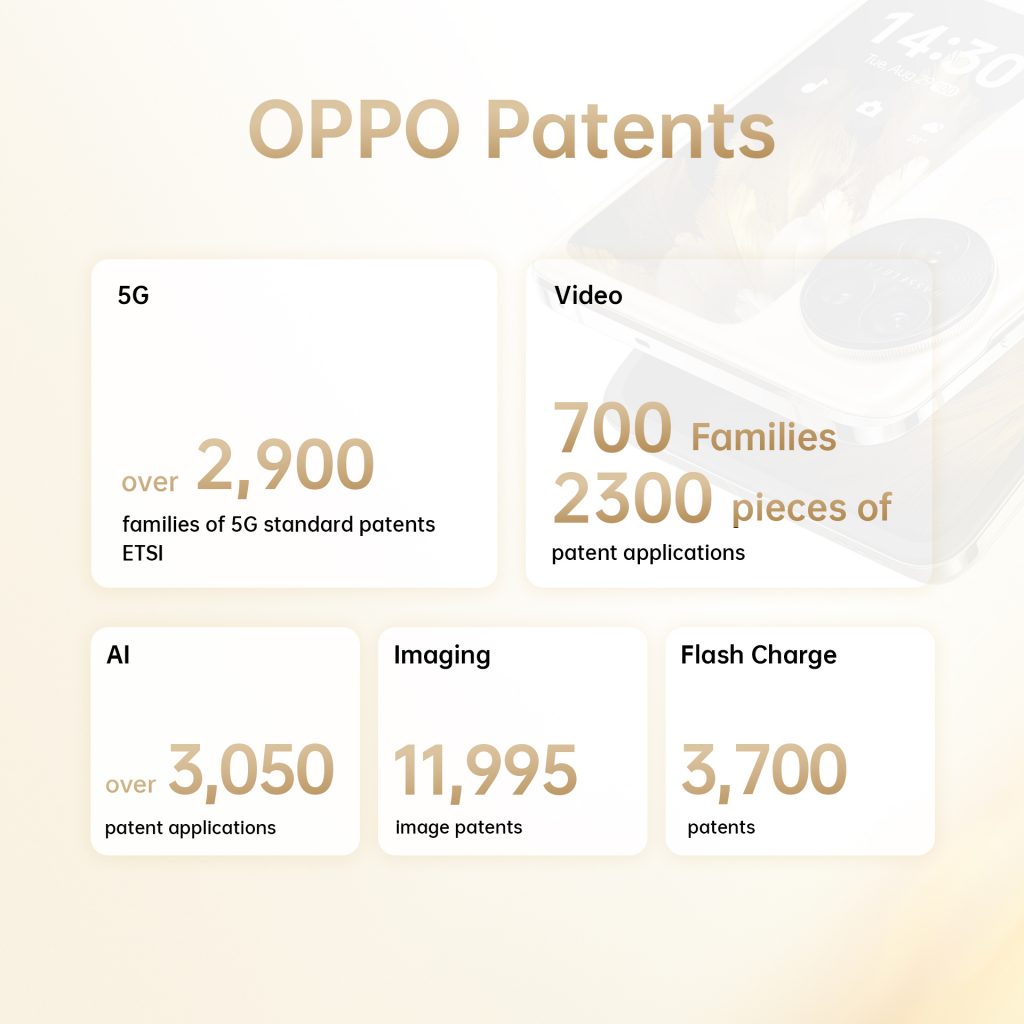
Image: OPPO
OPPO’s CEO, Mr. Chen Mingyong, has said that the flip phone represents a genuine expression of OPPO’s convictions. OPPO achieved the “first true introduction” in the foldable-screen phone category and “carved out a solid place among a crowded field of device strategies.” Even so, it took OPPO three years of research and exploration into flip phones before the effort paid off. Eventually, Mr. Chen Mingyong stopped working on another project entirely and made the personal decision to devote all available resources to building the “Flip Screen.”
Before the flip-screen phone project officially launched and before the first product was unveiled, OPPO had already mapped out a six-generation roadmap for flip-phone production covering “nearly every conceivable form.” The company’s first foldable smartphone, the Find N, was then introduced together with 125 patents. Not only did OPPO’s first-generation products succeed with forward-looking innovation, but the company also managed to bring fourth-generation products to market within 20 months — matching the idea of “sharpening the blade within four years.” That combination of standard-setting innovation is what allowed OPPO to capture, and continue to lead, this segment of the industry.
As of September 30, 2023, OPPO had filed more than 95,000 patent applications and already held more than 51,000 granted patents worldwide. Of those, 86,000 — or 90% of OPPO’s total patents — have already been approved. According to data from the World Intellectual Property Organization (WIPO), OPPO ranked sixth globally in 2022 with 1,963 international PCT patent applications, marking the company’s fourth consecutive year in the global top ten.
OPPO has filed patents in more than 40 countries and regions. In 2022, OPPO ranked fourth worldwide by the number of patents granted in China, 17th globally (or 2nd among Chinese companies) for European patent filings, and 4th among Chinese companies for US-granted patents.
5G: OPPO has already deployed its 5G-related patents across more than 40 countries and regions worldwide. By the end of September 2023, OPPO had declared more than 5,700 global patent families, over 2,900 5G standard-essential patents at ETSI, and had submitted more than 9,000 5G standardization proposals to 3GPP. According to a report published in October 2023 by LexisNexis IPlytics, a leading patent-tracking platform, OPPO ranked 8th in 5G patent ownership.

Image: OPPO
In video technology, OPPO has filed around 2,300 patent applications across some 700 patent families in more than 30 countries, ranking 30th worldwide overall. OPPO has also filed more than 3,050 patent applications related to AI, computer vision, speech technology, and machine learning. Globally, the company has filed for 11,995 image/design-related patents and currently holds 5,485 granted patents in that category.
Fast charging: OPPO has filed around 3,700 patents worldwide and already has roughly 2,000 patents granted, and it has licensed its fast-charging technology to more than 50 companies. In 2021, OPPO launched a new project called The Flash Initiative as part of its commitment to making consumers’ daily lives more convenient, using its innovative IP to extend fast charging beyond home chargers to cars, public spaces, and a wide range of chips used in everyday technology devices.