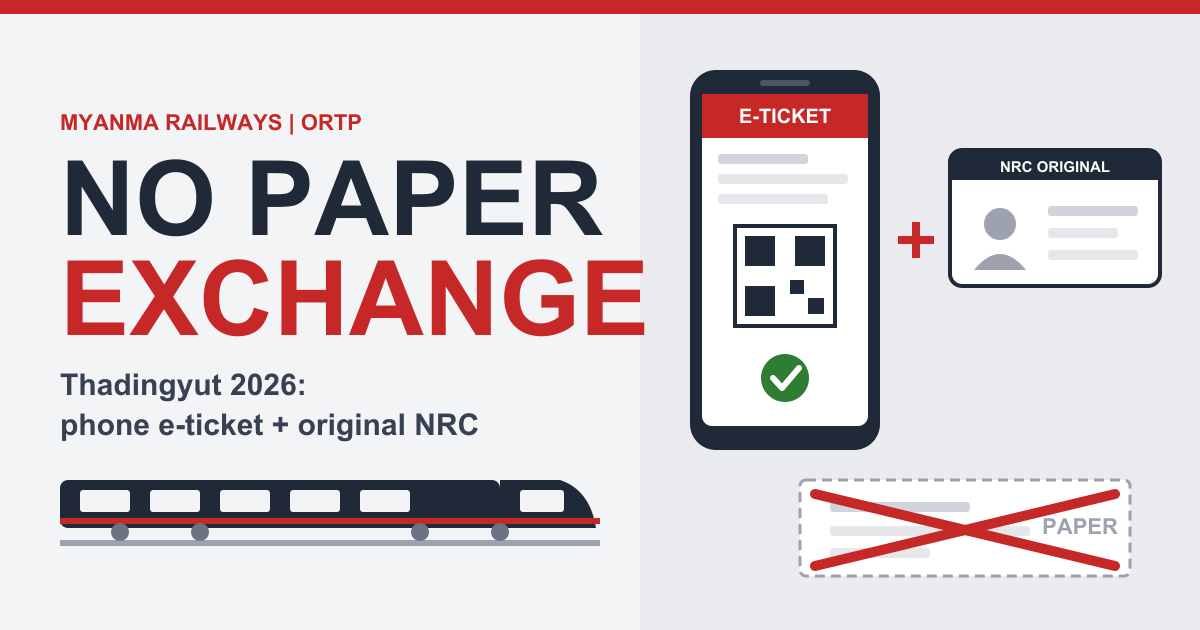
On 23 October 2026, the Online Railways Ticketing and Payment (ORTP) department of Myanma Railways announced that passengers who bought their tickets online can travel during the Thadingyut Festival by showing the e-ticket on their phone together with their original National Registration Card (NRC). They no longer have to exchange it for a paper ticket at the station first. The announcement was reported by Eleven Media on 23 October 2026.
That sounds like a small operational note, but it touches the one thing that has made Myanmar’s “online” railway ticket feel unfinished since launch: the last step still happened in a queue at a station counter. This article looks at what exactly changed, what the official ORTP portal still says, and what the announcement leaves unanswered.
What exactly changed for passengers this Thadingyut?
According to Eleven Media, passengers who bought tickets through ORTP board by presenting two things: the e-ticket stored on their mobile phone and their original NRC. The report says they will no longer need to queue at stations to swap the e-ticket for a paper one. Anyone who still prefers paper can exchange at the station, and station staff and ticket inspectors will help.
The festival context matters. Extra Thadingyut special trains run from 23 to 28 October on the Yangon-Nay Pyi Taw, Yangon-Mawlamyine and Yangon-Pyay routes, with an additional Nay Pyi Taw-Yangon down train on 27 October, the day after the Thadingyut full moon. These are exactly the days when station counters are most crowded, so removing a queue is most valuable now.
One small note on the report itself: the headline says passengers can travel with e-tickets “only”, but the body text is clear that paper tickets remain available as an option. We treat the body as the accurate description.
What does the official ORTP portal still say about paper tickets?
This is where the story gets interesting. When we checked the official ORTP portal on 23 October 2026, it still carried a Burmese notice saying the e-Receipt bought through ORTP must be exchanged for a ticket at the relevant station counter at least one hour before the train departs.
The same portal sets out the rules that the e-ticket system depends on:
- Only the person whose name and NRC number were entered at purchase may travel.
- The ticket is valid only for the purchased date and train.
- There is no refund for a trip not taken.
- Inspectors check the original NRC together with the e-ticket. A mismatch is treated as an irregular ticket, with a penalty of twice the full-route fare.
- Advance booking is 7 days for end-to-end journeys and 5 days for intermediate stations.
So there is a visible gap between the portal and the announcement. The portal describes a system where the phone receipt is a voucher and the paper ticket is the real thing. The announcement describes a system where the phone ticket itself is the ticket. Both were live on the same day, which suggests the festival rule is an overlay on top of the standard procedure rather than a rewrite of it.
Is the no-exchange rule permanent or just for Thadingyut?
We do not know, and the announcement does not say. Eleven Media’s text ties the arrangement to travel “during the Thadingyut Festival”, yet it also says passengers “will no longer need to queue” to exchange tickets. It gives no end date and does not say whether the rule lapses after the festival trains stop. We have seen no statement that it is permanent, so readers should not assume so.
There are two plausible readings, and either would be reasonable:
- A festival-only exception. Counters are overloaded during the holiday, and waiving the exchange is a way to reduce crowding without changing the rules for the rest of the year.
- A trial of the permanent model. A busy festival week is a natural stress test. If inspectors can verify a phone ticket against an original NRC at scale, the paper step has little reason to come back.
The distinction matters to passengers because the portal still tells them to be at the counter an hour before departure. A traveller who reads only the portal on a normal weekday could queue unnecessarily, and one who reads only the festival news could skip a step that is still required on other dates. Clear dated wording from Myanma Railways would remove that risk.
How does this fit the history of ORTP so far?
ORTP is only about eight and a half months old, which makes this change quick. The timeline from public reports:
- 29 January 2026: Myanma Railways announced that online sales would start on 1 February, piloted on the Yangon-Mandalay section on several express and DEMU trains. Passengers could use any browser or a QR code, and those who struggled could buy using the system at stations. A hotline was available.
- 8 February 2026: Myanmar International TV reported that 87 tickets for eight express trains had been bought online in advance as of 1 February, and that more than 80 per cent of first-class seats and all upper-class seats on Yangon-Nay Pyi Taw-Yangon DEMU trains were sold online before departure. The system runs under a public-private partnership, with hotline 1188.
- 4 April 2026: According to the ORTP portal, a ticket service fee of 200 kyats per passenger started (children under three without a seat are exempt), plus a bank transaction fee.
- 11 June 2026: Eleven Media reported that Myanma Railways warned of legal action against people advertising paid ticket-booking services on TikTok, Facebook, Telegram and Viber. It said it has appointed no agents.
- 24 June 2026: Myanmar Digital News reported that Yangon-Mawlamyine DEMU tickets went on sale online for service from 1 July, with a Mawlamyine station official saying they would be sold exclusively online rather than at stations. Expected fares were about K16,000 for First Class and K22,000 for Upper Class.
- 23 October 2026: the Thadingyut announcement above.
Read in order, the pattern is a steady move of the process out of the station: first booking, then (for some routes) all sales, and now the exchange step. The Mawlamyine line is the most telling precedent. If tickets there are sold only online, an obligatory paper exchange at the counter makes less and less sense. The Thadingyut notice looks like the next logical piece of the same direction, though the sources do not say it is planned that way.
What the announcement does not tell us
Public sources leave several practical questions open. We list them rather than guess.
- Duration. No end date, and no word on whether the rule continues after the festival.
- Sales volume. We found no figures for total ORTP tickets sold or user numbers after the February report. Without them it is impossible to judge how much of the festival travel the change actually covers.
- Offline fallback. The announcement does not explain what happens if a phone battery dies or there is no signal at the gate, beyond saying staff and inspectors will assist.
- Payment details. The sources we could verify do not say which payment channels ORTP accepts, so we do not discuss them here.
- Who operates the system. The reports say a technology company won the tender to develop and invest in ORTP and was authorised on 4 April to charge the service fee. The reports we reviewed do not name the company, and we will not infer one.
The name-and-NRC design, and the nun registration number workaround
The most useful detail in the announcement is an almost incidental one. Buddhist nuns buying tickets must enter a zero before their nun registration number, “in accordance with the system requirements”. A number such as 12345 becomes 012345.
This is a small example of a familiar pattern: when an ID format is baked into a system, users adapt to the system instead of the other way round. ORTP checks the name and ID of the traveller, and the portal’s e-ticket retrieval form offers NRC number, passport number or the old three-fold NRC. A religious ID does not fit those fields naturally, so a leading zero is the workaround. It works, and it is documented, but it is also the kind of rule that is easy to miss until a ticket purchase fails.
It also shows why dropping paper makes the ID matter more, not less. The paper ticket was a physical token. Without it, the whole trip rests on a phone screen and an original NRC matching the name entered online, with a penalty of twice the full-route fare for mismatches. That is a design choice that favours control and fraud prevention, and it is consistent with the June warning about unofficial resellers. We looked at the same theme of identity as the gateway to services in our report on Myanmar’s UID system becoming a single gateway for SIMs, bank accounts and passports, and the railway case fits it: the ID number is the key, and the format of that number decides who can get through the door easily.
It is also a reminder of how slowly digital services reach non-standard cases. We made a related point about the cash-first start of electronic toll collection in our TollPass piece on the Yangon-Mandalay Expressway: the technology is usually ready before the surrounding procedures are.
Who pays, and who gains?
Digitising ticketing is not free for passengers. Per the portal, the 200-kyat service fee applies to each passenger and goes alongside a bank transaction fee. If a train is cancelled because of Myanma Railways’ own fault, the fare is refunded but the service fee is not. Because the tender winner was authorised to charge the fee, the service fee is a charge levied by the private operator that built the system, under the public-private arrangement described by MITV.
That is not a criticism in itself. The fee is small relative to a K16,000 First Class fare, and the system has a clear benefit: fewer queues and less room for scalpers. But removing the paper step changes the balance slightly. When the station counter was mandatory, even online buyers still used the railway’s own ticket office. If the e-ticket becomes self-sufficient, more of the journey runs through the online channel and less through the station. Whether that helps passengers with weak phones or poor connectivity depends on how well the fallback support works, which the announcement does not detail.
Frequently asked questions
Do I need a paper ticket to travel on Myanma Railways during Thadingyut?
Not if you bought through ORTP. According to the 23 October 2026 announcement, you can board with the e-ticket on your phone and your original NRC. Paper tickets are still available at stations for those who want one.
What ID do I need to show with an ORTP e-ticket?
Your original NRC, according to the announcement. The ORTP portal says only the person whose name and NRC number were entered may travel, and that inspectors check the original NRC together with the e-ticket. The e-ticket retrieval form also lists passport number and the old three-fold NRC as ID options.
How do Buddhist nuns buy tickets on ORTP?
Nuns must enter a zero before their nun registration number. For example, 12345 should be entered as 012345.
Is the no-exchange rule permanent?
The announcement does not say. It refers to travel during the Thadingyut Festival and gives no end date. The ORTP portal still advised exchanging the e-Receipt at the station at least one hour before departure on the day we checked. Until Myanma Railways states otherwise, treat the change as applying to the festival period.
Which Thadingyut trains are running?
Extra special trains run from 23 to 28 October on the Yangon-Nay Pyi Taw, Yangon-Mawlamyine and Yangon-Pyay routes, plus an extra Nay Pyi Taw-Yangon down train on 27 October.
How much does the ORTP service fee cost?
The portal states a 200-kyat service fee per passenger from 4 April 2026 (children under three without a seat excepted), plus a bank transaction fee. The service fee is not refunded if a train is cancelled, although the fare is.
The bottom line
The Thadingyut announcement removes the most visible offline step in Myanmar’s online railway ticketing, at least for the festival. Eight and a half months after ORTP began on 1 February, a phone ticket and an original NRC can now be enough. What remains unclear is whether this is a holiday exception or the new normal, and the official portal’s contradictory wording on the same day shows that the change is not yet reflected in the standard procedure. For passengers, the practical advice is simple: carry your original NRC, keep your phone charged, check the exact date your ticket is for, and treat the festival rule as temporary until Myanma Railways says it is not. For the railway, the next useful step is a short, dated notice that tells everyone which rule applies after the festival trains stop running.
Sources: Eleven Media, “MR announces passengers using ORTP system can travel with e-tickets only during Thadingyut Festival”, 23 October 2026 (link); Myanma Railways ORTP portal, fetched 23 October 2026 (link); Eleven Media, “MR introduces ORTP system starting February 1”, 29 January 2026 (link); Myanmar International TV, 8 February 2026 (link); Eleven Media, 11 June 2026 (link); Myanmar Digital News, 24 June 2026 (link). Related Myanmar Tech Press articles: UID system (14 September 2026); TollPass (10 October 2026).