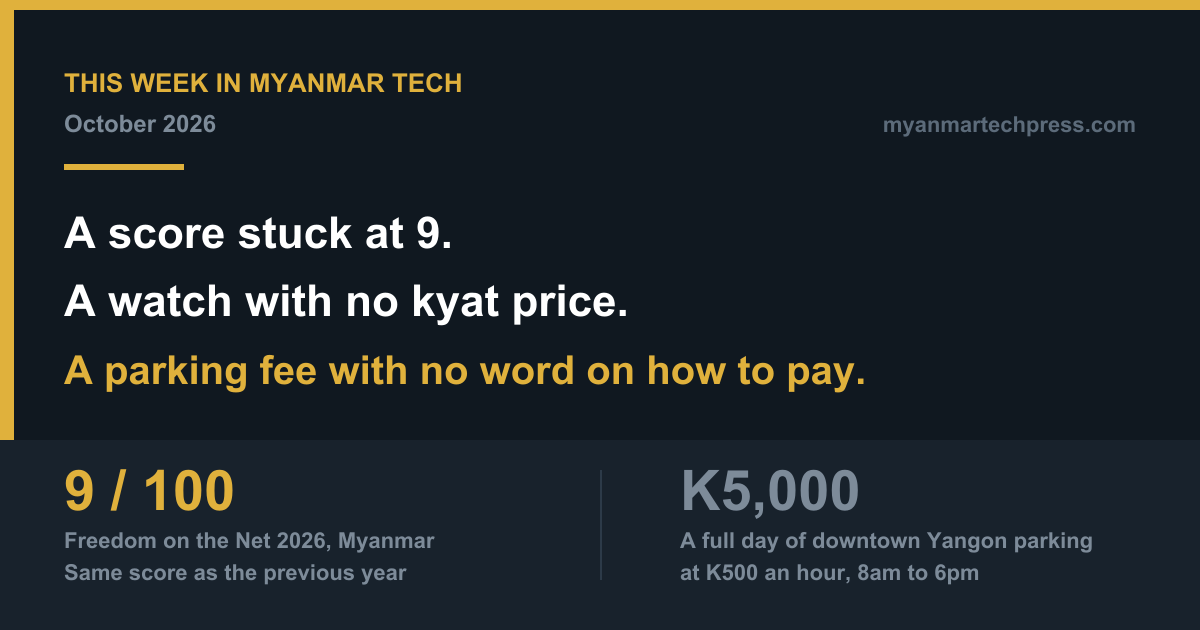
This is Myanmar Tech Press’s weekly column. We connect recent coverage, check back on things we flagged earlier, and add the analysis a single news article doesn’t have room for. The past week’s three stories cover a smartwatch, a global index and a downtown street. In all three, the most useful piece of information is the one that was not published: a price, a count, a way to pay.
This Week’s Articles
A Blood Pressure Watch With Unanswered Questions
Huawei Myanmar announced the HUAWEI WATCH D3, a smartwatch with an inflatable cuff in the strap. Its press release gives no Myanmar price, on-sale date or shop list. Footnotes on Huawei Myanmar’s own product page say several headline health features are “only available in some markets”, without saying whether Myanmar is one of them. The certifications Huawei cites are European and Chinese. Read the full piece.
What we would add now: those footnotes are written in Burmese, on a page built for Myanmar. Somebody translated the sentence “only available in some markets” for Myanmar readers, and the page still doesn’t tell those readers whether it applies to them. Read next to this week’s internet freedom story, there is a second question. Health Insights is delivered by an over-the-air update, and the Health Community feature sends alerts about relatives’ readings, which presumably needs a working connection. Athan counts 140 of 358 monitored townships under communication shutdowns. Part of what this watch offers may depend on where its owner lives as well as on what Huawei has enabled.
Freedom House Keeps Myanmar at 9 out of 100
Freedom House scored Myanmar 9 out of 100 on Freedom on the Net 2026, the same as last year. The Irrawaddy says it is the third year in a row. The figures underneath look worse: 140 of 358 monitored townships under shutdowns, against around 80 in Athan’s March 2024 count; a 24/7 online monitoring committee that includes the Central Bank; and a regime figure of 21,369 online users “actioned” between 2024 and May 2026, against the more than 2,000 detentions Data for Myanmar has counted since the coup. Read the full piece.
What we would add now: our article said the gap between those two numbers most likely reflects different periods and definitions. Doing the division weakens the “periods” half of that. If the regime’s window starts in January 2024, it runs about 29 months, or roughly 740 people a month. Data for Myanmar’s window runs about 68 months, or around 30 a month. The gap is about tenfold on the totals and about 25-fold per month, so the different periods make the gap look smaller than it is. Definitions have to explain the rest. One detail points in a direction: the regime describes the 21,369 as people who posted content, yet The Irrawaddy reports that nearly 20,000 were prosecuted under counter-terrorism charges, accused of funding or supporting resistance groups. If many of those cases are about money and not about posts, the two counts may be describing largely different groups of people. The sources do not say so, and we are raising it as a question. But it would make a central bank’s seat on an internet committee easier to understand.
Yangon Parking Fees, Due on 1 November
Eleven Media, citing the Yangon Region Government, reports fees of K500 an hour, from 8am to 6pm daily, across eight downtown zones run through a tender. Staying past the allotted time adds K300 for up to 30 minutes, or K500 for up to 60. The report names no app, no payment method and no operators. Plans from 2018 and 2020 did not produce results we can verify, and the three apps named in 2020 are unconfirmed. Read the full piece.
What we would add now: a full 10-hour day comes to K5,000, against K2,000 at the K200 rate in the 2018 plan. In 2019, a downtown resident told state media that paying daily fees wasn’t feasible for residents, and the new report doesn’t mention them. The overstay amounts are also more revealing than they first appear. Half an hour at the normal rate would cost K250, and a full hour K500. So if our first reading of the wording is right, K300 and K500 are barely a penalty at all. They look closer to a price for extra time. Either way, charging them requires someone or something to know when each car arrived. A fee schedule built on 30-minute steps needs a timekeeper in every zone, and the report doesn’t say who or what that will be. That is the same gap as the payment question, seen from the other side.
From the Archive: When a Huawei Launch Came With a Price
In August 2022 we reported that the HUAWEI Band 7 was on sale in Myanmar at 109,000 kyats, with a promotional price of 379,000 kyats on a nova Y70 phone. So a local Huawei launch story has carried a kyat figure before. The pattern isn’t a clean one: our 2021 piece on the Watch GT 2e had no price, and neither did our December 2024 piece on the Watch D2. We can’t say why, and an unstable exchange rate is only one possible reason.
Checking back also shows something about us. The 2022 article says in our own voice that the band can “accurately distinguish” six types of sleep problems. The D2 article likewise repeats “world’s first” with little distance. Those were a manufacturer’s claims, and we should have attributed them. This week’s D3 piece does that.
A second item from the archive bears on parking. In August 2019 we covered the Digital Yangon app, which let residents of downtown townships photograph illegally parked cars and report them, with GPS location and a ticket number in reply. The Play Store link in that article returned a not-found error in our automated check while writing this column. That may not reflect all regions, so we are not saying the app is gone. Either way, Yangon had an app for reporting parked cars years before it had a confirmed way of paying for parking by phone.
One Thing Worth Watching
Checking back: our last column asked whether the end-of-October enforcement on online gold sales, as expected by The Irrawaddy, would actually be reported. At the time of writing we can find no such report. October is only just ending, so this stays open. Separately, our searches found no new statement on the four Hopong Starlink sets, and no operator count of dedicated 5G base stations. We also found no public comment on the Norwegian charges against Telenor ASA and no official confirmation of the reported geo-block on payment apps. The Central Bank’s seat on the monitoring committee is a new fact, but it does not answer that question. This week’s coverage does not touch the other open items on World Cup audience figures, Myanmar Net’s 2026 price changes, PUBG MOBILE placings, AYA Bank’s response to The Crew’s listing, or new Russia-Myanmar contracts.
New this week: first, by the end of November, will any published source name a payment method and operators for all eight parking zones? In 2018, only five of eight zones found successful applicants, so the number itself is worth counting. Will MMQR be among the accepted methods? Second, by the end of 2026, will Huawei Myanmar publish a kyat price for the Watch D3 and say whether Myanmar is one of the “some markets”?
About This Column
This is a recurring column from Myanmar Tech Press. It steps back from single-story coverage to connect recent articles with our own archive, and it tracks specific claims until they are confirmed or quietly dropped. Our regular reporting continues alongside it at the usual pace.