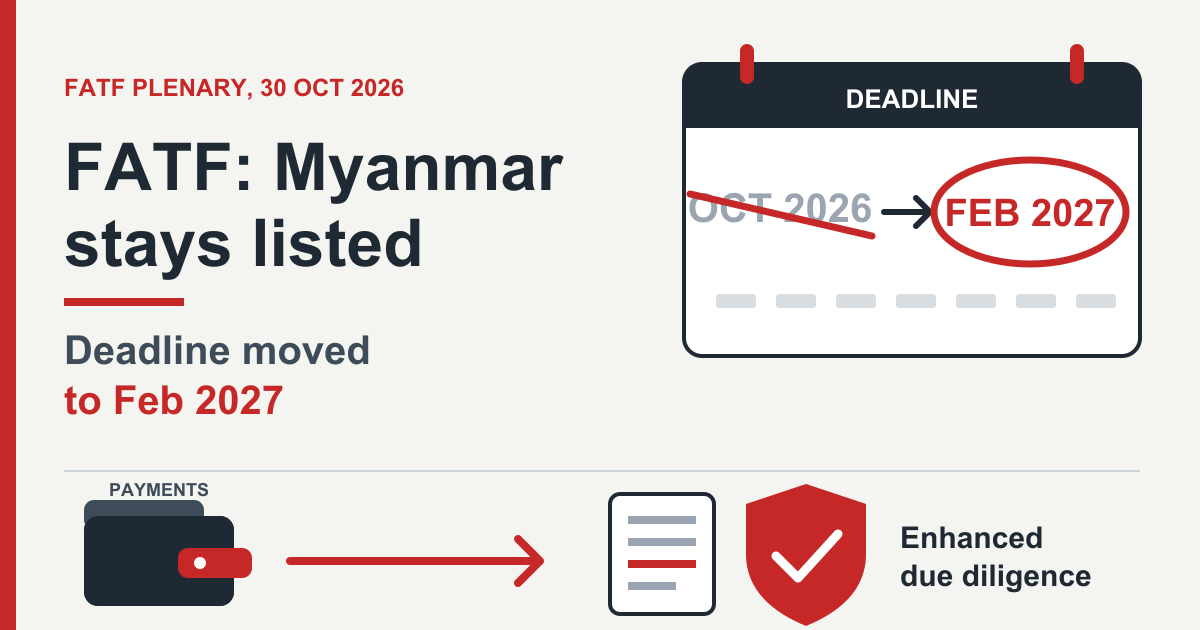
The Financial Action Task Force (FATF) kept Myanmar on its list of high-risk jurisdictions subject to a “call for action” when it issued its statement on 30 October 2026 at the plenary in Paris. According to the US Treasury’s FinCEN release of 30 October 2026, the FATF “also updated its public statement on Burma and Iran,” with Iran, North Korea and “Burma subject to calls for action.” The same release says “Burma remains subject to the application of enhanced due diligence, but not countermeasures.”
That is the short version: Myanmar is still on the blacklist, and it has not been hit with the harshest tier. What changed is the clock. Compliance outlets report that the FATF said it will consider countermeasures if no further progress is made by February 2027. After the June plenary, the date reported was October 2026. This article looks at what that means, what Myanmar’s government says it has done, and where the official accounts do not line up. It does not offer financial advice.
One note on sourcing. The FATF’s own page for the statement (titled “High-Risk Jurisdictions subject to a Call for Action – 30 October 2026”) could not be opened by our researcher because the site returned an access error. So every direct quotation of FATF wording below comes from the FinCEN release, which is a US government document. Anything else is attributed to the outlet that reported it.
What exactly did the FATF decide on 30 October?
Three things stand out from the verifiable record.
- Myanmar stays on the “call for action” list. That list is often called the blacklist. Per FinCEN, the only jurisdictions on it are Iran, North Korea and Burma (the name the US government uses for Myanmar).
- The tier did not change. FinCEN states that Myanmar remains subject to enhanced due diligence, “but not countermeasures.” Countermeasures are the stricter step, and Iran and North Korea are the cases where they apply.
- The grey list moved, but not for Myanmar. RegReportingDesk reports that four jurisdictions left the grey list (Bulgaria, Côte d’Ivoire, the Democratic Republic of the Congo and Monaco) and that none were added. The blacklist was unchanged.
The release also says “the FATF calls on all members and urges all jurisdictions to apply enhanced due diligence proportionate to the risks.” In plain terms, banks and payment providers abroad are asked to look harder at transactions linked to Myanmar, in proportion to the risk, rather than refuse them.
Why did the deadline move from October 2026 to February 2027?
This is an easily overlooked part of the story. AGBrief reported on 22 June 2026 that the FATF’s June statement kept Myanmar listed and said countermeasures could be considered if there was no progress by October 2026. ComplyAdvantage’s plenary summary says that after the October plenary, the FATF will consider countermeasures “if no further progress is made by February 2027.”
So the threat was not carried out, and it was not withdrawn. It was rescheduled. We cannot tell from the public record why the FATF chose to extend the window, because the full statement was not readable to us. What the secondary reports do say is that the FATF acknowledged steps by Myanmar, including plans for a national anti-online scams centre and stronger regional and international cooperation, while repeating its concern about illicit finance tied to fraud and cyber scam activity, which it described as extensive.
The pattern is worth keeping in mind. By AGBrief’s account, Myanmar has been on the call-for-action list since October 2022, and its original action plan expired in September 2021. A listing that has lasted four years, with a deadline that keeps sliding, suggests that the FATF treats Myanmar as a case to be watched rather than one to be escalated quickly. That is an interpretation, not something the FATF said.
What does Myanmar’s government say about its progress?
Myanmar’s side of the story has two parts. In a position statement on the FATF’s June statement, posted on 1 August 2026, the Ministry of Information said that 13 of the 15 action items had been addressed, that its 17th progress report had been submitted to the FATF’s Asia-Pacific Joint Group, that a new anti-money-laundering law had been enacted in 2026, and that an anti-online-scam law was being prepared. It also said a national anti-scam centre was being set up, and that a 2020 central bank notification bars the use of cryptocurrency as legal tender. The same statement said investigations had found no evidence that scam-related crypto entered the regulated financial system. Those are the government’s claims; we have not independently verified them.
After the plenary, Eleven Media reported on 2 November 2026 that a Myanmar delegation led by Central Bank of Myanmar Governor Dr Khin Naing Oo attended in Paris. Eleven wrote that Myanmar “has successfully completed 13 of the 15 action plan measures” and that the governor’s presentation “reportedly received supportive comments from major FATF member countries.” That wording is Eleven’s own, and the “reportedly” is theirs.
Neither source says which two items remain. We could not find that anywhere. It is the single most useful missing fact, because it would show whether the gap is a paperwork matter or a structural one.
Where does Eleven’s account differ from the FATF’s wording?
Here the reporting needs care. Eleven says the FATF “urged member countries to facilitate humanitarian assistance to Myanmar and remittance transfers by Myanmar workers living abroad.”
The wording quoted by FinCEN, taken from a footnote in the FATF statement, is narrower. It says that “when applying enhanced due diligence, countries should ensure that flows of funds for humanitarian assistance, legitimate NPO activity and remittances are neither disrupted nor discouraged.” It adds that “the FATF will also continue to monitor whether Myanmar’s AML/CFT activities apply undue scrutiny to legitimate financial flows.”
These are not the same instruction. “Facilitate” reads like an active request to make remittances easier. “Neither disrupted nor discouraged” is a protective floor: while banks apply extra checks, they should not choke off legitimate flows. It is a guard against over-caution, not a promise of easier transfers. For a Myanmar worker abroad sending money home, the difference matters. The FATF’s language says extra checks are expected, but blanket refusal is not what it wants. It does not say those checks will disappear.
It is also worth noticing the second sentence. The FATF says it will watch whether Myanmar’s own anti-money-laundering rules apply “undue scrutiny” to legitimate flows. That points the lens inward as well as outward, which matters given recent moves on payments inside the country (see below).
Why is scam finance now the real sticking point?
Counting action items can hide where the pressure sits. ComplyAdvantage reports that the plenary approved a new FATF report on end-to-end illicit financial flows linked to scam compounds, and that the FATF called such compounds “among the most rapidly expanding forms of organized crime globally.” To be clear, the ComplyAdvantage article does not say the report is about Myanmar, and we have no confirmation that it has been published. We should not read it as aimed at Myanmar.
Still, the FATF’s repeated concern about fraud and cyber scam activity in the Myanmar entry is exactly the kind of risk a checklist of 15 items may not capture. If 13 items are complete but the headline concern is an evolving criminal economy, finishing the last two items may not by itself end the listing. This is our reading of the situation, not a FATF statement.
Domestic enforcement is moving in parallel. The state newspaper GNLM reported on 4 November 2026 that, of 63 buildings designated for demolition in Phase II of the Shwe Kokko crackdown, four had been brought down by controlled explosions and four by heavy machinery, with 55 still to go (GNLM). Whether physical demolition shifts the FATF’s assessment of the underlying money flows is a separate question that none of the sources answer. We have covered related enforcement before, including the Hopong scam raid and Starlink enforcement on 16 October.
How does this connect to wallets, remittances and banks?
A blacklist entry rarely shows up as a headline sanction. It shows up as friction: more questions, slower checks, and more cautious correspondent banks. That friction lands on cross-border channels first. Three recent MTP stories sit in this territory:
- In late August, Wave Money and Merchantrade launched a Malaysia-to-Myanmar remittance corridor. That is the type of legitimate flow the FATF footnote says should be “neither disrupted nor discouraged.”
- In September, we covered a report that the central bank had ordered banks to block KBZPay, Wave Money, AYA Pay and CB Pay from working overseas. The report came from a Myanmar outlet and was reported as such, not as confirmed policy. If those restrictions exist, they are a domestic control measure that the FATF’s “undue scrutiny” monitoring language could bear on, though no source links the two.
- Security is part of the picture too. Our report on KBZ and AYA being named on ransomware leak sites shows that financial institutions face pressure on their own systems, not just from regulators.
One more caution. We found no evidence in any source that a specific foreign bank or remittance provider changed how it treats Myanmar after the 30 October statement, and we are not claiming that any did. The statement is recent, and it kept the existing tier. If providers change behaviour, it is likely to be gradual and quiet, and hard to see from outside until customers notice.
The commerce ministry’s ban on online gold sales, covered on 14 October, is another example of how regulators are tightening controls on value transfer (read our report). Whether it was driven by FATF concerns is not stated in any source we found, so treat it as context rather than cause.
What did the announcement not tell us?
- Which two action items are outstanding. Neither the government nor the media coverage names them.
- What “further progress” means in practice for February 2027. The FATF text we could read does not set measurable targets, and the February date comes from secondary reporting.
- Whether scam compound findings point to Myanmar. The FATF’s new report is about the phenomenon globally as far as the available summary shows.
- How banks abroad are responding. No evidence has surfaced yet.
- The full FATF text. We could not open the FATF’s own page, so our reading depends on FinCEN’s excerpts and trade summaries. Anyone making compliance decisions should read the FATF statement directly.
One smaller discrepancy: Eleven Media gives the plenary dates as 26 to 30 October, while other sources point to 28 to 30 October. We have avoided stating a start date. What is consistent across sources is that the statement was issued on 30 October.
Frequently asked questions
Is Myanmar still on the FATF blacklist?
Yes. According to FinCEN’s 30 October 2026 release, Burma (Myanmar) remains one of three jurisdictions, with Iran and North Korea, subject to calls for action.
Does the blacklist mean sanctions on Myanmar?
Not directly. The FATF is not a sanctions body. FinCEN says Myanmar remains subject to enhanced due diligence “but not countermeasures.” Individual countries and banks decide how to apply the FATF’s call, and US institutions are told to keep consulting existing FinCEN and OFAC guidance.
What is the February 2027 deadline?
Compliance outlets report that the FATF will consider countermeasures if no further progress is made by February 2027. The earlier timeline pointed to October 2026. “Consider” is not “impose,” and we could not read the FATF’s full wording ourselves.
Can people still send money to Myanmar?
The FATF wording quoted by FinCEN says countries applying enhanced due diligence should ensure remittances and humanitarian flows are “neither disrupted nor discouraged.” That is not a promise that transfers will be quick or free of checks. Check with your provider about current requirements.
Has Myanmar completed its FATF action plan?
Myanmar’s government and Eleven Media say 13 of 15 measures are complete. The FATF’s entry remains in place, and we found no public list of the two remaining items.
The bottom line
The 30 October statement did not escalate Myanmar’s status, and it did not release it. It moved the countermeasures decision to February 2027 and kept the focus on scam-linked finance. The most useful details to watch are the two unnamed action items, any FATF detail on what counts as progress, and whether banks and wallet operators change their cross-border practices. The gap between Eleven’s “urged to facilitate” and the FATF’s “neither disrupted nor discouraged” is a reminder to read the statement itself. We will update this article if the full FATF text or the identity of the two remaining items becomes available.
Sources (all accessed 4 November 2026): FinCEN news release, 30 October 2026; Eleven Media, 2 November 2026; ComplyAdvantage, published 30 October 2026 and updated 2 November 2026; RegReportingDesk, 1 November 2026; AGBrief, 22 June 2026; Myanmar Ministry of Information position statement, posted 1 August 2026; GNLM, 4 November 2026. The FATF’s own statement, “High-Risk Jurisdictions subject to a Call for Action – 30 October 2026” (fatf-gafi.org), is the official document; its page could not be opened during our research, so FATF wording here is quoted via FinCEN. Related MTP reports: 9 September 2026, 27 August 2026, 16 October 2026, 28 September 2026, 14 October 2026.