Once a week, this column puts the stories we published side by side, checks them against our archive, and names a few things that can be verified later. This edition covers the past week, which brought two stories about money rather than gadgets. Read together, they describe the same thing from two directions: how Myanmar’s financial system is judged from outside, and how it is being tightened from inside.
The FATF kept Myanmar on its blacklist and moved the clock
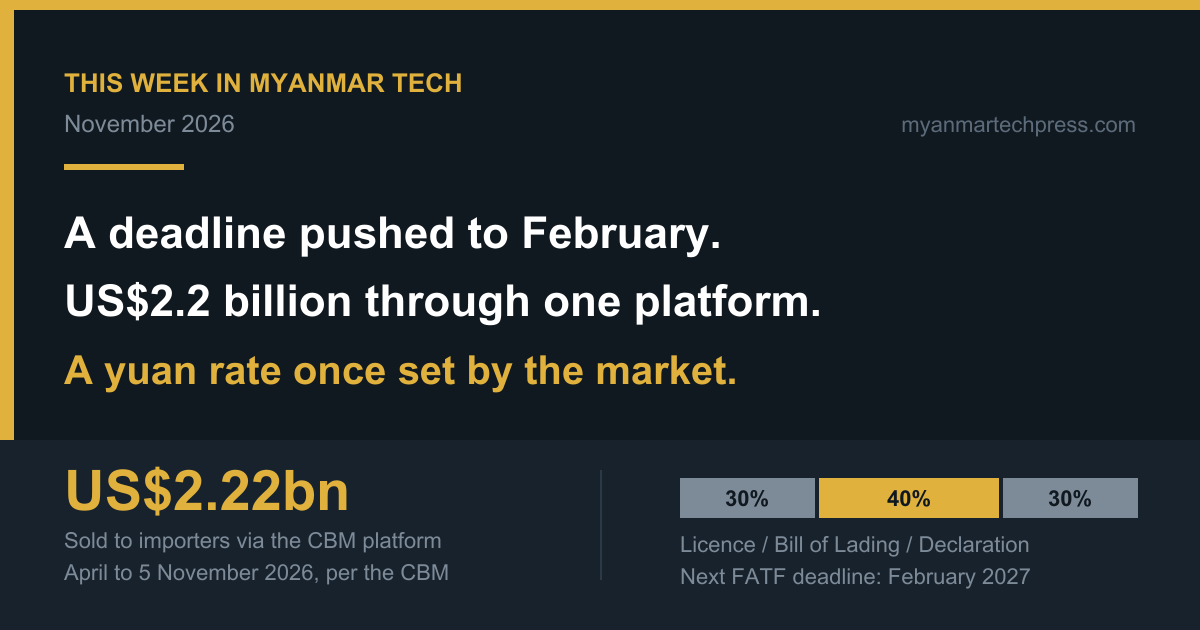
On 30 October 2026, the Financial Action Task Force kept Myanmar on its “call for action” list, alongside Iran and North Korea. According to the US Treasury’s FinCEN release, Myanmar remains subject to enhanced due diligence “but not countermeasures.” Compliance outlets report that the FATF will consider countermeasures if no further progress is made by February 2027; after the June plenary, the date reported was October 2026. Myanmar’s government and Eleven Media say 13 of 15 action items are complete, but no source names the remaining two.
What we would add now: Our article dwelt on one gap between Eleven Media’s wording (“urged … to facilitate” remittances) and the FATF’s (“neither disrupted nor discouraged”). Two days later, a second gap became visible. The FATF says it will watch whether Myanmar’s own rules apply “undue scrutiny” to legitimate flows. The central bank’s new announcement, covered below, is exactly the kind of domestic rule that sentence could apply to: it threatens legal action against anyone who exchanges currency outside official channels or at unofficial rates. Whether outside examiners will see that as better control or as more friction for ordinary senders is not something either side has said. But the two stories now have to be read together.
The central bank reported US$2.2 billion sold through its FX platform
In a statement dated 5 November and reported by Eleven Myanmar, the Central Bank of Myanmar warned that buying, selling or exchanging foreign currency without a licence, or at rates other than those it prescribes, will face legal action. It said that from April 2026 to 5 November it sold about US$2.2212 billion, 1.9071 billion yuan, 6.7128 billion baht and 74.5 million rupees to importers through its FX Online Trading Platform and licensed banks. A companion report described a new schedule for approved imports: 30% of the foreign exchange at licence approval, 40% at the Bill of Lading and 30% at the Import Declaration.
What we would add now: Placed next to the FATF story, the 30/40/30 schedule reads as a traceability tool as much as a liquidity tool. Every tranche is tied to a document, so every dollar sold can be matched to a shipment. That is the kind of record an anti-money-laundering review asks for, though the CBM did not cite the FATF as a reason, and we do not claim it was one. The other number worth noticing is the yuan figure. Close to 1.91 billion yuan went through the platform, which says something about where Myanmar’s imports come from. That is also where our archive has something to say.
From the archive: when a bank said the market would set the rate
In April 2022, we reported that CB Bank was opening Chinese yuan company accounts for Myanmar-China border traders, run through its Muse branch. The notable line was about pricing. The daily yuan/kyat rate, the bank said, “will depend on the Yuan/Kyat market in Muse,” and it would ask Chinese banks for the market price three times a day and compare it before setting its own rate.
Four and a half years later, the instruction runs the other way. The central bank now says money changers, banks and customers must use the rates it prescribes, published daily on its website and in state newspapers. In 2022, a bank told border traders it would follow the market so they would not lose out; in 2026, following any rate other than the official one is the thing being warned against. We do not know whether CB Bank’s yuan service still prices that way. The contrast is between what was announced then and what is announced now.
A second archive piece fits the FATF side. In August 2023, we covered KBank and KBZ Bank launching app-to-app transfers from Thailand to KBZPay. KBank’s chairman said Myanmar nationals in Thailand typically send home MMK 100,000 to 200,000 a month, and the service let users see the applicable exchange rate in the Myanmar language. That is the kind of legitimate remittance the FATF footnote says should be “neither disrupted nor discouraged.” It is also exactly the kind of flow where the official-versus-market rate question lands on an individual worker, not an importer.
One thing worth watching
Two new items:
- Will anyone name the two outstanding FATF action items before the February 2027 plenary? The Ministry of Information, the central bank, or the FATF itself could do it. Until then, it is impossible to tell whether the gap is paperwork or structural.
- Will the central bank publish who can use the FX platform, and what counts as a “necessary” import? By the end of 2026, will there be stated criteria on business size or import category? Neither was given in the reports we read.
Checking earlier items: last week we asked whether Yangon’s parking fees, set to return on 1 November, would come with clear payment information for every zone. A web search on 7 November found no new reporting either way, so that item stays open. The same is true of the expected crackdown on online gold sales: we found no November reports of enforcement. And the September report that banks were told to block mobile payment apps overseas is still unconfirmed by the central bank or the four providers. The FATF’s “undue scrutiny” language gives that question a new angle, but not an answer.
About this column
This is a weekly roundup from Myanmar Tech Press. It links the past week’s stories to each other and to our archive, which goes back to 2017, and it ends with items that can be checked in later editions. We publish around two news articles a week; this column is where we look back at them with a few more days of context. Earlier editions are in the Articles section.