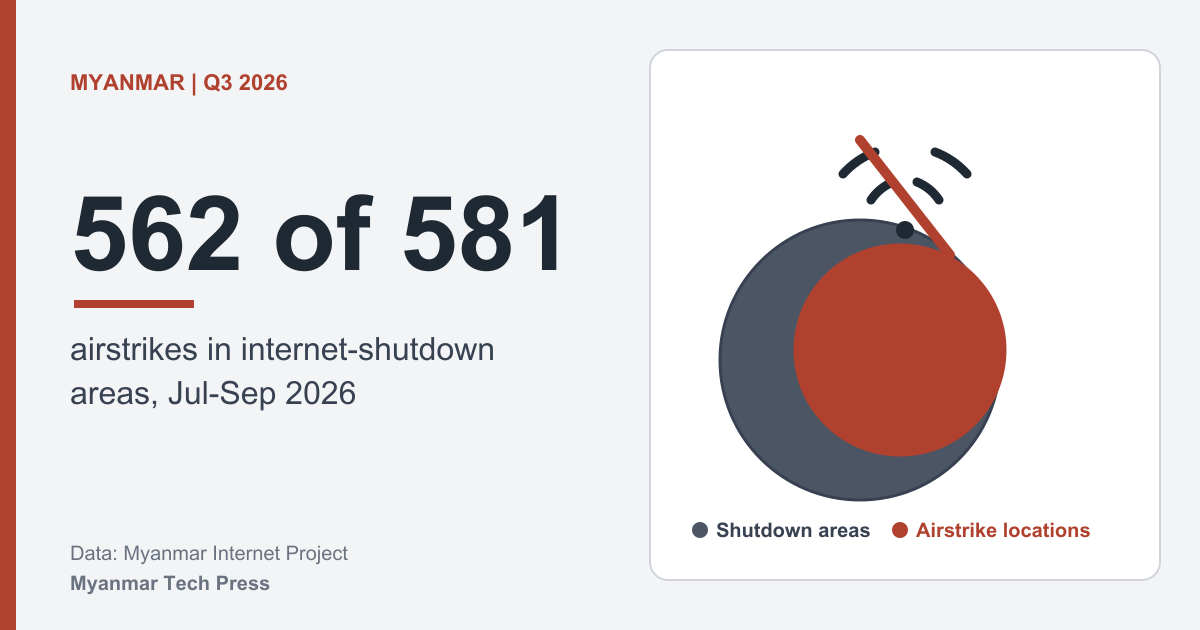
The Myanmar Internet Project (MIP) published its report on airstrikes and internet shutdowns for July to September 2026 on 23 October 2026. According to MIP, the military junta carried out 581 airstrikes in the quarter, and 562 of them (96.88%) hit areas that were experiencing internet shutdowns. MIP says at least 353 civilians were killed. This article summarises those figures, compares them with MIP’s previous quarterly report, and adds our own reading of what the data can and cannot tell us. Every number below is MIP’s unless stated otherwise, and the analysis sections are clearly marked as ours.
Source: Myanmar Internet Project, July-September 2026 report (published 2026-10-23).
What did MIP report for July to September 2026?
MIP’s headline figures for the quarter are:
- 581 airstrikes, which MIP says is 11.73% more than the previous quarter.
- 562 of those (96.88%) struck areas with internet shutdowns.
- 99 townships hit across 13 regions and states (Yangon is the exception). Sagaing had 23 townships hit, Rakhine 15 and Magway 12.
- Rakhine 151, Sagaing 107, Magway 106 airstrikes, together about 62.65% of the total.
- At least 353 civilians killed, including at least 90 women, 34 children and 43 elderly people. MIP says about 96.88% of deaths occurred in areas with internet shutdowns.
- Damage to buildings: 39 religious buildings, 16 schools, 4 hospitals or clinics, 2 IDP camps, 3 bridges and 3 markets. MIP says it could not give exact figures for damage to homes and shops.
MIP states that the data is collected daily from independent media outlets and regional news agencies. In its conclusion, MIP says the military’s heavy reliance on air power continued, that the airstrikes mostly targeted areas with disrupted communications and so put civilians there at greatest risk, and that attacks on markets with no apparent military connection caused mass civilian casualties.
How does this compare with April to June 2026?
MIP’s previous quarterly report, published on 13 July 2026, covered April to June. Placing the two side by side:
- Airstrikes: 520 in Q2, 581 in Q3. The difference is 61, which is 11.73% of 520, so MIP’s stated increase checks out against its own numbers.
- Share in shutdown areas: 510 of 520 (98.08%) in Q2; 562 of 581 (96.88%) in Q3. Slightly lower, but near-total in both quarters.
- Townships hit: 87 in Q2, 99 in Q3.
- Civilians killed (at least): 314 in Q2, 353 in Q3.
- Most-hit regions: Chin 122, Sagaing 101, Rakhine 98 in Q2 (about 62% of the total); Rakhine 151, Sagaing 107, Magway 106 in Q3 (about 62.65%).
Two other differences stand out. First, on landmarks: the Q2 report said that all landmarks hit by airstrikes were in areas with communication shutdowns. The Q3 report says that, besides 4 religious buildings, 2 IDP camps and 2 schools, all landmarks hit were in shutdown areas. So the near-total pattern holds, but Q3 lists a small set of exceptions that Q2 did not. Second, Chin State, the most-hit in Q2, is not among Q3’s top three. MIP’s report does not explain this shift, and we will not guess at a cause.
Why does this matter to a tech and telecom audience?
This section is our analysis.
Internet shutdowns are usually discussed as an access problem: lost business, blocked services, a lower score in a freedom index. MIP’s data points to a more immediate dimension. When mobile data and phone networks are cut in a township, the people living there lose the most basic tools for dealing with danger: warning neighbours, calling for help, contacting relatives, and getting information out to journalists and aid groups.
There is a second, less obvious effect on the data itself. MIP says the true death toll may be significantly higher than the figure it reports because of communication constraints. That is a direct statement that the shutdowns affect not only the people living through events but also whether those events can be documented and counted. A report built on independent media and regional news agencies can only record what reaches them. The places with the least connectivity are the places hardest to report from, so a count “of at least” 353 is, by MIP’s own account, a floor.
What does the report not tell us?
This section is our analysis, and it is about the limits of the data, not a criticism of MIP’s work.
- There is no definition of a “shutdown area”. Neither the Q2 nor the Q3 report states how an area experiencing internet shutdowns is determined: at township level or finer, from which sources, over what time window. Without that, readers cannot check whether 96.88% means “cut for the whole quarter” or “affected at some point”.
- The sources are media reports. MIP compiles the data from independent and regional media. That is a reasonable method where on-the-ground verification is impossible, but it means coverage depends on what was reported and where.
- The death-share figure matches the strike-share figure. MIP gives 96.88% for the share of airstrikes in shutdown areas (562 of 581) and says “about 96.88%” of deaths occurred in shutdown areas. The two percentages are identical, and MIP does not give an absolute number of deaths in shutdown areas. We note this neutrally, as something readers may want to ask MIP about when they cite the figure. We are not suggesting an error.
- No operator-level detail. The report does not break down shutdowns by operator or by type of network, so it cannot tell us how the cuts were carried out.
Does this show that shutdowns cause airstrikes?
This section is our analysis.
No, and the report does not claim it does. A figure like 96.88% shows overlap, not causation. Areas with internet shutdowns and areas of active armed conflict appear to largely coincide, and MIP itself describes the three hardest-hit regions as being in intense armed conflict. A high overlap is exactly what you would expect if both the shutdowns and the airstrikes are concentrated in the same conflict zones, whatever the reason for each. To say anything stronger, for example that shutdowns are used to hide strikes or enable them, you would need evidence about intent and timing that this dataset does not provide. We make no such claim, and MIP’s conclusions, as summarised above, do not either.
What the data does support is a narrower statement that MIP makes itself: because strikes mostly fall on communication-disrupted areas, civilians in those areas are at greatest risk, and they are the least able to communicate when it happens.
How does this connect to other MTP coverage?
Three recent MTP articles cover neighbouring parts of the same picture:
- Myanmar’s Freedom on the Net 2026 score (2026-10-28): the 9/100 score, and Athan’s figure of 140 of 358 monitored townships facing shutdowns according to October 2026 reporting. That article looks at the national-level index; MIP’s report looks at where strikes land.
- The Dawei flood telecom blackout (2026-10-05): a flood disrupted phone and internet service in Dawei, and that article cited MIP’s May-July 2026 quarterly report. It is a reminder that connectivity can be lost for more than one reason.
- Hopong scam raid and Starlink (2026-10-16): on Starlink enforcement, including civil society groups’ call, reported by DVB in July 2026, for SpaceX to stop deactivating terminals. In our reading, satellite links become more important where terrestrial networks are cut, which is why that enforcement debate connects to MIP’s data.
Frequently asked questions
How many airstrikes did MIP record in Myanmar from July to September 2026?
MIP recorded 581, of which 562 (96.88%) were in areas with internet shutdowns.
How many civilians were killed according to MIP?
At least 353, including at least 90 women, 34 children and 43 elderly people. MIP says the real number may be significantly higher because of communication constraints.
How does Q3 compare with the previous quarter?
In April to June, MIP recorded 520 airstrikes (98.08% in shutdown areas) and at least 314 civilian deaths. Q3’s 581 strikes are 11.73% more, and the number of townships hit rose from 87 to 99.
Which areas were hit hardest in Q3?
Rakhine (151), Sagaing (107) and Magway (106), together about 62.65% of the total, per MIP.
Does the report prove that internet shutdowns cause airstrikes?
No. It documents an overlap between shutdown areas and airstrike locations. Shutdown areas and conflict zones appear to largely coincide, so the overlap alone does not establish cause.
The takeaway
MIP’s July to September data shows a near-total overlap between airstrikes and areas without internet access for the second quarter in a row, with strikes, townships hit and recorded civilian deaths all higher than in April to June. The report is most useful as a record of where connectivity loss and violence coincide, and as a reminder that where the network is cut, the count of what happened is likely an undercount. It is less useful for answering questions it does not claim to answer: how shutdowns are defined, how they are carried out, and whether one drives the other. Readers who cite the figures should cite MIP directly, and treat “at least 353” as a minimum.
Sources: Myanmar Internet Project, “Report on Communication Disruptions and Impacts in Regions Affected By Airstrikes (July – September 2026)”, published 2026-10-23 (link); Myanmar Internet Project, “Report on Communication Disruptions and Impacts in Regions Affected By Airstrikes (April – June 2026)”, published 2026-07-13 (link). Related Myanmar Tech Press articles: Freedom on the Net 2026 (2026-10-28); Dawei flood telecom blackout (2026-10-05); Hopong scam raid and Starlink (2026-10-16). Analysis sections are Myanmar Tech Press’s own.