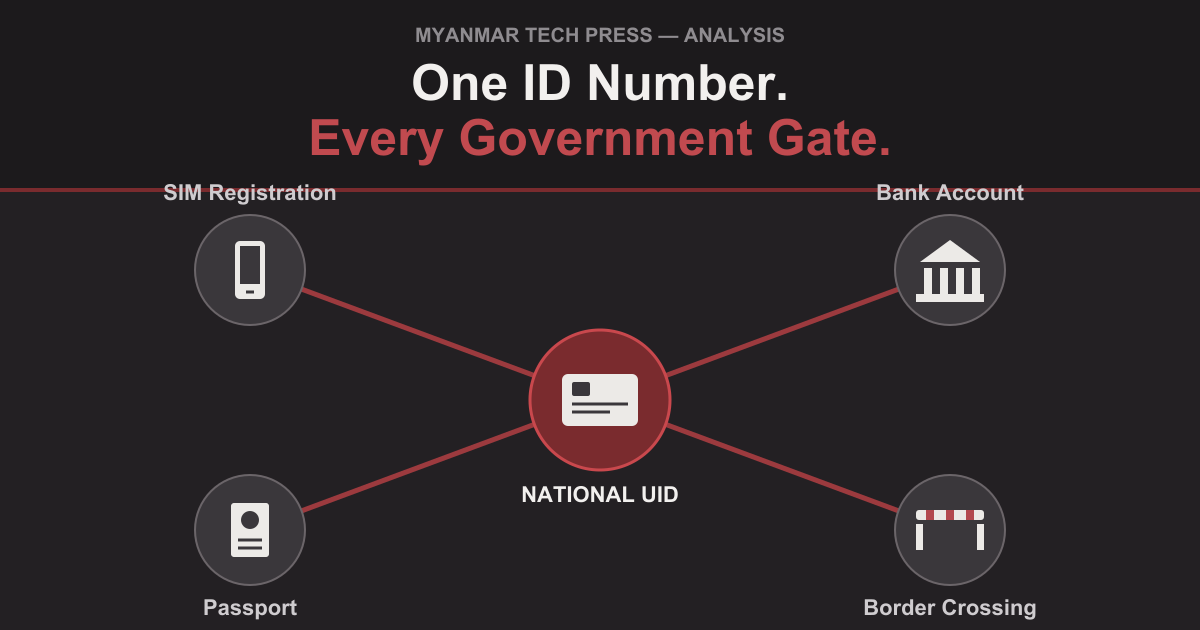
Myanmar’s military-run Ministry of Immigration and Population has issued a pre-qualification tender for a “National e-ID Smart Card Pilot Project” covering the 2026-2027 fiscal year, seeking 110,000 cards that combine a chip-based smart card with a Visible Digital Seal (VDS) paper format, according to reporting by biometricupdate.com on September 8, 2026, which reviewed the procurement documents. The outlet, an industry publication that covers biometric and identity technology, frames the tender as the latest step in a build-out that has already made Myanmar’s Unified ID (UID) — a 10-digit national identity number — a precondition for applying for a passport, crossing land borders, registering a SIM card, opening a bank account and collecting a pension.
The technical backbone is MOSIP, an open-source identity platform modeled on India’s Aadhaar system. Myanmar’s immigration ministry signed a memorandum of understanding with India’s National Institute for Smart Government (NISG) in July 2025, and the two sides ran MOSIP integration testing from November 13-19, 2025, according to a separate biometricupdate.com report dated November 14, 2025. That same report notes India is running comparable digital-ID support work with Sri Lanka at the same time — Myanmar is one node in a wider regional export of India’s identity-infrastructure model.
Why This Matters Beyond the SIM Card Story We Already Told
Myanmar Tech Press has been tracking the country’s Central Equipment Identity Register (CEIR) — the system that ties every mobile phone’s IMEI number to a registered SIM — since it went live, and we published a six-month check on how CEIR enforcement was actually working in early September 2026. Read on its own, CEIR looks like a telecom-sector policy: block unregistered handsets, force SIM registration, tidy up the network. Read alongside the September 8 biometricupdate.com report, it looks like something narrower — one application sitting on top of a much larger identity system.
The UID is not a telecom product. It is a population-wide identity number that SIM registration happens to depend on, the same way passport applications, border crossings, bank KYC checks and pension payouts now depend on it. The Ministry of Immigration and Population’s own account of the program’s early history, published on its official site on June 15, 2023, describes the pilot starting in Nay Pyi Taw, Yangon, Ayeyarwady and Bago on November 14, 2022, with an API layer built specifically to connect the ID database to SIM registration, lottery ticket sales and passport processing. In other words, the interconnection between UID and everyday services was designed in from the start — CEIR is simply the piece that intersected with our telecom coverage first.
What the New Tender Actually Covers
According to biometricupdate.com’s reading of the procurement documents, the FY2026-2027 pre-qualification tender is for 110,000 cards issued in two formats: a chip-embedded smart card and a VDS paper card, the latter presumably intended for contexts where card-reading infrastructure is unavailable. A pre-qualification tender is not yet a full production order — it is the stage at which vendors demonstrate they are eligible to bid on the actual manufacturing and rollout contract. That distinction matters: it tells us the pilot phase of card issuance is still being scaled up procedurally, even though the underlying UID number has already been treated as mandatory for years for the services listed above.
The Official Story and the Border Reality Don’t Match
The framing coming out of the ministry and its Indian technical partners is one of modernization: an open-source platform, a proven Aadhaar-derived architecture, streamlined government services, and — per the ministry’s 2023 statement — a program built for administrative efficiency. What that framing omits is documented in a Radio Free Asia report from May 20, 2024, published shortly after UID cards became mandatory for crossing into Thailand, China and India on May 1, 2024. RFA reported that issuance offices could not keep up with demand — the border town of Muse, for example, was limited to just 100 tokens a day on a single processing machine — and that bribes of 50,000 to 600,000 kyat (roughly $12 to $150 at the time) were being paid to jump the queue for a card that is officially supposed to be free. The same report raised concerns that UID checkpoints were being used to screen young men of conscription age, adding a layer of risk to a process ordinary travelers cannot avoid.
That gap — a card system pitched as efficient and free, operating in practice as a bottleneck that rewards those who can pay — is the most important thing missing from any purely technical account of the UID rollout. A procurement tender for 110,000 cards tells you what the government intends to issue; it tells you nothing about whether the issuance process will function any better than it did at land borders in 2024.
One Number, Many Gates: How Far the UID Now Reaches
Based on the sources reviewed for this article, a Myanmar UID is now a stated precondition for at least five distinct services: passport applications, land border crossings, SIM registration, bank account opening, and pension collection. Each of these was, at some point before UID’s expansion, a separate bureaucratic process with its own paperwork. The consolidation of all of them behind a single identity number is the actual story here — the smart card tender is just the latest visible artifact of that consolidation, not the beginning of it.
This is precisely the architecture MOSIP was built to enable: a single verified identity that downstream systems — telecom, banking, immigration, social welfare — can all query rather than maintain their own separate identity checks. It is efficient by design. Whether that efficiency serves the people whose data it centralizes, or primarily serves the state agencies that can now cross-reference someone’s telecom, banking, travel and pension activity through one number, is a separate question that the tender documents do not address.
What the Numbers Do and Don’t Tell Us
Myanmar’s e-ID Department publishes a live dashboard at eid.gov.mm. As of our access on September 14, 2026, it displayed 7,953,556 total registrations, 1,656,892 total authentications, and 33 connected government agencies. The dashboard also references a goal of registering 70 million adults by the end of 2025.
We want to be precise about the limits of this data. The dashboard does not display a “last updated” timestamp or a date for the figures shown — it is a live counter with no visible historical snapshot, so we cannot say with confidence what date those registration and authentication numbers correspond to beyond “as displayed on September 14, 2026.” Whether the 70-million-adult target for end-2025 was met has not been publicly confirmed by the ministry in any source we reviewed, and we are not going to guess at a completion percentage the government itself has not published. For comparison, the ministry’s 2023 statement cited a Naing-4 database with more than 52 million records and more than 13 million digitized household registration forms as of November 2022 — a different metric (database records, not verified UID registrations) from a different point in time, so the two figures are not directly comparable.
That an official dashboard for a program this consequential does not carry a visible update date is itself worth noting. For a system that gates access to banking, travel and telecom services, the absence of basic data provenance — when a figure was last refreshed, how registrations vs. authentications differ, whether the 2025 target was met — makes independent verification of the program’s actual reach effectively impossible from outside the ministry.
The Missing Piece: Legal Protection and Independent Oversight
Biometricupdate.com’s September 8 report specifically flags the absence of legal protections and independent oversight mechanisms around Myanmar’s UID system. That gap deserves to be read in context. Myanmar has been under military rule since the February 2021 coup, and the country’s pre-coup data protection legislative efforts have not resulted in an operating independent regulator. A biometric identity system that increasingly gates telecom, banking, travel and pension access — built and expanded by a government not accountable to an elected legislature, using a platform designed for centralized cross-agency data linkage — is a different risk proposition than the same technology deployed under a functioning oversight framework. We are not aware of any published audit, ombudsman mechanism, or data-protection authority with jurisdiction over the UID program in the sources reviewed for this article; if one exists, we were unable to find it and would treat that gap in our own research as worth flagging rather than assuming it doesn’t exist.
Frequently Asked Questions
What is Myanmar’s UID and how is it different from the e-ID smart card?
The UID is the underlying 10-digit unified identity number assigned to a person in the government’s identity database. The e-ID smart card (and its VDS paper equivalent) is the physical credential that carries and verifies that number. The September 2026 tender covers production of 110,000 of these physical cards; the UID number system behind them has been in use since the pilot began in November 2022.
Do I need a UID to register a SIM card in Myanmar?
According to the Ministry of Immigration and Population’s own account of the program, SIM registration was one of the services connected to the UID database via API from the pilot’s early stages. This is consistent with Myanmar’s separate CEIR/IMEI registration enforcement, which Myanmar Tech Press covered in a six-month check published in early September 2026.
What platform does Myanmar’s UID system run on?
MOSIP, an open-source identity platform modeled on India’s Aadhaar system. Myanmar’s immigration ministry and India’s National Institute for Smart Government signed an MOU in July 2025 and conducted integration testing in November 2025, according to biometricupdate.com.
How many people are registered in Myanmar’s UID system?
The government’s own dashboard at eid.gov.mm showed 7,953,556 total registrations as of our access on September 14, 2026, but the dashboard does not indicate what date that figure reflects, and the ministry’s stated goal of registering 70 million adults by the end of 2025 has not been publicly confirmed as met or not.
Is it true that people are paying bribes to get a UID card at Myanmar’s borders?
Radio Free Asia reported in May 2024 that bribes of 50,000 to 600,000 kyat were being paid at border crossings to obtain UID cards faster, following the May 1, 2024 rule making UID cards mandatory for crossing into Thailand, China and India. We have not seen more recent independent reporting confirming whether this pattern has changed.
The Bigger Picture
None of this is a story about a single tender for 110,000 cards. It is a story about how many separate gates in Myanmar — a SIM card, a bank account, a passport, a border crossing, a pension — have quietly become the same gate, opened by the same 10-digit number, running on infrastructure imported from India’s identity-technology playbook. The efficiency case for that consolidation is real and is the one the government and its technical partners are making. The accountability case — who can see what through that single gateway, what legal protection exists if the data is misused, and why a government dashboard tracking millions of registrations can’t tell the public when its own numbers were last updated — has not yet been made by anyone in a position to make it. Until it is, the honest way to describe Myanmar’s UID system is as an expanding piece of infrastructure whose reach is easier to document than its safeguards.
Sources: biometricupdate.com, “Myanmar’s digital ID strategy comes amid a fraught landscape,” September 8, 2026 (https://www.biometricupdate.com/202609/myanmars-digital-id-strategy-comes-amid-a-fraught-landscape); biometricupdate.com, “Myanmar adopts MOSIP, begins digital ID pilot,” November 14, 2025 (https://www.biometricupdate.com/202511/myanmar-adopts-mosip-begins-digital-id-pilot); Myanmar Ministry of Immigration and Population official statement, June 15, 2023 (https://www.moi.gov.mm/moi:eng/news/10755); Radio Free Asia, “Bribes, long queues plague Myanmar’s new border smart card system,” May 20, 2024 (https://www.rfa.org/english/news/myanmar/smart-card-border-pass-05202024164811.html); Myanmar e-ID Department official dashboard, accessed September 14, 2026 (https://eid.gov.mm/en/home-en/), figures undated on the source page.