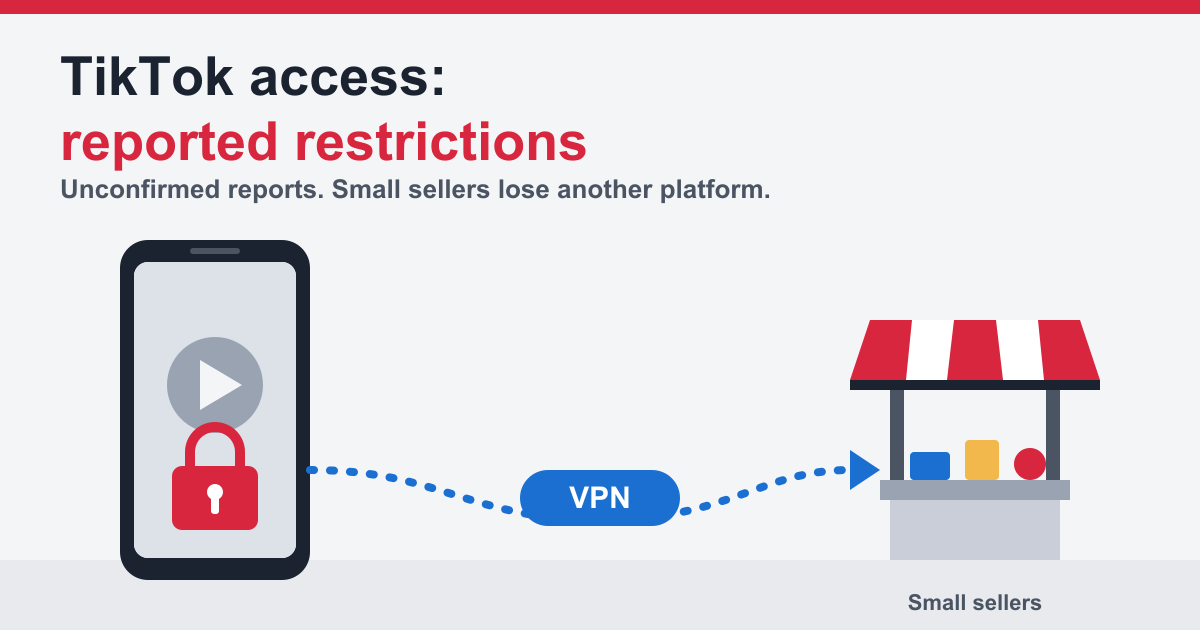
On 2026-10-06, Shan Herald Agency for News, published through Burma News International (BNI), reported that the military authorities “appear” to have blocked TikTok in Myanmar. According to the BNI report, users across the country have not been able to load or upload videos without a VPN since late September 2026. The same report says neither the authorities nor TikTok’s parent company ByteDance has commented.
That is the whole evidential basis for this story, and we want to be upfront about it. Myanmar Tech Press (MTP) found no second outlet reporting the same thing, and no independent technical measurement from network-monitoring projects such as NetBlocks or OONI. So this article does not state that TikTok is blocked. It sets out what one credible outlet has reported, what remains unknown, and why the report matters if it holds up. We will update this piece if confirmation, or a denial, appears.
What is reported
Everything in this section is attributed to BNI’s reporting, not to MTP’s own testing.
- Timing: The restriction is described as starting “late last month”, that is, late September 2026. BNI does not give an exact date, and neither do we.
- Symptom: Users say TikTok will not work normally without a VPN, whether for watching or uploading.
- Which accounts: According to local users quoted by BNI, accounts registered to the Myanmar region need a VPN, while foreign-registered accounts remain partially accessible. This is a detail worth treating cautiously, because a single report cannot tell us how widely it holds.
- Official response: The report says there has been no comment from the junta or from ByteDance.
- Background: BNI notes that Facebook, Instagram, WhatsApp and X have been blocked since the February 2021 coup.
BNI quotes a local entrepreneur identified as Sai Ko, in his 30s: “Since late last month, we haven’t been able to use TikTok without a VPN. We already relied on VPNs to access Facebook and Messenger, so I had shifted my business primarily to TikTok…” A trader in northern Shan State told the outlet that the earlier Facebook block “forced people to move to TikTok”, and that blocking TikTok too shows the military “is trying to cut the public off from the outside world and information.” Those are the interviewees’ interpretations, as reported by BNI, and not established findings.
What is not known
The gaps are large, and they are what separates a confirmed block from a report of one.
- No official statement. Neither the authorities nor ByteDance has said anything, according to BNI. The headline itself uses the word “appears”.
- No independent measurement. MTP looked for data from NetBlocks, OONI and similar projects and found none. Without it, we cannot tell a deliberate block from a slowdown, an app-store issue, or a fault.
- No method. The report does not say how any restriction works, so we do not speculate on technical mechanisms.
- No operator breakdown. It is not stated which mobile or fixed-line providers are affected, or whether all of them are. We name none.
- No user numbers. BNI does not say how many people or sellers in Myanmar use TikTok, so the scale of any impact cannot be sized from this source.
One more caution. While researching this piece we saw other web results claiming Myanmar banned TikTok in earlier years. We could not verify those claims and have not used them. The only dated, checkable report on this is the BNI article from 2026-10-06.
Why it matters for small sellers if the reports are accurate
The most concrete human angle in the BNI report is not about entertainment. It is about commerce. Sai Ko describes having moved his business primarily to TikTok after already relying on VPNs for Facebook and Messenger. If that pattern is common, then the story is about small sellers losing a second sales channel in five years, not about a video app.
The logic is easy to follow even without numbers. When Facebook became hard to reach after February 2021, people who sold goods or promoted services online needed somewhere else to find customers. Short-video apps offered a place to show products and reach people without a shopfront. A trader quoted by BNI draws the same line: the Facebook block pushed people to TikTok. If TikTok is now restricted as well, a seller faces a choice between paying for a VPN, moving to another platform, or reverting to offline and messaging-only sales.
We want to be careful here. BNI gives no figure for how many sellers made this move, and MTP has no data of its own. What the report offers is two interviewees’ accounts, which are illustrative rather than representative.
VPN dependence and what Myanmar’s Cybersecurity Law says
The report’s central practical detail, that a VPN is needed to use the app, matters because VPNs already sit in a legal grey zone. Myanmar’s Cybersecurity Law was enacted on 2025-01-01 and took effect on 2025-07-30. According to a summary by law firm Tilleke & Gibbins, providing a VPN service without ministry approval carries a penalty for individuals of one to six months in jail and/or a fine of MMK 1 million to 10 million (companies face a higher minimum fine). The same summary says the ministry may take control of digital platform services for defense or security reasons.
Per Tilleke’s reading of the law text, those penalties are aimed at VPN providers, not at ordinary people who use a VPN. We have not independently reviewed the Burmese-language statute, and we are relying on the law firm’s summary here. Readers should not take this as legal advice, and the way a law is applied in practice can differ from its text. The Tilleke summary was published on 2025-08-01.
What this does suggest is a structural dependence. If the platforms people use for business and communication can only be reached through VPN tools, then access depends on a category of service that the law says needs ministry approval to offer.
A timing coincidence we should flag, and not over-read
Earlier this year MTP covered a TikTok dance campaign run by MPT, which ran from 2026-07-28 to 2026-09-27, with a prize pool we valued at roughly 6.7 million kyats and 204 winners. Entry was by screenshot to MPT’s TikTok inbox. The campaign ended in late September, around the time the reported restrictions began.
We are pointing this out only because readers may notice it. It is a coincidence of dates. Nothing in the BNI report links the two, and we are not suggesting any cause or connection between a scheduled marketing campaign and the reported access problems. It does illustrate a different point: until very recently, a state-backed operator was treating TikTok as a normal channel for reaching customers.
Where this sits in a longer pattern of digital control
If the restriction is confirmed, it would fit a pattern that MTP has tracked through 2026, in which access to foreign digital services and the data tied to users has become more tightly managed. The CEIR phone registration system links devices to identity, and BNI has reported on warnings from the Myanmar Internet Project about surveillance concerns (BNI, 2026-03-07). Separately, we covered the central bank’s move against overseas mobile payment apps. Each of these is its own story with its own official reasoning, and we do not claim they are coordinated. But for a small seller, they stack up: identity-linked devices, restricted payment options and now, reportedly, a second social platform needing a workaround.
The company’s last Myanmar-specific announcement that MTP covered was in November 2024, when TikTok introduced user-safety features such as family controls for its Myanmar community (our earlier article). That was about safety tools, not access. We have not found any new statement from the company that responds to the current reports.
What would change our assessment
Three things would move this from “reported” to “confirmed”, or the opposite. First, a technical measurement from an independent monitor showing failed connections to TikTok services from inside Myanmar. Second, an official statement or order from the authorities or ByteDance. Third, reporting from at least one more outlet with its own sources. If you use TikTok in Myanmar and can say whether it works with or without a VPN, and on which type of connection, that information is useful too, and we would treat it as anecdotal rather than as measurement.
Frequently asked questions
Has Myanmar officially blocked TikTok?
No official announcement has been reported. BNI’s 2026-10-06 article says the authorities appear to have blocked it and that neither the authorities nor ByteDance has commented. MTP has not confirmed a block independently.
Since when has TikTok been hard to access in Myanmar?
BNI reports that users have had problems since “late last month”, meaning late September 2026. No exact start date has been published.
Do I need a VPN to use TikTok in Myanmar right now?
According to BNI, users with Myanmar-registered accounts say they do, while foreign-registered accounts are reported to be partially accessible. This comes from a single report, and experiences may differ by connection and location.
Is it illegal to use a VPN in Myanmar?
Per Tilleke’s summary of the Cybersecurity Law, the penalties apply to those who provide VPN services without ministry approval, not to people who use them. We cannot give legal advice, and practice may differ from the text of the law.
Is this connected to the MPT TikTok dance campaign?
There is no connection in any source we reviewed. The campaign ended on 2026-09-27, around when the restrictions were reportedly starting. That is a coincidence of dates and nothing more.
Summary
One outlet, BNI, reports that TikTok has been difficult to use in Myanmar without a VPN since late September 2026. There has been no official comment, and we found no independent technical data. The report matters mostly for what interviewees say about small sellers who moved from Facebook to TikTok and now face a second disruption, with VPNs as the workaround in a country whose Cybersecurity Law targets unapproved VPN providers. Treat it as a developing, unconfirmed report. MTP will revisit it if confirmation arrives.
Sources: Shan Herald Agency for News via Burma News International, “Myanmar junta appears to block TikTok amid broader digital crackdown”, 2026-10-06 (https://www.bnionline.net/en/news/myanmar-junta-appears-block-tiktok-amid-broader-digital-crackdown). Tilleke & Gibbins, “Myanmar Cybersecurity Law takes effect” (https://www.tilleke.com/insights/myanmar-cybersecurity-law-takes-effect/); law enacted 2025-01-01, effective 2025-07-30; published 2025-08-01. BNI, Myanmar Internet Project warning on IMEI registration, 2026-03-07 (https://www.bnionline.net/en/news/myanmar-internet-project-warns-enhanced-surveillance-new-imei-registration-system). MTP, MPT TikTok dance campaign, 2026-08-21 (https://en.myanmartechpress.com/mpt-is-paying-1-5-million-kyats-for-a-tiktok-dance-heres-what-the-prize-pool-is-actually-worth/). Other MTP articles linked above. Article written 2026-10-07; the story rests on a single source and may be updated.