On 2026-08-13, Myanmar Tech Press asked whether MPT’s flood-emergency network deployment — two satellite terminals and one Cell-on-Wheels (COW) mobile base station in a single township, plus a free seven-day data/voice/SMS pack — was proportioned to a disaster that had already left 441,788 people affected across 17 townships. Four days later, MPT published a second press release, and it is now possible to check whether any of those open questions got answered. Mostly, they didn’t.
MPT’s follow-up, published 2026-08-17 under the headline “MPT Extends Humanitarian Aid and Continued Connectivity to Flood-Affected Communities in Ayeyarwaddy Region,” describes a new round of activity on 2026-08-14 and 2026-08-15: food, clothing, medicine and other basic necessities distributed to more than 300 households at two relief camps — Ye Tan Khun Monastery Relief Camp in Ngathaingchaung and camps in Laymyethnar Township. Both locations sit within the same general area as MPT’s original 2026-08-05 deployment. What the release does not describe is any expansion of the telecom relief it is named after: no new satellite terminals, no additional COW base stations, and no mention of the free data pack continuing past the seven days it was originally given.
What “Extends” Actually Covers, and What It Doesn’t
MPT’s own August 6 release said the free relief pack — 1GB of data, 100 on-net minutes, 100 SMS — would run from 2026-08-07, framed as a seven-day offer. The August 17 release refers to this pack only in the past tense, as something MPT “provided,” with no statement that it was renewed, extended, or made available again for households still displaced ten days later. Read narrowly, that means the free-connectivity component of MPT’s flood response was a one-week program that has now been over for four days by the time the follow-up release was published. The two satellite terminals and one COW unit deployed on 2026-08-05 in Laymyethna Township remain, per MPT’s own disclosures, the only network hardware the company has publicly said it put into the field for this flood — not a second wave, not a second township, not a second region.
That matters for how the headline should be read. “Extends humanitarian aid and continued connectivity” is MPT’s own framing, not an independently verified description of what happened. On the facts MPT discloses, the humanitarian side did extend — new distribution dates, new households, a modest expansion within the same local area. The connectivity side did not extend; it simply continued to be referenced, past tense, as something MPT had already done. Readers relying on the headline alone would reasonably assume MPT kept the free data pack running or added new coverage. Neither claim is supported by the release’s own content.
Before and After: MPT’s Two Releases Against NUG’s Numbers
| Metric | MPT release, 2026-08-06 | MPT release, 2026-08-17 | NUG-reported flood scale, 2026-08-22 |
|---|---|---|---|
| Network hardware deployed | 2 satellite terminals + 1 COW base station, Laymyethna Township only | No new hardware mentioned | — |
| Free data/voice/SMS pack | Announced: 1GB data, 100 min, 100 SMS, effective 2026-08-07 for 7 days | Referenced only in past tense; no renewal or extension stated | — |
| Other aid | Not mentioned | Food, clothing, medicine to 300+ households, 2 camps, Aug 14-15 | — |
| Geographic footprint | Laymyethna Township, Ayeyarwady Region | Same area (Ngathaingchaung, Laymyethnar) | — |
| People affected | Not stated by MPT | Not stated by MPT | 619,768 |
| Deaths | Not stated by MPT | Not stated by MPT | 32 (2 missing) |
| Townships / regions affected | Not stated by MPT | Not stated by MPT | 25 townships, 5 regions/states (Sagaing, Mandalay, Ayeyarwady, Magway, Karen State) |
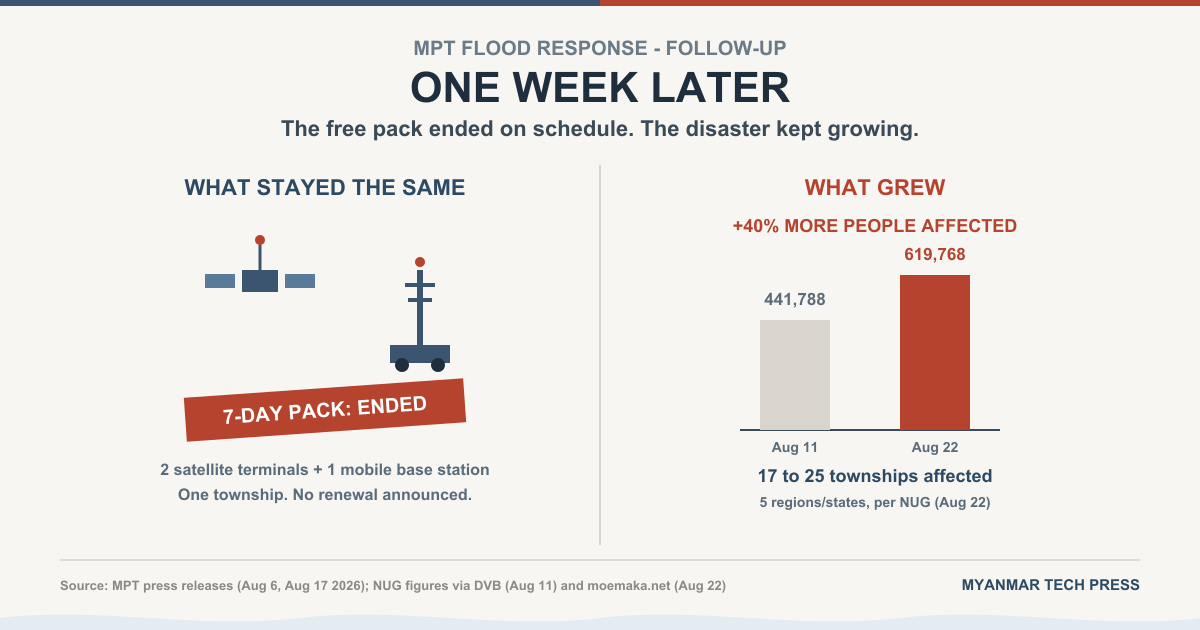
The NUG figures come from Myanmar’s National Unity Government Ministry of Humanitarian Affairs and Disaster Management, cited in a moemaka.net roundup published 2026-08-23 that references a report dated 2026-08-22. We’re presenting these as figures reported by NUG, not as independently confirmed casualty data, and we are not taking a position on the broader political context around them — this outlet’s focus is on what they mean for telecom coverage. Set next to DVB’s 2026-08-11 report of the same NUG data source — 441,788 affected, 25 dead, 17 townships at that point — the number of people affected grew by roughly 40% and the number of townships by roughly 47% in the eleven days that followed, and the map of affected areas grew with it: Karen State appears for the first time, and Sagaing (260,000-plus affected, 24 of the 32 deaths) and Mandalay (190,000-plus affected) now account for most of the people affected. Neither of MPT’s two press releases has ever mentioned Sagaing, Mandalay, Magway or Karen State. Every disclosed piece of MPT’s network and aid response, across both releases, sits inside Ayeyarwady Region.
The Questions From Our Last Report, Revisited
Our 2026-08-13 article raised four specific questions. Here is what the August 17 release does and doesn’t resolve:
- Is a one-township response proportionate to a multi-region disaster? Unresolved, and the gap has widened rather than narrowed — the disaster now spans five regions and states against a response that, on MPT’s own disclosures, has never left Ayeyarwady.
- Will the free data pack be renewed? Answered, by omission: it was not. MPT’s own release describes it in the past tense with no statement of renewal, four days after the seven-day window had already closed.
- Who is the satellite provider? Still not named in either release.
- How many customers actually benefited? Still not disclosed for the data pack. The August 17 release does give a number for the new food-aid distribution — “300+ households” — which is more specific than anything in the August 6 release, but it describes a different program (general humanitarian aid, not telecom relief) from a different, smaller pool of beneficiaries.
Frequently Asked Questions
Did MPT extend its free flood-relief data pack?
No. MPT’s original release said the pack (1GB data, 100 minutes, 100 SMS) was effective from 2026-08-07 for seven days. The August 17 follow-up release refers to the pack only in the past tense and does not state that it was renewed or extended.
What’s actually new in MPT’s August 17 release?
A separate humanitarian aid distribution — food, clothing, medicine and other basic necessities — delivered to more than 300 households at two relief camps on 2026-08-14 and 2026-08-15. This is not a telecom or connectivity program.
Did MPT deploy any new network equipment after its initial response?
Not according to either press release. The two satellite terminals and one COW mobile base station deployed on 2026-08-05 in Laymyethna Township remain the only network hardware MPT has disclosed for this flood, as of 2026-08-17.
How much has the flood grown since MPT’s first response?
NUG-reported figures went from 441,788 people affected across 17 townships (2026-08-11) to 619,768 affected, 32 dead, across 25 townships in five regions and states (2026-08-22) — an increase of roughly 40% in people affected and roughly 47% in the number of townships.
Have Sagaing, Mandalay, or Karen State received any MPT telecom relief?
Not that either of MPT’s two press releases discloses. Both releases describe activity solely within Ayeyarwady Region, even though Sagaing and Mandalay together now account for the large majority of NUG-reported people affected.
The Takeaway
MPT remains, as far as we can find, the only Myanmar mobile operator with any dated 2026 public statement on this flood at all — and a company that publishes two dated releases with named spokespeople is at least giving readers something to check its claims against, which is more than its competitors have offered. But “extends humanitarian aid and continued connectivity” is a headline that promises more than the release underneath it delivers. The connectivity half of that promise quietly expired on schedule after seven days, with no renewal, no new hardware, and no expansion beyond the single region where MPT started. Meanwhile the disaster itself grew by roughly 40% in people affected (47% in townships) and spread into regions MPT’s telecom response has never touched. Whether that’s the honest limit of what one operator can sustain, or a communications choice to keep publicizing camp-level generosity rather than acknowledge a response that hasn’t scaled with the crisis, is a judgment we’ll leave to readers — but it’s a gap worth watching the next time MPT, or any Myanmar operator, puts out a flood-relief release with an “extends” or “continues” headline attached to it.
Sources: MPT, “MPT Extends Humanitarian Aid and Continued Connectivity to Flood-Affected Communities in Ayeyarwaddy Region,” published 2026-08-17 (https://mpt.com.mm/en/mpt-extends-humanitarian-aid-and-continued-connectivity-to-flood-affected-communities-in-ayeyarwaddy-region-en/). MPT, “MPT Deploys Emergency Network Solutions and Provides Free Data, Voice, SMS Support for Flood-Affected Communities,” published 2026-08-06 (https://mpt.com.mm/en/mpt-deploys-emergency-network-solutions-and-provides-free-data-voice-sms-support-for-flood-affected-communities-en/). Myanmar Tech Press, “MPT’s Flood Emergency Network Response: Satellite Terminals, One Mobile Base Station, and a Free Data Pack — How Far Does It Actually Reach?” published 2026-08-13 (https://en.myanmartechpress.com/mpts-flood-emergency-network-response-satellite-terminals-one-mobile-base-station-and-a-free-data-pack-how-far-does-it-actually-reach/). DVB, “NUG reports 25 dead and over 440,000 affected as severe flooding spreads across 17 townships in Myanmar,” published 2026-08-11 (https://english.dvb.no/nug-reports-25-dead-and-over-440000-affected-as-severe-flooding-spreads-across-17-townships-in-myanmar/). moemaka.net, domestic news roundup citing an NUG Ministry of Humanitarian Affairs and Disaster Management report dated 2026-08-22, published 2026-08-23 (https://moemaka.net/eng/2026/08/august-23-2026-m-cdm-domestic-news/).